
用不同方案的强力霉素加伊维菌素治疗盘尾丝虫病患者后,对其皮肤中微丝蚴负荷的评估。
Assessment of microfilarial loads in the skin of onchocerciasis patients after treatment with different regimens of doxycycline plus ivermectin.
作者信息
Debrah Alexander Yaw, Mand Sabine, Marfo-Debrekyei Yeboah, Larbi John, Adjei Ohene, Hoerauf Achim
机构信息
Institute for Medical Parasitology, University of Bonn, Sigmund-Freud-Str, 25, D-53105 Bonn, Germany.
出版信息
Filaria J. 2006 Feb 5;5:1. doi: 10.1186/1475-2883-5-1.
BACKGROUND
Infection with the filarial nematode Onchocerca volvulus can lead to severe dermatitis, visual impairment, and ultimately blindness. Since the currently used drug, ivermectin does not have macrofilaricidal or strong permanent sterilising effects on the adult worm, more effective drugs are needed to complement the use of ivermectin alone. Wolbachia endosymbiotic bacteria in filariae have emerged as a new target for treatment with antibiotics which can lead to long -term sterilization of the adult female filariae.
METHODS
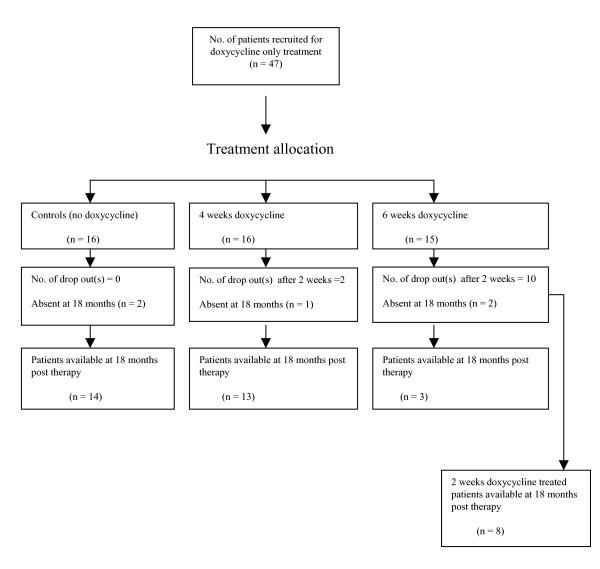
In the Central Region of Ghana, 60 patients were recruited, allocated into four groups and treated with 200 mg doxycycline per day for 2 weeks, 4 weeks, 6 weeks respectively. Untreated patients served as controls. Some of the treated patients and the untreated controls were given 150 microg/kg ivermectin 8 months after the start of doxycycline treatment.
RESULTS
A follow up study 18 months post treatment showed that when using doxycycline alone there was a significant reduction of microfilarial (mf) loads in patients treated for either 4 or 6 weeks. However, there was no significant difference between the untreated controls and those given the 2 weeks regimen. Although no significant difference was demonstrated between the 4 and 6 weeks regimens, there was a trend observed, in that, microfilarial reduction appeared to have been greater following the 6 weeks regimen. Twelve months after ivermectin (i.e. 20 months after doxycycline) treatment, 8 out of 11 ivermectin-alone treated patients were mf-positive. In contrast, 1 out of the 7 patients treated for 4 weeks with doxycycline and none of the 4 patients treated for 6 weeks doxycycline (who were available for re-examination) were mf-positive after the combined treatment of doxycycline plus ivermectin treatment.
CONCLUSION
Treatment of onchocerciasis with doxycycline for 4 weeks is effective. Nonetheless, mf reduction appeared to be greater in the 6 weeks regimen. It is recommended that until further studies are carried out i.e. 4 weeks treatment with doxycycline is proven equivalent to the 6 weeks, selected groups of onchocerciasis patients should be treated for 6 weeks with doxycycline. As discussed earlier, this treatment should be accompanied by two doses of ivermectin.
背景
感染丝状线虫盘尾丝虫可导致严重皮炎、视力损害并最终失明。由于目前使用的药物伊维菌素对成虫没有杀大丝蚴或强大的永久性绝育作用,因此需要更有效的药物来补充单独使用伊维菌素的治疗。丝虫内共生菌沃尔巴克氏体已成为抗生素治疗的新靶点,抗生素可导致成年雌丝虫长期绝育。
方法
在加纳中部地区,招募了60名患者,分为四组,分别接受每日200mg强力霉素治疗2周、4周、6周。未治疗的患者作为对照。部分接受治疗的患者和未治疗的对照在强力霉素治疗开始8个月后给予150μg/kg伊维菌素。
结果
治疗后18个月的随访研究表明,单独使用强力霉素时,接受4周或6周治疗的患者微丝蚴(mf)负荷显著降低。然而,未治疗的对照与接受2周治疗方案的患者之间没有显著差异。虽然4周和6周治疗方案之间没有显示出显著差异,但观察到一种趋势,即6周治疗方案后微丝蚴减少似乎更大。伊维菌素治疗12个月后(即强力霉素治疗20个月后),11名单独接受伊维菌素治疗的患者中有8名mf呈阳性。相比之下,在强力霉素加伊维菌素联合治疗后,7名接受4周强力霉素治疗的患者中有1名mf呈阳性,4名接受6周强力霉素治疗的患者(可接受复查)中无一例mf呈阳性。
结论
用强力霉素治疗盘尾丝虫病4周是有效的。尽管如此,6周治疗方案中mf减少似乎更大。建议在进行进一步研究(即证明4周强力霉素治疗等同于6周治疗)之前,选择的盘尾丝虫病患者组应接受6周强力霉素治疗。如前所述,这种治疗应伴有两剂伊维菌素。

 Zotero 插件