
从大麦根中纯化和鉴定一种厌氧诱导的丙氨酸氨基转移酶。
Purification and characterization of an anaerobically induced alanine aminotransferase from barley roots.
机构信息
Department of Genetics, University of Alberta, Edmonton, Alberta, Canada T6G 2E9.
出版信息
Plant Physiol. 1992 Aug;99(4):1520-5. doi: 10.1104/pp.99.4.1520.
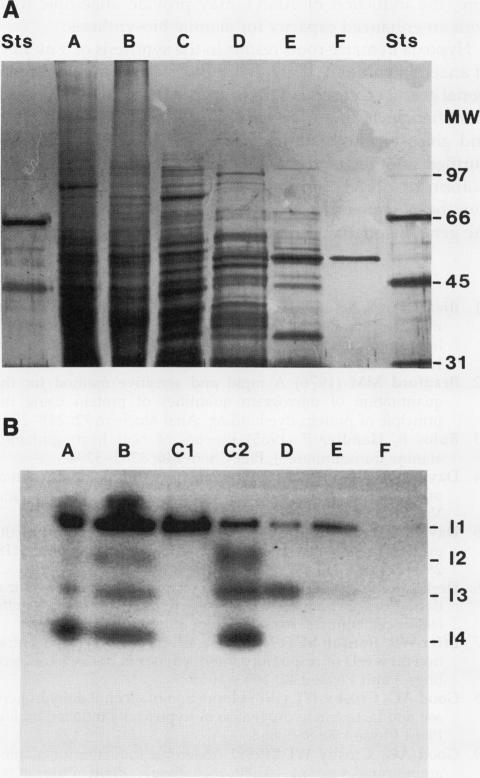
Alanine aminotransferase (AlaAT, EC 2.6.1.2) is an enzyme that is induced under anaerobic conditions in cereal roots. In barley (Hordeum vulgare L.) roots, there are a number of isoforms of AlaAT. We have identified the anaerobically induced isoform and have purified it to homogeneity. The isolation procedure involved a two-step ammonium sulfate precipitation, gel filtration, ion-exchange chromatography, and chromatofocusing. The enzyme was purified approximately 350-fold to a specific activity of 2231 units/milligram protein. The apparent molecular masses of the native and sodium dodecyl sulfate-denatured AlaAT proteins are 97 and 50 kilodaltons, respectively, indicating that the native enzyme is probably a homodimer. AlaAT has a number of interesting characteristics when compared with other plant aminotransferases. AlaAT does not require the presence of pyridoxyl-5-phosphate to retain its activity, and it appears to be very specific in the reactions that it will catalyze.
丙氨酸氨基转移酶(AlaAT,EC 2.6.1.2)是一种在谷物根中无氧条件下诱导产生的酶。在大麦(Hordeum vulgare L.)根中,存在多种 AlaAT 同工酶。我们已经鉴定出了缺氧诱导的同工酶,并将其纯化至均质。分离过程包括两步硫酸铵沉淀、凝胶过滤、离子交换层析和等电聚焦。该酶的纯度提高了约 350 倍,比活达到 2231 单位/毫克蛋白。天然和十二烷基硫酸钠变性 AlaAT 蛋白的表观分子量分别为 97 和 50 千道尔顿,表明天然酶可能是同源二聚体。与其他植物氨基转移酶相比,AlaAT 具有许多有趣的特性。AlaAT 不需要吡哆醛-5-磷酸的存在就能保持其活性,而且它在催化的反应中似乎非常特异。
 Zotero 插件