
14q12区域的大规模拷贝数变异(CNV)与肿瘤形成中的基因组异常存在相关。
Large scale copy number variation (CNV) at 14q12 is associated with the presence of genomic abnormalities in neoplasia.
作者信息
Braude Ilan, Vukovic Bisera, Prasad Mona, Marrano Paula, Turley Stefanie, Barber Dwayne, Zielenska Maria, Squire Jeremy A
机构信息
Department of Laboratory Medicine and Pathobiology, University of Toronto, Toronto, Ontario, Canada.
出版信息
BMC Genomics. 2006 Jun 6;7:138. doi: 10.1186/1471-2164-7-138.
BACKGROUND
Advances made in the area of microarray comparative genomic hybridization (aCGH) have enabled the interrogation of the entire genome at a previously unattainable resolution. This has lead to the discovery of a novel class of alternative entities called large-scale copy number variations (CNVs). These CNVs are often found in regions of closely linked sequence homology called duplicons that are thought to facilitate genomic rearrangements in some classes of neoplasia. Recently, it was proposed that duplicons located near the recurrent translocation break points on chromosomes 9 and 22 in chronic myeloid leukemia (CML) may facilitate this tumor-specific translocation. Furthermore, approximately 15-20% of CML patients also carry a microdeletion on the derivative 9 chromosome (der(9)) and these patients have a poor prognosis. It has been hypothesised that der(9) deletion patients have increased levels of chromosomal instability.
RESULTS
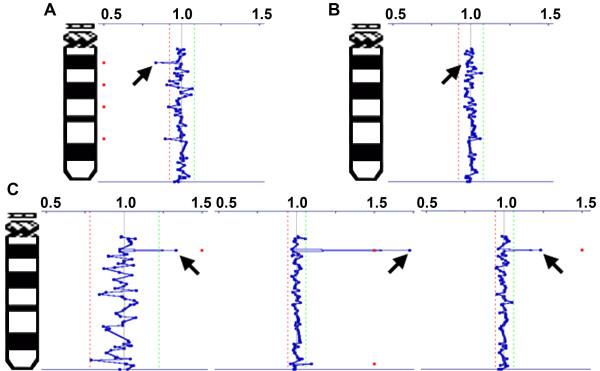
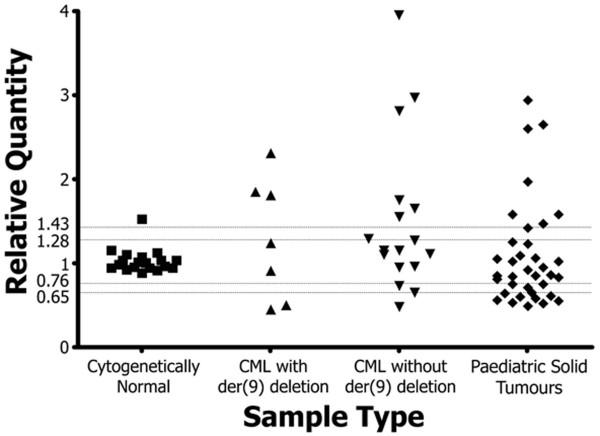
In this study aCGH was performed and identified a CNV (RP11-125A5, hereafter called CNV14q12) that was present as a genomic gain or loss in 10% of control DNA samples derived from cytogenetically normal individuals. CNV14q12 was the same clone identified by Iafrate et al. as a CNV. Real-time polymerase chain reaction (Q-PCR) was used to determine the relative frequency of this CNV in DNA from a series of 16 CML patients (both with and without a der(9) deletion) together with DNA derived from 36 paediatric solid tumors in comparison to the incidence of CNV in control DNA. CNV14q12 was present in approximately 50% of both tumor and CML DNA, but was found in 72% of CML bearing a der(9) microdeletion. Chi square analysis found a statistically significant difference (p <or= 0.001) between the incidence of this CNV in cancer and normal DNA and a slightly increased incidence in CML with deletions in comparison to those CML without a detectable deletion.
CONCLUSION
The increased incidence of CNV14q12 in tumor samples suggests that either acquired or inherited genomic variation of this new class of variation may be associated with onset or progression of neoplasia.
背景
微阵列比较基因组杂交(aCGH)领域取得的进展使得能够以前所未有的分辨率对整个基因组进行检测。这导致发现了一类新型的变异实体,称为大规模拷贝数变异(CNV)。这些CNV常出现在称为重复子的紧密连锁序列同源区域,据认为这些区域在某些肿瘤类型中促进基因组重排。最近,有人提出慢性髓性白血病(CML)中9号和22号染色体上复发性易位断点附近的重复子可能促进这种肿瘤特异性易位。此外,约15 - 20%的CML患者在衍生9号染色体(der(9))上还携带一个微缺失,这些患者预后较差。据推测,der(9)缺失患者的染色体不稳定性水平升高。
结果
在本研究中,进行了aCGH检测,鉴定出一个CNV(RP11 - 125A5,以下称为CNV14q12),在来自细胞遗传学正常个体的10%的对照DNA样本中以基因组增益或缺失形式存在。CNV14q12与Iafrate等人鉴定为CNV的克隆相同。使用实时聚合酶链反应(Q-PCR)来确定该CNV在一系列16例CML患者(有和没有der(9)缺失)的DNA以及36例儿童实体瘤的DNA中的相对频率,并与对照DNA中CNV的发生率进行比较。CNV14q12在大约50%的肿瘤和CML DNA中存在,但在携带der(9)微缺失的CML患者中发现率为72%。卡方分析发现该CNV在癌症和正常DNA中的发生率之间存在统计学显著差异(p≤0.001),并且与没有可检测到缺失的CML患者相比,有缺失的CML患者中该CNV的发生率略有增加。
结论
肿瘤样本中CNV14q12发生率的增加表明,这类新变异的获得性或遗传性基因组变异可能与肿瘤的发生或进展有关。


 Zotero 插件