
比较贝母兰和蝴蝶兰(兰科)花朵中的转录本以推断单萜生物合成途径。
Comparison of transcripts in Phalaenopsis bellina and Phalaenopsis equestris (Orchidaceae) flowers to deduce monoterpene biosynthesis pathway.
作者信息
Hsiao Yu-Yun, Tsai Wen-Chieh, Kuoh Chang-Sheng, Huang Tian-Hsiang, Wang Hei-Chia, Wu Tian-Shung, Leu Yann-Lii, Chen Wen-Huei, Chen Hong-Hwa
机构信息
Department of Life Sciences, National Cheng-Kung University, Tainan 701, Taiwan.
出版信息
BMC Plant Biol. 2006 Jul 13;6:14. doi: 10.1186/1471-2229-6-14.
BACKGROUND
Floral scent is one of the important strategies for ensuring fertilization and for determining seed or fruit set. Research on plant scents has hampered mainly by the invisibility of this character, its dynamic nature, and complex mixtures of components that are present in very small quantities. Most progress in scent research, as in other areas of plant biology, has come from the use of molecular and biochemical techniques. Although volatile components have been identified in several orchid species, the biosynthetic pathways of orchid flower fragrance are far from understood. We investigated how flower fragrance was generated in certain Phalaenopsis orchids by determining the chemical components of the floral scent, identifying floral expressed-sequence-tags (ESTs), and deducing the pathways of floral scent biosynthesis in Phalaneopsis bellina by bioinformatics analysis.
RESULTS
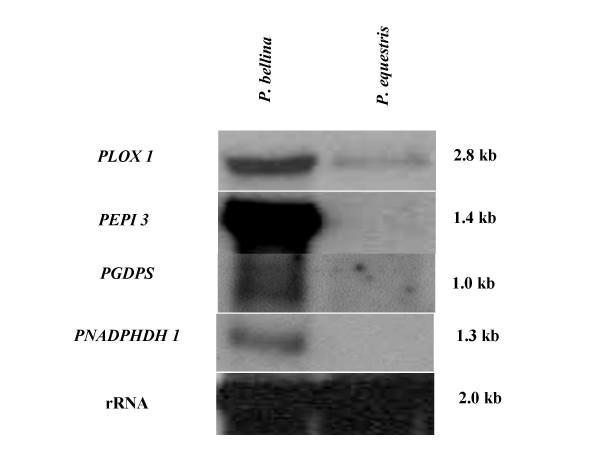
The main chemical components in the P. bellina flower were shown by gas chromatography-mass spectrometry to be monoterpenoids, benzenoids and phenylpropanoids. The set of floral scent producing enzymes in the biosynthetic pathway from glyceraldehyde-3-phosphate (G3P) to geraniol and linalool were recognized through data mining of the P. bellina floral EST database (dbEST). Transcripts preferentially expressed in P. bellina were distinguished by comparing the scent floral dbEST to that of a scentless species, P. equestris, and included those encoding lipoxygenase, epimerase, diacylglycerol kinase and geranyl diphosphate synthase. In addition, EST filtering results showed that transcripts encoding signal transduction and Myb transcription factors and methyltransferase, in addition to those for scent biosynthesis, were detected by in silico hybridization of the P. bellina unigene database against those of the scentless species, rice and Arabidopsis. Altogether, we pinpointed 66% of the biosynthetic steps from G3P to geraniol, linalool and their derivatives.
CONCLUSION
This systems biology program combined chemical analysis, genomics and bioinformatics to elucidate the scent biosynthesis pathway and identify the relevant genes. It integrates the forward and reverse genetic approaches to knowledge discovery by which researchers can study non-model plants.
背景
花香是确保授粉以及决定种子或果实结实的重要策略之一。植物气味的研究主要受到该特性不可见、其动态性质以及存在的成分复杂且含量极少的混合物的阻碍。与植物生物学的其他领域一样,气味研究的大部分进展来自分子和生化技术的应用。虽然已在几种兰花物种中鉴定出挥发性成分,但兰花花香的生物合成途径仍远未被理解。我们通过确定花香的化学成分、鉴定花的表达序列标签(EST)以及通过生物信息学分析推导白蝴蝶兰花香生物合成途径,研究了某些蝴蝶兰如何产生花香。
结果
气相色谱 - 质谱分析表明,白蝴蝶兰花中的主要化学成分是单萜类、苯类和苯丙素类。通过对白蝴蝶兰花EST数据库(dbEST)的数据挖掘,识别出了从3 - 磷酸甘油醛(G3P)到香叶醇和芳樟醇的生物合成途径中产生花香的一组酶。通过将有花香的白蝴蝶兰花dbEST与无香物种马蹄莲的dbEST进行比较,区分了在白蝴蝶兰中优先表达的转录本,其中包括编码脂氧合酶、表异构酶、二酰基甘油激酶和香叶基二磷酸合酶的转录本。此外,EST筛选结果表明,除了花香生物合成相关的转录本外,通过对白蝴蝶兰单基因数据库与无香物种水稻和拟南芥的数据库进行电子杂交,还检测到了编码信号转导、Myb转录因子和甲基转移酶的转录本。总之,我们确定了从G3P到香叶醇、芳樟醇及其衍生物的66%的生物合成步骤。
结论
这个系统生物学项目结合了化学分析、基因组学和生物信息学来阐明气味生物合成途径并鉴定相关基因。它整合了正向和反向遗传方法用于知识发现,研究人员可以借此研究非模式植物。


 Zotero 插件