
哮喘患儿中病毒性呼吸道感染的患病率。
Prevalence of viral respiratory tract infections in children with asthma.
作者信息
Khetsuriani Nino, Kazerouni N Neely, Erdman Dean D, Lu Xiaoyan, Redd Stephen C, Anderson Larry J, Teague W Gerald
机构信息
Division of Viral Diseases, National Center for Immunization and Respiratory Diseases, Centers for Disease Control and Prevention, Atlanta, GA, USA.
出版信息
J Allergy Clin Immunol. 2007 Feb;119(2):314-21. doi: 10.1016/j.jaci.2006.08.041. Epub 2006 Nov 30.
BACKGROUND
Previous studies support a strong association between viral respiratory tract infections and asthma exacerbations. The effect of newly discovered viruses on asthma control is less well defined.
OBJECTIVE
We sought to determine the contribution of respiratory viruses to asthma exacerbations in children with a panel of PCR assays for common and newly discovered respiratory viruses.
METHODS
Respiratory specimens from children aged 2 to 17 years with asthma exacerbations (case patients, n = 65) and with well-controlled asthma (control subjects, n = 77), frequency matched by age and season of enrollment, were tested for rhinoviruses, enteroviruses, respiratory syncytial virus, human metapneumovirus, coronaviruses 229E and OC43, parainfluenza viruses 1 to 3, influenza viruses, adenoviruses, and human bocavirus.
RESULTS
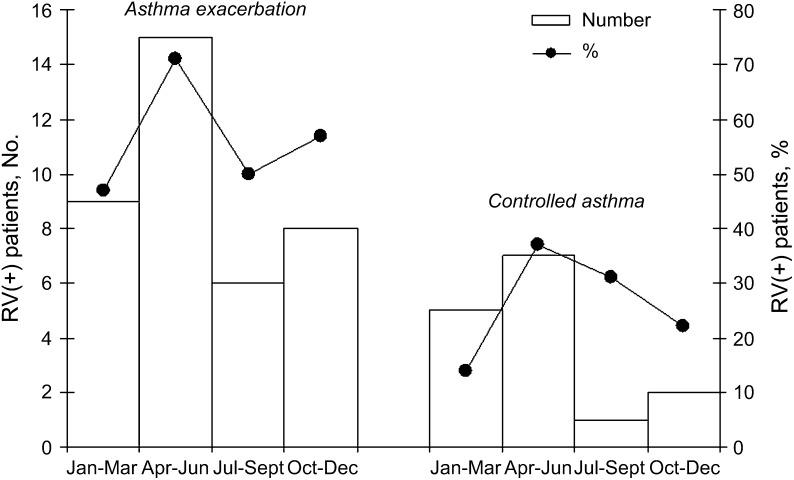
Infection with respiratory viruses was associated with asthma exacerbations (63.1% in case patients vs 23.4% in control subjects; odds ratio, 5.6; 95% CI, 2.7- 11.6). Rhinovirus was by far the most prevalent virus (60% among case patients vs 18.2% among control subjects) and the only virus significantly associated with exacerbations (odds ratio, 6.8; 95% CI, 3.2-14.5). However, in children without clinically manifested viral respiratory tract illness, the prevalence of rhinovirus infection was similar in case patients (29.2%) versus control subjects (23.4%, P > .05). Other viruses detected included human metapneumovirus (4.6% in patients with acute asthma vs 2.6% in control subjects), enteroviruses (4.6% vs 0%), coronavirus 229E (0% vs 1.3%), and respiratory syncytial virus (1.5% vs 0%).
CONCLUSION
Symptomatic rhinovirus infections are an important contributor to asthma exacerbations in children.
CLINICAL IMPLICATIONS
These results support the need for therapies effective against rhinovirus as a means to decrease asthma exacerbations.
背景
既往研究支持病毒性呼吸道感染与哮喘急性发作之间存在密切关联。新发现病毒对哮喘控制的影响尚不太明确。
目的
我们试图通过一组针对常见及新发现呼吸道病毒的聚合酶链反应检测,确定呼吸道病毒在儿童哮喘急性发作中的作用。
方法
对年龄在2至17岁的哮喘急性发作患儿(病例组,n = 65)和哮喘控制良好的儿童(对照组,n = 77)的呼吸道标本进行检测,根据年龄和入组季节进行频率匹配,检测鼻病毒、肠道病毒、呼吸道合胞病毒、人偏肺病毒、冠状病毒229E和OC43、副流感病毒1至3型、流感病毒、腺病毒和人博卡病毒。
结果
呼吸道病毒感染与哮喘急性发作相关(病例组为63.1%,对照组为23.4%;比值比为5.6;95%可信区间为2.7 - 11.6)。鼻病毒是迄今为止最常见的病毒(病例组中占60%,对照组中占18.2%),也是唯一与急性发作显著相关的病毒(比值比为6.8;95%可信区间为3.2 - 14.5)。然而,在无临床症状的病毒性呼吸道疾病患儿中,病例组鼻病毒感染率(29.2%)与对照组(23.4%)相似(P > 0.05)。检测到的其他病毒包括人偏肺病毒(急性哮喘患儿中为4.6%,对照组中为2.6%)、肠道病毒(4.6%对0%)、冠状病毒229E(0%对1.3%)和呼吸道合胞病毒(1.5%对0%)。
结论
有症状的鼻病毒感染是儿童哮喘急性发作的重要原因。
临床意义
这些结果支持需要有针对鼻病毒的有效治疗方法,作为减少哮喘急性发作的一种手段。
 Zotero 插件