
让代谢网络鲜活起来:动力学、代谢组学和蛋白质组学数据的整合
Bringing metabolic networks to life: integration of kinetic, metabolic, and proteomic data.
作者信息
Liebermeister Wolfram, Klipp Edda
机构信息
Computational Systems Biology, Max Planck Institute for Molecular Genetics, Berlin, Germany.
出版信息
Theor Biol Med Model. 2006 Dec 15;3:42. doi: 10.1186/1742-4682-3-42.
BACKGROUND
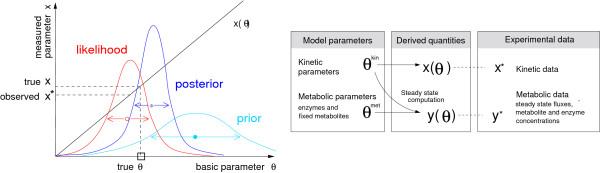
Translating a known metabolic network into a dynamic model requires reasonable guesses of all enzyme parameters. In Bayesian parameter estimation, model parameters are described by a posterior probability distribution, which scores the potential parameter sets, showing how well each of them agrees with the data and with the prior assumptions made.
RESULTS
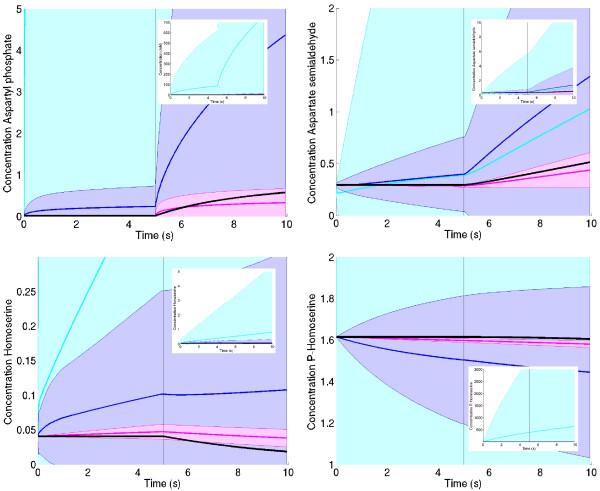
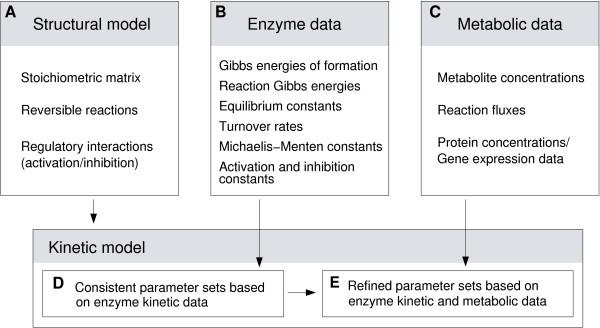
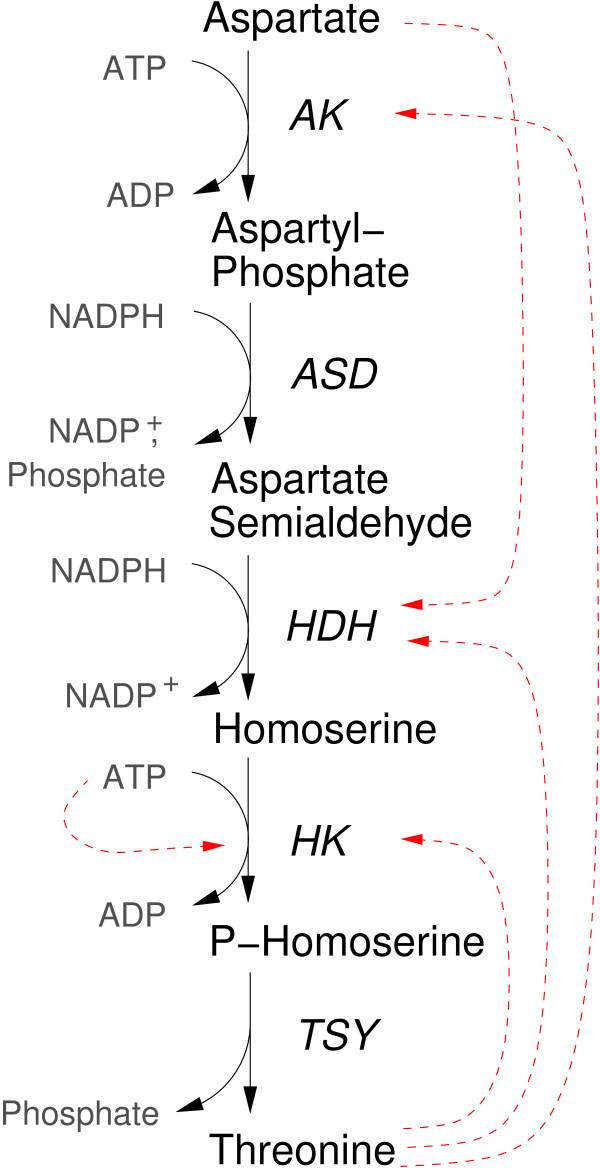
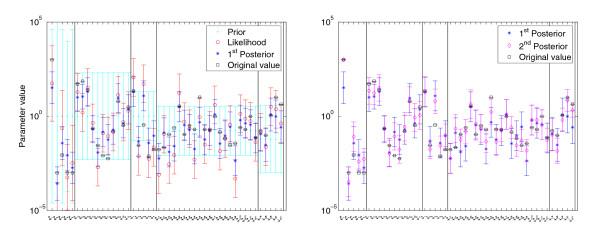
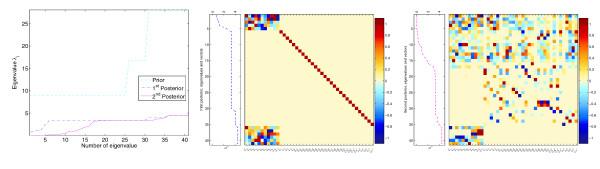
We compute posterior distributions of kinetic parameters within a Bayesian framework, based on integration of kinetic, thermodynamic, metabolic, and proteomic data. The structure of the metabolic system (i.e., stoichiometries and enzyme regulation) needs to be known, and the reactions are modelled by convenience kinetics with thermodynamically independent parameters. The parameter posterior is computed in two separate steps: a first posterior summarises the available data on enzyme kinetic parameters; an improved second posterior is obtained by integrating metabolic fluxes, concentrations, and enzyme concentrations for one or more steady states. The data can be heterogeneous, incomplete, and uncertain, and the posterior is approximated by a multivariate log-normal distribution. We apply the method to a model of the threonine synthesis pathway: the integration of metabolic data has little effect on the marginal posterior distributions of individual model parameters. Nevertheless, it leads to strong correlations between the parameters in the joint posterior distribution, which greatly improve the model predictions by the following Monte-Carlo simulations.
CONCLUSION
We present a standardised method to translate metabolic networks into dynamic models. To determine the model parameters, evidence from various experimental data is combined and weighted using Bayesian parameter estimation. The resulting posterior parameter distribution describes a statistical ensemble of parameter sets; the parameter variances and correlations can account for missing knowledge, measurement uncertainties, or biological variability. The posterior distribution can be used to sample model instances and to obtain probabilistic statements about the model's dynamic behaviour.
背景
将已知的代谢网络转化为动态模型需要对所有酶参数进行合理猜测。在贝叶斯参数估计中,模型参数由后验概率分布描述,该分布对潜在参数集进行评分,显示它们与数据以及所做的先验假设的吻合程度。
结果
我们基于动力学、热力学、代谢和蛋白质组学数据的整合,在贝叶斯框架内计算动力学参数的后验分布。代谢系统的结构(即化学计量和酶调节)需要已知,并且反应通过具有热力学独立参数的便利动力学进行建模。参数后验通过两个独立步骤计算:第一个后验总结了关于酶动力学参数的可用数据;通过对一个或多个稳态的代谢通量、浓度和酶浓度进行整合,得到改进的第二个后验。数据可以是异质的、不完整的和不确定的,并且后验通过多元对数正态分布进行近似。我们将该方法应用于苏氨酸合成途径的模型:代谢数据的整合对单个模型参数的边际后验分布影响很小。然而,它导致联合后验分布中的参数之间存在强相关性,这通过随后的蒙特卡罗模拟极大地改善了模型预测。
结论
我们提出了一种将代谢网络转化为动态模型的标准化方法。为了确定模型参数,使用贝叶斯参数估计对来自各种实验数据的证据进行组合和加权。所得的后验参数分布描述了参数集的统计集合;参数方差和相关性可以解释缺失的知识、测量不确定性或生物变异性。后验分布可用于对模型实例进行采样,并获得关于模型动态行为的概率陈述。
 Zotero 插件