
单核苷酸多态性(SNPs)可区分印度起源和中国起源的恒河猴(猕猴)。
Single nucleotide polymorphisms (SNPs) distinguish Indian-origin and Chinese-origin rhesus macaques (Macaca mulatta).
作者信息
Ferguson Betsy, Street Summer L, Wright Hollis, Pearson Carlo, Jia Yibing, Thompson Shaun L, Allibone Patrick, Dubay Christopher J, Spindel Eliot, Norgren Robert B
机构信息
Genetics Research and Informatics Program, Oregon National Primate Research Center, Oregon Health and Sciences University, Beaverton, OR 97006, USA.
出版信息
BMC Genomics. 2007 Feb 7;8:43. doi: 10.1186/1471-2164-8-43.
BACKGROUND
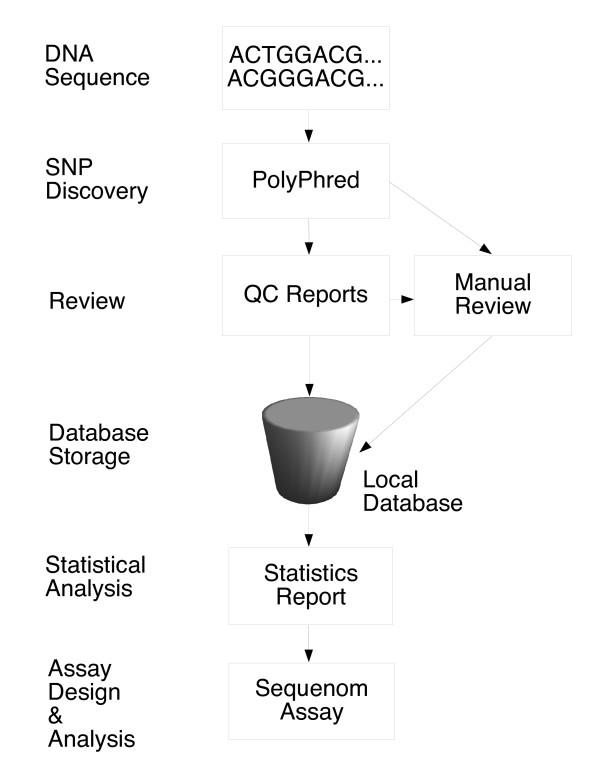
Rhesus macaques serve a critical role in the study of human biomedical research. While both Indian and Chinese rhesus macaques are commonly used, genetic differences between these two subspecies affect aspects of their behavior and physiology, including response to simian immunodeficiency virus (SIV) infection. Single nucleotide polymorphisms (SNPs) can play an important role in both establishing ancestry and in identifying genes involved in complex diseases. We sequenced the 3' end of rhesus macaque genes in an effort to identify gene-based SNPs that could distinguish between Indian and Chinese rhesus macaques and aid in association analysis.
RESULTS
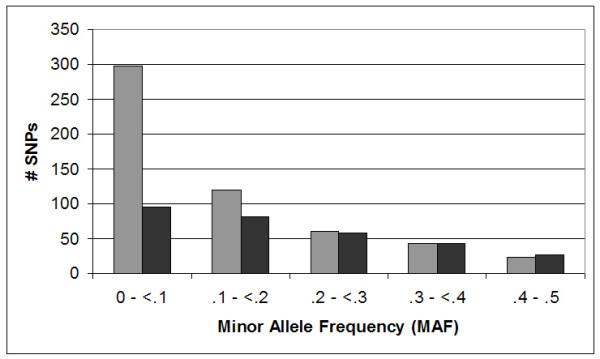
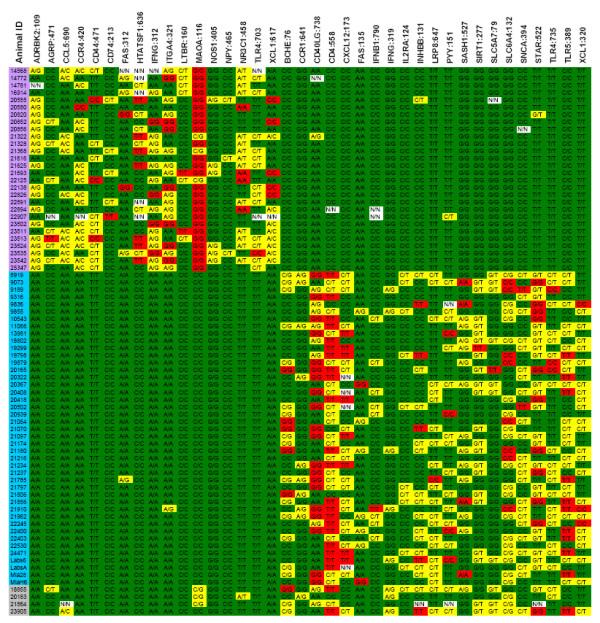
We surveyed the 3' end of 94 genes in 20 rhesus macaque animals. The study included 10 animals each of Indian and Chinese ancestry. We identified a total of 661 SNPs, 457 of which appeared exclusively in one or the other population. Seventy-nine additional animals were genotyped at 44 of the population-exclusive SNPs. Of those, 38 SNPs were confirmed as being population-specific.
CONCLUSION
This study demonstrates that the 3' end of genes is rich in sequence polymorphisms and is suitable for the efficient discovery of gene-linked SNPs. In addition, the results show that the genomic sequences of Indian and Chinese rhesus macaque are remarkably divergent, and include numerous population-specific SNPs. These ancestral SNPs could be used for the rapid scanning of rhesus macaques, both to establish animal ancestry and to identify gene alleles that may contribute to the phenotypic differences observed in these populations.
背景
恒河猴在人类生物医学研究中起着关键作用。虽然印度恒河猴和中国恒河猴都被广泛使用,但这两个亚种之间的基因差异会影响它们行为和生理的各个方面,包括对猴免疫缺陷病毒(SIV)感染的反应。单核苷酸多态性(SNP)在确定祖先以及识别参与复杂疾病的基因方面都能发挥重要作用。我们对恒河猴基因的3'端进行了测序,旨在识别基于基因的SNP,这些SNP能够区分印度恒河猴和中国恒河猴,并有助于关联分析。
结果
我们对20只恒河猴动物的94个基因的3'端进行了检测。该研究包括10只具有印度血统和10只具有中国血统的动物。我们总共鉴定出661个SNP,其中457个仅出现在其中一个群体中。另外79只动物对44个群体特异性SNP进行了基因分型。其中,38个SNP被确认为群体特异性。
结论
本研究表明,基因的3'端富含序列多态性,适合高效发现与基因相关的SNP。此外,结果表明印度恒河猴和中国恒河猴的基因组序列存在显著差异,并且包含大量群体特异性SNP。这些祖先SNP可用于快速筛查恒河猴,既可以确定动物的血统,也可以识别可能导致这些群体中观察到的表型差异的基因等位基因。

 Zotero 插件