
减少对乙酰氨基酚中毒相关规定的间断时间序列分析
Interrupted time-series analysis of regulations to reduce paracetamol (acetaminophen) poisoning.
作者信息
Morgan Oliver W, Griffiths Clare, Majeed Azeem
机构信息
Department of Primary Care and Social Medicine, Imperial College London, United Kingdom.
出版信息
PLoS Med. 2007 Apr;4(4):e105. doi: 10.1371/journal.pmed.0040105.
BACKGROUND
Paracetamol (acetaminophen) poisoning is the leading cause of acute liver failure in Great Britain and the United States. Successful interventions to reduced harm from paracetamol poisoning are needed. To achieve this, the government of the United Kingdom introduced legislation in 1998 limiting the pack size of paracetamol sold in shops. Several studies have reported recent decreases in fatal poisonings involving paracetamol. We use interrupted time-series analysis to evaluate whether the recent fall in the number of paracetamol deaths is different to trends in fatal poisoning involving aspirin, paracetamol compounds, antidepressants, or nondrug poisoning suicide.
METHODS AND FINDINGS
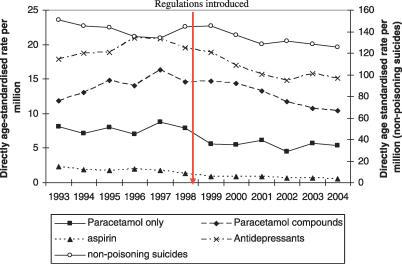
We calculated directly age-standardised mortality rates for paracetamol poisoning in England and Wales from 1993 to 2004. We used an ordinary least-squares regression model divided into pre- and postintervention segments at 1999. The model included a term for autocorrelation within the time series. We tested for changes in the level and slope between the pre- and postintervention segments. To assess whether observed changes in the time series were unique to paracetamol, we compared against poisoning deaths involving compound paracetamol (not covered by the regulations), aspirin, antidepressants, and nonpoisoning suicide deaths. We did this comparison by calculating a ratio of each comparison series with paracetamol and applying a segmented regression model to the ratios. No change in the ratio level or slope indicated no difference compared to the control series. There were about 2,200 deaths involving paracetamol. The age-standardised mortality rate rose from 8.1 per million in 1993 to 8.8 per million in 1997, subsequently falling to about 5.3 per million in 2004. After the regulations were introduced, deaths dropped by 2.69 per million (p = 0.003). Trends in the age-standardised mortality rate for paracetamol compounds, aspirin, and antidepressants were broadly similar to paracetamol, increasing until 1997 and then declining. Nondrug poisoning suicide also declined during the study period, but was highest in 1993. The segmented regression models showed that the age-standardised mortality rate for compound paracetamol dropped less after the regulations (p = 0.012) but declined more rapidly afterward (p = 0.031). However, age-standardised rates for aspirin and antidepressants fell in a similar way to paracetamol after the regulations. Nondrug poisoning suicide declined at a similar rate to paracetamol after the regulations were introduced.
CONCLUSIONS
Introduction of regulations to limit availability of paracetamol coincided with a decrease in paracetamol-poisoning mortality. However, fatal poisoning involving aspirin, antidepressants, and to a lesser degree, paracetamol compounds, also showed similar trends. This raises the question whether the decline in paracetamol deaths was due to the regulations or was part of a wider trend in decreasing drug-poisoning mortality. We found little evidence to support the hypothesis that the 1998 regulations limiting pack size resulted in a greater reduction in poisoning deaths involving paracetamol than occurred for other drugs or nondrug poisoning suicide.
背景
在英国和美国,对乙酰氨基酚(扑热息痛)中毒是急性肝衰竭的主要原因。需要采取成功的干预措施以减少对乙酰氨基酚中毒造成的伤害。为实现这一目标,英国政府于1998年出台立法,限制商店销售的对乙酰氨基酚包装规格。多项研究报告称,近期涉及对乙酰氨基酚的致命中毒事件有所减少。我们采用中断时间序列分析,以评估近期对乙酰氨基酚死亡人数的下降与涉及阿司匹林、对乙酰氨基酚复方制剂、抗抑郁药或非药物中毒自杀的致命中毒趋势是否不同。
方法与结果
我们直接计算了1993年至2004年英格兰和威尔士对乙酰氨基酚中毒的年龄标准化死亡率。我们使用普通最小二乘回归模型,在1999年将其分为干预前和干预后两个阶段。该模型包括时间序列内自相关的一项。我们测试了干预前和干预后阶段水平和斜率的变化。为评估时间序列中观察到的变化是否对乙酰氨基酚特有,我们将其与涉及对乙酰氨基酚复方制剂(不受该法规涵盖)、阿司匹林、抗抑郁药和非中毒自杀死亡情况进行了比较。我们通过计算每个比较序列与对乙酰氨基酚的比率,并将分段回归模型应用于这些比率来进行此比较。比率水平或斜率无变化表明与对照序列无差异。涉及对乙酰氨基酚的死亡约有2200例。年龄标准化死亡率从1993年的每百万8.1例升至1997年的每百万8.8例,随后在2004年降至约每百万5.3例。法规出台后,死亡人数下降了每百万2.69例(p = 0.003)。对乙酰氨基酚复方制剂、阿司匹林和抗抑郁药的年龄标准化死亡率趋势与对乙酰氨基酚大致相似,在1997年前上升,之后下降。非药物中毒自杀在研究期间也有所下降,但在1993年最高。分段回归模型显示,法规出台后对乙酰氨基酚复方制剂的年龄标准化死亡率下降幅度较小(p = 0.012),但之后下降更快(p = 0.031)。然而,法规出台后,阿司匹林和抗抑郁药的年龄标准化死亡率下降方式与对乙酰氨基酚相似。法规出台后,非药物中毒自杀下降速度与对乙酰氨基酚相似。
结论
限制对乙酰氨基酚可得性的法规出台与对乙酰氨基酚中毒死亡率下降同时出现。然而,涉及阿司匹林、抗抑郁药以及程度较轻的对乙酰氨基酚复方制剂中毒也呈现出类似趋势。这就引发了一个问题,即对乙酰氨基酚死亡人数的下降是由于法规所致,还是药物中毒死亡率下降这一更广泛趋势的一部分。我们几乎没有证据支持这样的假设,即1998年限制包装规格的法规导致涉及对乙酰氨基酚的中毒死亡人数减少幅度大于其他药物或非药物中毒自杀。
 Zotero 插件