
酿酒酵母FKBP12与拟南芥TOR结合,其在植物中的表达导致对雷帕霉素敏感。
Saccharomyces cerevisiae FKBP12 binds Arabidopsis thaliana TOR and its expression in plants leads to rapamycin susceptibility.
作者信息
Sormani Rodnay, Yao Lei, Menand Benoît, Ennar Najla, Lecampion Cécile, Meyer Christian, Robaglia Christophe
机构信息
DSV-DEVM Laboratoire de Génétique et de Biophysique des Plantes, UMR 6191 CNRS-CEA-Université de la Méditerranée, Faculté des Sciences de Luminy, Marseille France.
出版信息
BMC Plant Biol. 2007 Jun 1;7:26. doi: 10.1186/1471-2229-7-26.
BACKGROUND
The eukaryotic TOR pathway controls translation, growth and the cell cycle in response to environmental signals such as nutrients or growth-stimulating factors. The TOR protein kinase can be inactivated by the antibiotic rapamycin following the formation of a ternary complex between TOR, rapamycin and FKBP12 proteins. The TOR protein is also found in higher plants despite the fact that they are rapamycin insensitive. Previous findings using the yeast two hybrid system suggest that the FKBP12 plant homolog is unable to form a complex with rapamycin and TOR, while the FRB domain of plant TOR is still able to bind to heterologous FKBP12 in the presence of rapamycin. The resistance to rapamycin is therefore limiting the molecular dissection of the TOR pathway in higher plants.
RESULTS
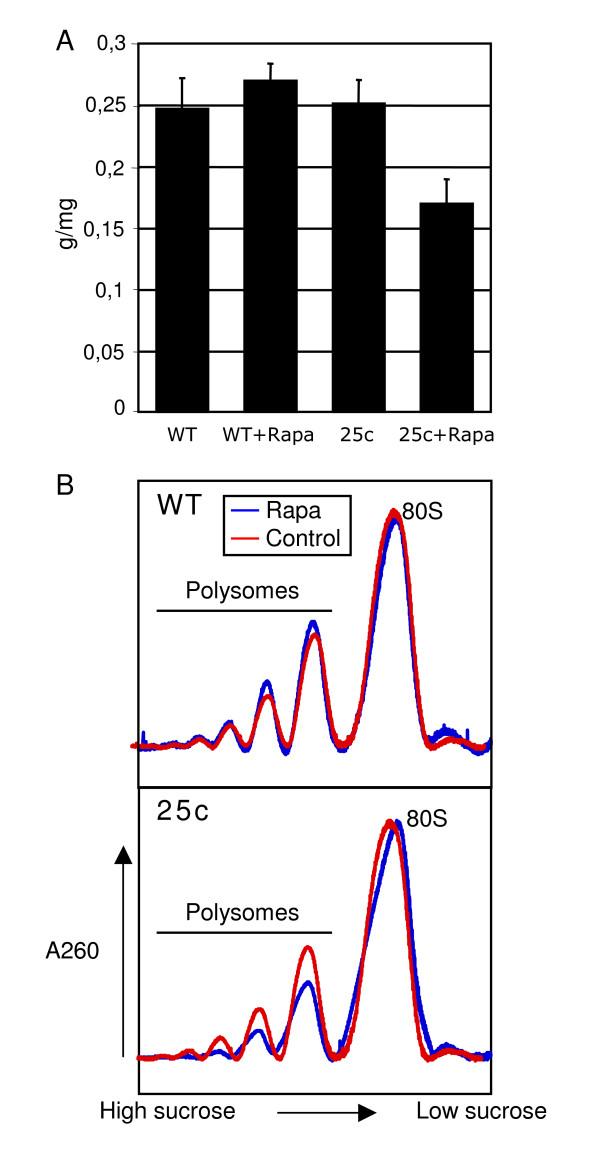
Here we show that none of the FKBPs from the model plant Arabidopsis (AtFKBPs) is able to form a ternary complex with the FRB domain of AtTOR in the presence of rapamycin in a two hybrid system. An antibody has been raised against the AtTOR protein and binding of recombinant yeast ScFKBP12 to native Arabidopsis TOR in the presence of rapamycin was demonstrated in pull-down experiments. Transgenic lines expressing ScFKBP12 were produced and were found to display a rapamycin-dependent reduction of the primary root growth and a lowered accumulation of high molecular weight polysomes.
CONCLUSION
These results further strengthen the idea that plant resistance to rapamycin evolved as a consequence of mutations in plant FKBP proteins. The production of rapamycin-sensitive plants through the expression of the ScFKBP12 protein illustrates the conservation of the TOR pathway in eukaryotes. Since AtTOR null mutants were found to be embryo lethal 1, transgenic ScFKBP12 plants will provide an useful tool for the post-embryonic study of plant TOR functions. This work also establish for the first time a link between TOR activity and translation in plant cells.
背景
真核生物的TOR信号通路可响应营养物质或生长刺激因子等环境信号,控制翻译、生长和细胞周期。在TOR、雷帕霉素和FKBP12蛋白形成三元复合物后,TOR蛋白激酶可被抗生素雷帕霉素灭活。尽管高等植物对雷帕霉素不敏感,但仍能发现TOR蛋白。先前利用酵母双杂交系统的研究结果表明,植物FKBP12同源物无法与雷帕霉素和TOR形成复合物,而植物TOR的FRB结构域在雷帕霉素存在的情况下仍能与异源FKBP12结合。因此,对雷帕霉素的抗性限制了高等植物中TOR信号通路的分子解析。
结果
我们在此表明,在双杂交系统中,模式植物拟南芥(AtFKBPs)的任何一种FKBP在雷帕霉素存在的情况下都无法与AtTOR的FRB结构域形成三元复合物。我们制备了一种针对AtTOR蛋白的抗体,并在下拉实验中证明了重组酵母ScFKBP12在雷帕霉素存在的情况下与天然拟南芥TOR的结合。我们培育了表达ScFKBP12的转基因株系,发现其主根生长呈现出雷帕霉素依赖性降低,且高分子量多聚核糖体的积累减少。
结论
这些结果进一步强化了这样一种观点,即植物对雷帕霉素的抗性是植物FKBP蛋白突变的结果。通过表达ScFKBP12蛋白培育出对雷帕霉素敏感的植物,说明了TOR信号通路在真核生物中的保守性。由于发现AtTOR缺失突变体胚胎致死,转基因ScFKBP12植物将为植物TOR功能的胚后研究提供一个有用的工具。这项工作还首次建立了植物细胞中TOR活性与翻译之间的联系。


 Zotero 插件