
抗菌肽的分析与预测
Analysis and prediction of antibacterial peptides.
作者信息
Lata Sneh, Sharma B K, Raghava G P S
机构信息
Institute of Microbial Technology, Sector39A, Chandigarh, India.
出版信息
BMC Bioinformatics. 2007 Jul 23;8:263. doi: 10.1186/1471-2105-8-263.
BACKGROUND
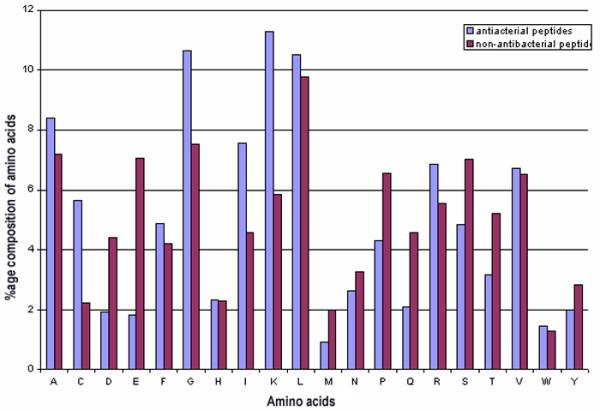
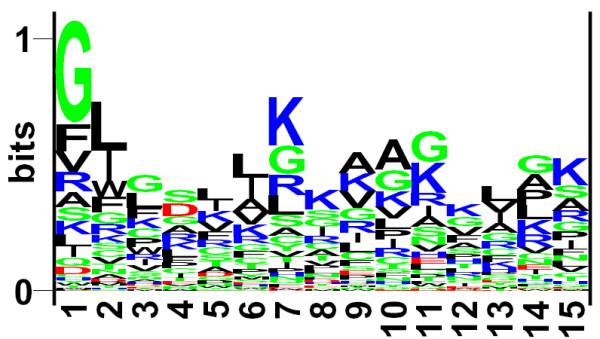
Antibacterial peptides are important components of the innate immune system, used by the host to protect itself from different types of pathogenic bacteria. Over the last few decades, the search for new drugs and drug targets has prompted an interest in these antibacterial peptides. We analyzed 486 antibacterial peptides, obtained from antimicrobial peptide database APD, in order to understand the preference of amino acid residues at specific positions in these peptides.
RESULTS
It was observed that certain types of residues are preferred over others in antibacterial peptides, particularly at the N and C terminus. These observations encouraged us to develop a method for predicting antibacterial peptides in proteins from their amino acid sequence. First, the N-terminal residues were used for predicting antibacterial peptides using Artificial Neural Network (ANN), Quantitative Matrices (QM) and Support Vector Machine (SVM), which resulted in an accuracy of 83.63%, 84.78% and 87.85%, respectively. Then, the C-terminal residues were used for developing prediction methods, which resulted in an accuracy of 77.34%, 82.03% and 85.16% using ANN, QM and SVM, respectively. Finally, ANN, QM and SVM models were developed using N and C terminal residues, which achieved an accuracy of 88.17%, 90.37% and 92.11%, respectively. All the models developed in this study were evaluated using five-fold cross validation technique. These models were also tested on an independent or blind dataset.
CONCLUSION
Among antibacterial peptides, there is preference for certain residues at N and C termini, which helps to demarcate them from non-antibacterial peptides. Both the termini play a crucial role in imparting the antibacterial property to these peptides. Among the methods developed, SVM shows the best performance in predicting antibacterial peptides followed by QM and ANN, in that order. AntiBP (Antibacterial peptides) will help in discovering efficacious antibacterial peptides, which we hope will prove to be a boon to combat the dreadful antibiotic resistant bacteria. A user friendly web server has also been developed to help the biological community, which is accessible at http://www.imtech.res.in/raghava/antibp/.
背景
抗菌肽是天然免疫系统的重要组成部分,宿主利用其保护自身免受不同类型病原菌的侵害。在过去几十年中,对新药和药物靶点的探索引发了人们对这些抗菌肽的兴趣。我们分析了从抗菌肽数据库APD中获取的486种抗菌肽,以了解这些肽中特定位置氨基酸残基的偏好。
结果
观察到在抗菌肽中,某些类型的残基比其他残基更受青睐,特别是在N端和C端。这些观察结果促使我们开发一种从氨基酸序列预测蛋白质中抗菌肽的方法。首先,使用人工神经网络(ANN)、定量矩阵(QM)和支持向量机(SVM),利用N端残基预测抗菌肽,准确率分别为83.63%、84.78%和87.85%。然后,使用C端残基开发预测方法,使用ANN、QM和SVM时的准确率分别为77.34%、82.03%和85.16%。最后,使用N端和C端残基开发了ANN、QM和SVM模型,准确率分别达到88.17%、90.37%和92.11%。本研究中开发的所有模型均使用五折交叉验证技术进行评估。这些模型也在一个独立或盲法数据集上进行了测试。
结论
在抗菌肽中,N端和C端对某些残基有偏好,这有助于将它们与非抗菌肽区分开来。两个末端在赋予这些肽抗菌特性方面都起着关键作用。在开发的方法中,SVM在预测抗菌肽方面表现最佳,其次是QM和ANN。AntiBP(抗菌肽)将有助于发现有效的抗菌肽,我们希望这将被证明是对抗可怕的抗生素耐药细菌的福音。还开发了一个用户友好的网络服务器来帮助生物界,可通过http://www.imtech.res.in/raghava/antibp/访问。

 Zotero 插件