
肌细胞内脂质动力学与胰岛素抵抗
Intramyocellular lipid kinetics and insulin resistance.
作者信息
Guo ZengKui
机构信息
Endocrine Research Unit, Mayo Foundation, Rochester, Minnesota 55905, USA.
出版信息
Lipids Health Dis. 2007 Jul 24;6:18. doi: 10.1186/1476-511X-6-18.
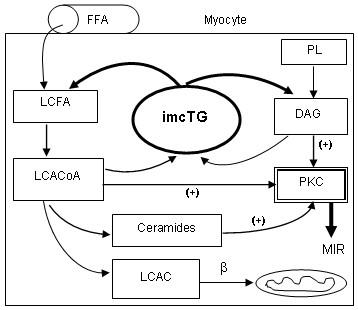
More than fifteen years ago it was discovered that intramyocellular triglyceride (imcTG) content in skeletal muscle is abnormally high in conditions of lipid oversupply (e.g. high fat feeding) and, later, obesity, type 2 diabetes (T2D) and other metabolic conditions. This imcTG excess is robustly associated with muscle insulin resistance (MIR). However, to date the pathways responsible for the imcTG excess and the mechanisms underlying the imcTG-MIR correlation remain unclear. A current hypothesis is based on a backward mechanism that impaired fatty acid oxidation by skeletal muscle causes imcTG to accumulate. As such, imcTG excess is considered a marker but not a player in MIR. However, recent results from kinetic studies indicated that imcTG pool in high fat-induced obesity (HFO) model is kinetically dynamic. On one hand, imcTG synthesis is accelerated and contributes to imcTG accumulation. On the other, the turnover of imcTG is also accelerated. A hyperdynamic imcTG pool can impose dual adverse effects on glucose metabolism in skeletal muscle. It increases the release and thus the availability of fatty acids in myocytes that may promote fatty acid oxidation and suppress glucose utilization. Meanwhile, it releases abundant fatty acid products (e.g. diacylglycerol, ceramides) that impair insulin actions via signal transduction, thereby causing MIR. Thus, intramyocellular fatty acids and their products released from imcTG appear to function as a link to MIR. Accordingly, a forward mechanism is proposed that explains the imcTG-MIR correlation.
十五年多前人们发现,在脂质供应过剩(如高脂喂养)的情况下,以及后来在肥胖、2型糖尿病(T2D)和其他代谢状况下,骨骼肌中的肌细胞内甘油三酯(imcTG)含量异常高。这种imcTG过量与肌肉胰岛素抵抗(MIR)密切相关。然而,迄今为止,导致imcTG过量的途径以及imcTG与MIR相关性的潜在机制仍不清楚。目前的一种假说是基于一种逆向机制,即骨骼肌脂肪酸氧化受损导致imcTG积累。因此,imcTG过量被认为是MIR的一个标志物而非一个影响因素。然而,近期动力学研究结果表明,高脂诱导肥胖(HFO)模型中的imcTG库在动力学上是动态的。一方面,imcTG合成加速并导致imcTG积累。另一方面,imcTG的周转也加速。一个高动态的imcTG库可对骨骼肌葡萄糖代谢产生双重不利影响。它增加了脂肪酸在肌细胞中的释放,从而增加了脂肪酸的可利用性,这可能会促进脂肪酸氧化并抑制葡萄糖利用。同时它会释放大量脂肪酸产物(如二酰甘油、神经酰胺),这些产物通过信号转导损害胰岛素作用,从而导致MIR。因此,从imcTG释放的肌细胞内脂肪酸及其产物似乎充当了与MIR的一个联系环节。据此,提出了一种正向机制来解释imcTG与MIR的相关性。

 Zotero 插件