
通过原子力显微镜研究卷曲菌毛、纤维素和BapA在沙门氏菌生物膜形态中的作用。
Roles of curli, cellulose and BapA in Salmonella biofilm morphology studied by atomic force microscopy.
作者信息
Jonas Kristina, Tomenius Henrik, Kader Abdul, Normark Staffan, Römling Ute, Belova Lyubov M, Melefors Ojar
机构信息
Swedish Institute for Infectious Disease Control, Solna, Sweden.
出版信息
BMC Microbiol. 2007 Jul 24;7:70. doi: 10.1186/1471-2180-7-70.
BACKGROUND
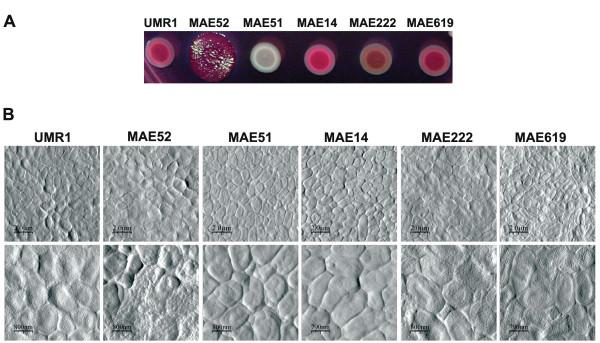
Curli, cellulose and the cell surface protein BapA are matrix components in Salmonella biofilms. In this study we have investigated the roles of these components for the morphology of bacteria grown as colonies on agar plates and within a biofilm on submerged mica surfaces by applying atomic force microscopy (AFM) and light microscopy.
RESULTS
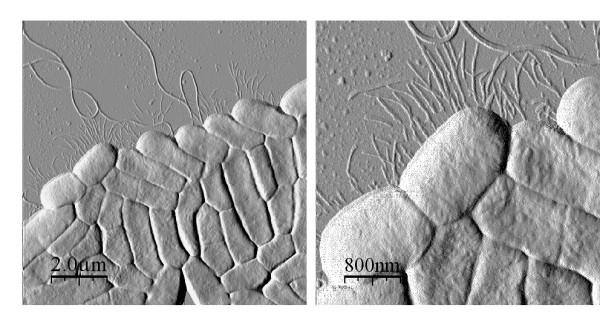
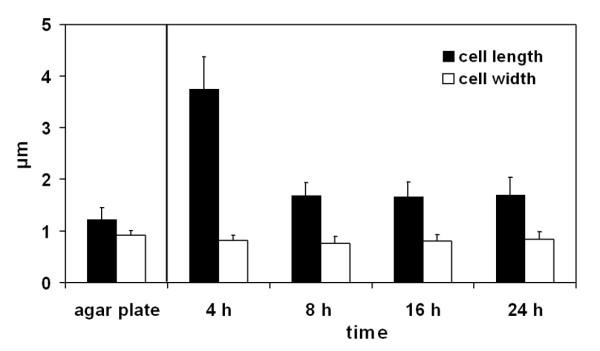
AFM imaging was performed on colonies of Salmonella Typhimurium grown on agar plates for 24 h and on biofilms grown for 4, 8, 16 or 24 h on mica slides submerged in standing cultures. Our data show that in the wild type curli were visible as extracellular material on and between the cells and as fimbrial structures at the edges of biofilms grown for 16 h and 24 h. In contrast to the wild type, which formed a three-dimensional biofilm within 24 h, a curli mutant and a strain mutated in the global regulator CsgD were severely impaired in biofilm formation. A mutant in cellulose production retained some capability to form cell aggregates, but not a confluent biofilm. Extracellular matrix was observed in this mutant to almost the same extent as in the wild type. Overexpression of CsgD led to a much thicker and a more rapidly growing biofilm. Disruption of BapA altered neither colony and biofilm morphology nor the ability to form a biofilm within 24 h on the submerged surfaces. Besides curli, the expression of flagella and pili as well as changes in cell shape and cell size could be monitored in the growing biofilms.
CONCLUSION
Our work demonstrates that atomic force microscopy can efficiently be used as a tool to monitor the morphology of bacteria grown as colonies on agar plates or within biofilms formed in a liquid at high resolution.
背景
卷曲菌毛、纤维素和细胞表面蛋白BapA是沙门氏菌生物膜中的基质成分。在本研究中,我们通过应用原子力显微镜(AFM)和光学显微镜,研究了这些成分对在琼脂平板上形成菌落以及在浸没于云母表面的生物膜中生长的细菌形态的作用。
结果
对在琼脂平板上生长24小时的鼠伤寒沙门氏菌菌落以及在静置培养中浸没于云母载玻片上生长4、8、16或24小时的生物膜进行了AFM成像。我们的数据表明,在野生型中,卷曲菌毛在细胞表面和细胞之间可见,并且在生长16小时和24小时的生物膜边缘处呈现为菌毛结构。与在24小时内形成三维生物膜的野生型相比,卷曲菌毛突变体和全局调节因子CsgD突变的菌株在生物膜形成方面严重受损。纤维素产生缺陷的突变体保留了一些形成细胞聚集体的能力,但不能形成融合的生物膜。在该突变体中观察到的细胞外基质与野生型几乎相同。CsgD的过表达导致生物膜更厚且生长更快。BapA的破坏既不改变菌落和生物膜形态,也不改变在浸没表面上24小时内形成生物膜的能力。除了卷曲菌毛外,还可以在生长的生物膜中监测鞭毛和菌毛的表达以及细胞形状和细胞大小的变化。
结论
我们的工作表明,原子力显微镜可以有效地用作一种工具,以高分辨率监测在琼脂平板上形成菌落或在液体中形成的生物膜内生长的细菌的形态。



 Zotero 插件