
基因转换限制了哺乳动物TLR1和TLR6的差异。
Gene conversion limits divergence of mammalian TLR1 and TLR6.
作者信息
Kruithof Egbert K O, Satta Nathalie, Liu Jia Wei, Dunoyer-Geindre Sylvie, Fish Richard J
机构信息
Service of Angiology and Hemostasis, University Hospital of Geneva, CH-1211 Geneva, Switzerland.
出版信息
BMC Evol Biol. 2007 Aug 29;7:148. doi: 10.1186/1471-2148-7-148.
BACKGROUND
Toll-like receptors (TLR) recognize pathogen-associated molecular patterns and are important mediators of the innate immune system. TLR1 and TLR6 are paralogs and located in tandem on the same chromosome in mammals. They form heterodimers with TLR2 and bind lipopeptide components of gram-positive and gram-negative bacterial cell walls. To identify conserved stretches in TLR1 and TLR6, that may be important for their function, we compared their protein sequences in nine mammalian species(Homo sapiens, Pan troglodytes, Macaca mulatta, Mus musculus, Rattus norvegicus; Erinaceus europaeus, Bos Taurus, Sus scrofa and Canis familiaris).
RESULTS
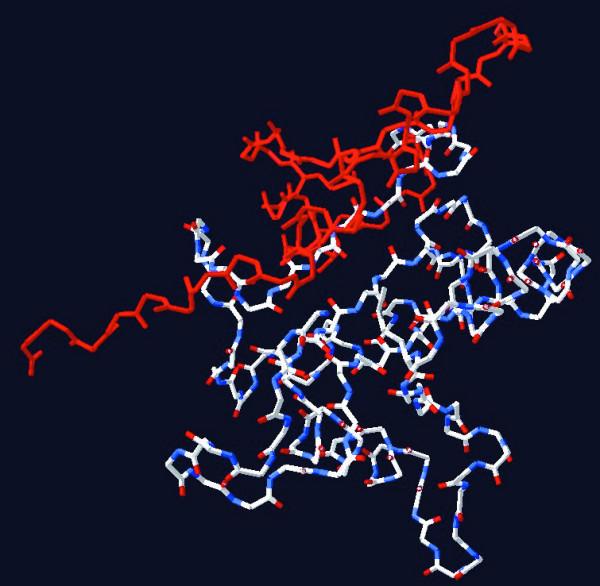
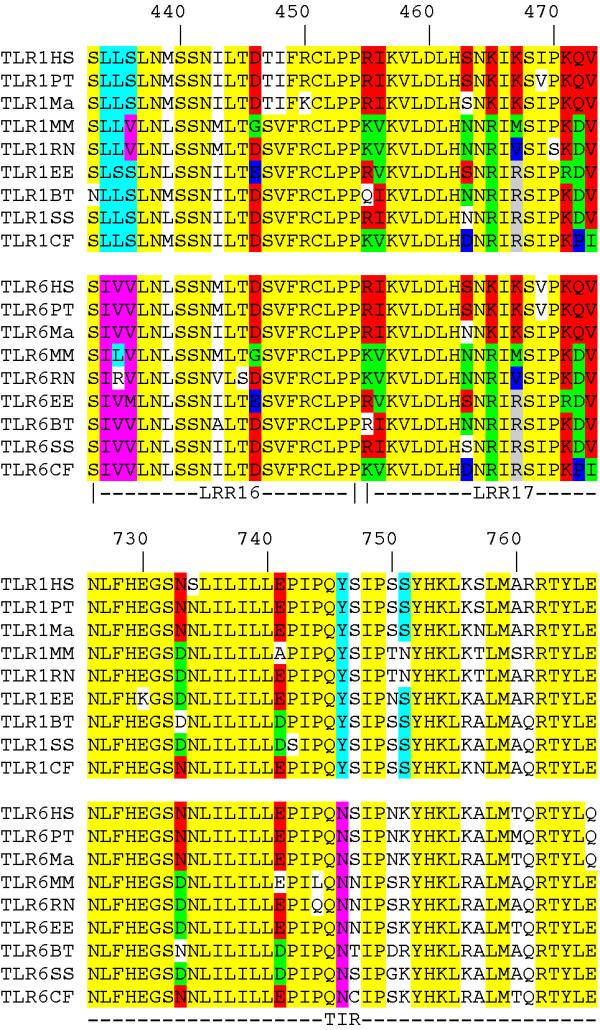
The N-terminal sequences of the orthologous proteins showed greater similarity than corresponding paralog sequences. However, we identified a region of 300 amino acids towards the C-terminus of TLR1 and TLR6, where paralogs had a greater degree of sequence identity than orthologs. Preservation of DNA sequence identity of paralogs in this region was observed in all nine mammalian species investigated, and is due to independent gene conversion events. The regions having undergone gene conversion in each species are almost identical and encode the leucine-rich repeat motifs 16 to 19, the C-terminal cap motif, the transmembrane domain and most of the intracellular Toll/interleukin-1 receptor (TIR) domain.
CONCLUSION
Our results show that, for a specific conserved region, divergence of TLR1 and TLR6 is limited by gene conversion, most likely because of the need for co-evolution with multiple intracellular and extracellular binding partners. Thus, gene conversion provides a mechanism for limiting the divergence of functional regions of protein paralogs, while allowing other domains to evolve diversified functions.
背景
Toll样受体(TLR)可识别病原体相关分子模式,是固有免疫系统的重要介质。TLR1和TLR6是旁系同源物,在哺乳动物中位于同一条染色体上串联排列。它们与TLR2形成异二聚体,并结合革兰氏阳性和革兰氏阴性细菌细胞壁的脂肽成分。为了确定TLR1和TLR6中可能对其功能重要的保守区域,我们比较了九种哺乳动物(智人、黑猩猩、猕猴、小家鼠、褐家鼠、刺猬、牛、猪和犬)的蛋白质序列。
结果
直系同源蛋白的N端序列比相应的旁系同源序列具有更高的相似性。然而,我们在TLR1和TLR6的C端鉴定出一个300个氨基酸的区域,其中旁系同源物的序列同一性程度高于直系同源物。在所有九种被研究的哺乳动物物种中,均观察到该区域旁系同源物的DNA序列同一性得以保留,这是由于独立的基因转换事件所致。每个物种中发生基因转换的区域几乎相同,编码富含亮氨酸的重复基序16至19、C端帽基序、跨膜结构域以及大部分细胞内Toll/白细胞介素-1受体(TIR)结构域。
结论
我们的结果表明,对于一个特定的保守区域,TLR1和TLR6的分歧受到基因转换的限制,最有可能是因为需要与多个细胞内和细胞外结合伴侣共同进化。因此,基因转换提供了一种机制,可限制蛋白质旁系同源物功能区域的分歧,同时允许其他结构域进化出多样化的功能。

 Zotero 插件