
缅甸东部活跃冲突地区恶性疟原虫的流行情况:横断面数据总结。
Prevalence of Plasmodium falciparum in active conflict areas of eastern Burma: a summary of cross-sectional data.
机构信息
Department of Internal Medicine, Montefiore Medical Center, Albert Einstein College of Medicine, 305 East 161st Street, Bronx, NY 10451, USA.
出版信息
Confl Health. 2007 Sep 5;1:9. doi: 10.1186/1752-1505-1-9.
BACKGROUND
Burma records the highest number of malaria deaths in southeast Asia and may represent a reservoir of infection for its neighbors, but the burden of disease and magnitude of transmission among border populations of Burma remains unknown.
METHODS
Plasmodium falciparum (Pf) parasitemia was detected using a HRP-II antigen based rapid test (Paracheck-Pf(R)). Pf prevalence was estimated from screenings conducted in 49 villages participating in a malaria control program, and four retrospective mortality cluster surveys encompassing a sampling frame of more than 220,000. Crude odds ratios were calculated to evaluate Pf prevalence by age, sex, and dry vs. rainy season.
RESULTS
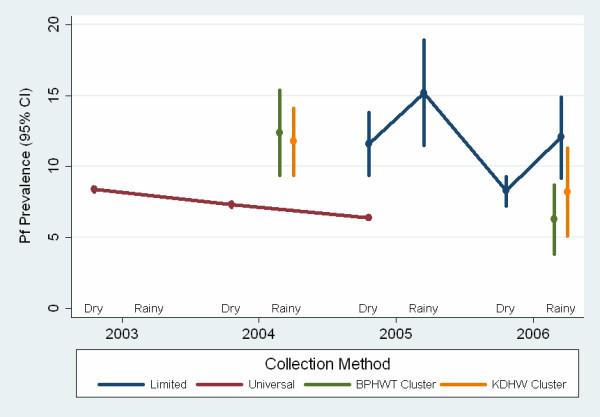
9,796 rapid tests were performed among 28,410 villagers in malaria program areas through four years (2003: 8.4%, 95% CI: 8.3 - 8.6; 2004: 7.1%, 95% CI: 6.9 - 7.3; 2005:10.5%, 95% CI: 9.3 - 11.8 and 2006: 9.3%, 95% CI: 8.2 - 10.6). Children under 5 (OR = 1.99; 95% CI: 1.93 - 2.06) and those 5 to 14 years (OR = 2.24, 95% CI: 2.18 - 2.29) were more likely to be positive than adults. Prevalence was slightly higher among females (OR = 1.04, 95% CI: 1.02 - 1.06) and in the rainy season (OR = 1.48, 95% CI: 1.16 - 1.88). Among 5,538 rapid tests conducted in four cluster surveys, 10.2% were positive (range 6.3%, 95% CI: 3.9 - 8.8; to 12.4%, 95% CI: 9.4 - 15.4).
CONCLUSION
Prevalence of plasmodium falciparum in conflict areas of eastern Burma is higher than rates reported among populations in neighboring Thailand, particularly among children. This population serves as a large reservoir of infection that contributes to a high disease burden within Burma and likely constitutes a source of infection for neighboring regions.
背景
缅甸的疟疾死亡人数居东南亚之首,可能是其邻国的感染源,但缅甸边境地区的疾病负担和传播程度尚不清楚。
方法
采用 HRP-II 抗原快速检测试剂盒(Paracheck-Pf(R))检测恶性疟原虫(Pf)寄生虫血症。在参与疟疾控制项目的 49 个村庄进行筛查,对 4 次回顾性死亡聚集调查进行抽样,调查涵盖了超过 22 万人的抽样框架,估计 Pf 患病率。计算粗比值比以评估年龄、性别、旱季和雨季的 Pf 患病率。
结果
在四年(2003 年:8.4%,95%CI:8.3-8.6;2004 年:7.1%,95%CI:6.9-7.3;2005 年:10.5%,95%CI:9.3-11.8 和 2006 年:9.3%,95%CI:8.2-10.6)期间,对疟疾规划地区的 28410 名村民进行了 9796 次快速检测。5 岁以下儿童(OR=1.99;95%CI:1.93-2.06)和 5-14 岁儿童(OR=2.24,95%CI:2.18-2.29)比成年人更有可能呈阳性。女性(OR=1.04,95%CI:1.02-1.06)和雨季(OR=1.48,95%CI:1.16-1.88)的患病率略高。在四次聚类调查中进行的 5538 次快速检测中,有 10.2%呈阳性(范围 6.3%,95%CI:3.9-8.8;至 12.4%,95%CI:9.4-15.4)。
结论
在缅甸东部冲突地区恶性疟原虫的流行率高于邻国泰国人群报告的流行率,尤其是儿童。该人群是一个巨大的感染源,对缅甸境内的高疾病负担做出了贡献,并且可能是邻国感染源。

 Zotero 插件