
含术中放疗的多模式治疗后进行根治性切除是局部复发性直肠癌患者治疗结果的最重要决定因素。
Radical resection after IORT-containing multimodality treatment is the most important determinant for outcome in patients treated for locally recurrent rectal cancer.
作者信息
Dresen Raphaëla C, Gosens Marleen J, Martijn Hendrik, Nieuwenhuijzen Grard A, Creemers Geert-Jan, Daniels-Gooszen Alette W, van den Brule Adriaan J, van den Berg Hetty A, Rutten Harm J
机构信息
Department of Surgery, Catharina Hospital Eindhoven, Postbox 1350, 5602 ZA, Eindhoven, The Netherlands.
出版信息
Ann Surg Oncol. 2008 Jul;15(7):1937-47. doi: 10.1245/s10434-008-9896-z. Epub 2008 Apr 4.
BACKGROUND
The optimal treatment for locally recurrent rectal cancer (LRRC) is still a matter of debate. This study assessed the outcome of LRRC patients treated with multimodality treatment, consisting of neoadjuvant radio (chemo-) therapy, extended resection, and intraoperative radiotherapy.
METHODS
One hundred and forty-seven consecutive patients with LRRC who underwent treatment between 1994 and 2006 were studied. The prognostic values of patient-, tumor- and treatment-related characteristics were tested with uni- and multivariate analysis.
RESULTS
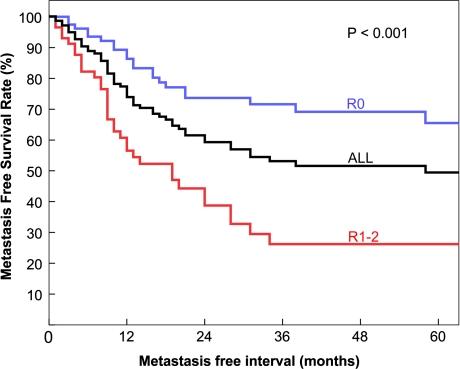
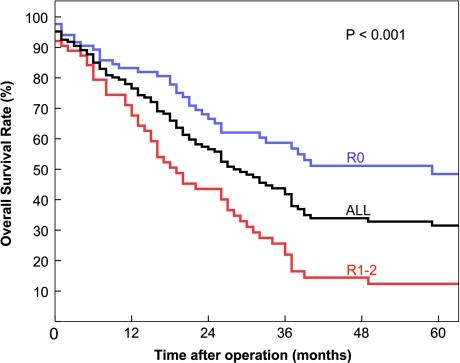
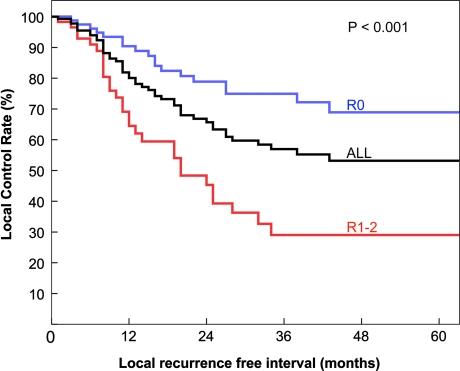
Median overall survival was 28 months (range 0-146 months). Five-year overall, disease-free, and metastasis-free survival and local control (OS, DFS, MFS, and LC respectively) were 31.5%, 34.1%, 49.5% and 54.1% respectively. Radical resection (R0) was obtained in 84 patients (57.2%), microscopically irradical resection (R1) in 34 patients (23.1%), and macroscopically irradical resection (R2) in 29 patients (19.7%). For patients with a radical resection median OS was 59 months and the 5-year OS, DFS, MFS, and LC were 48.4%, 52.3%, 65.5% and 68.9%, respectively. Radical resection was significantly correlated with improved OS, DFS, and LC (P < 0.001). Patients who received re-irradiation or full-course radiotherapy survived significantly longer (P = 0.043) and longer without local recurrence (P = 0.038) or metastasis (P < 0.001) compared to patients who were not re-irradiated.
CONCLUSIONS
Radical resection is the most significant predictor of improved survival in patients with LRRC. Neoadjuvant radio (chemo-) therapy is the best option in order to realize a radical resection. Re-irradiation is feasible in patients who already received irradiation as part of the primary rectal cancer treatment.
背景
局部复发性直肠癌(LRRC)的最佳治疗方案仍存在争议。本研究评估了接受多模式治疗的LRRC患者的治疗结果,该治疗包括新辅助放(化)疗、扩大切除术和术中放疗。
方法
对1994年至2006年间连续接受治疗的147例LRRC患者进行研究。通过单因素和多因素分析检验患者、肿瘤和治疗相关特征的预后价值。
结果
中位总生存期为28个月(范围0 - 146个月)。五年总生存率、无病生存率、无转移生存率和局部控制率(分别为OS、DFS、MFS和LC)分别为31.5%、34.1%、49.5%和54.1%。84例患者(57.2%)实现了根治性切除(R0),34例患者(23.1%)为显微镜下非根治性切除(R1),29例患者(19.7%)为肉眼下非根治性切除(R2)。对于接受根治性切除的患者,中位OS为59个月,五年OS、DFS、MFS和LC分别为48.4%、52.3%、65.5%和68.9%。根治性切除与改善OS、DFS和LC显著相关(P < 0.001)。与未接受再照射的患者相比,接受再照射或全程放疗的患者生存期显著更长(P = 0.043),无局部复发生存期显著更长(P = 0.038),无转移生存期显著更长(P < 0.001)。
结论
根治性切除是LRRC患者生存改善的最重要预测因素。新辅助放(化)疗是实现根治性切除的最佳选择。对于已经接受过作为原发性直肠癌治疗一部分的放疗的患者,再照射是可行的。
 Zotero 插件