
尺寸很重要:脑容量影响神经解剖学中的性别差异。
Size matters: cerebral volume influences sex differences in neuroanatomy.
作者信息
Leonard Christiana M, Towler Stephen, Welcome Suzanne, Halderman Laura K, Otto Ron, Eckert Mark A, Chiarello Christine
机构信息
Department of Neuroscience, University of Florida, Gainesville, FL 32601, USA.
出版信息
Cereb Cortex. 2008 Dec;18(12):2920-31. doi: 10.1093/cercor/bhn052. Epub 2008 Apr 24.
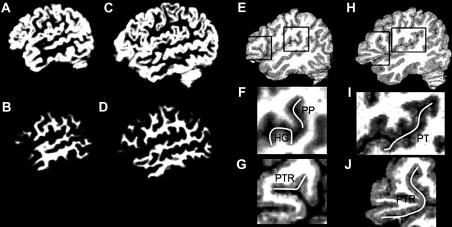
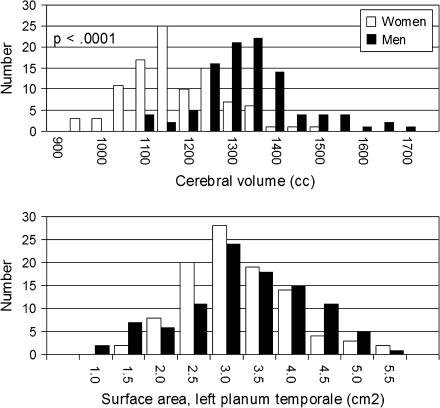
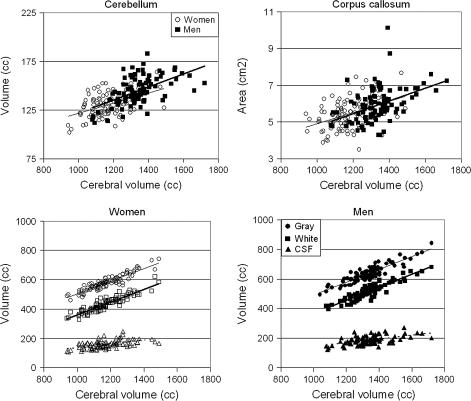
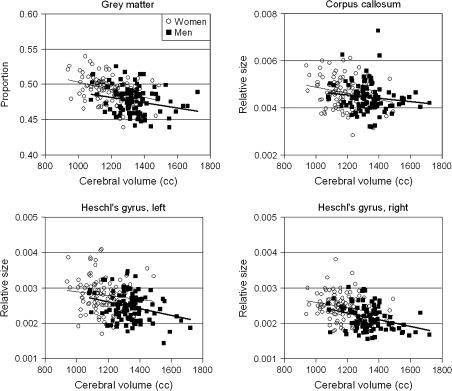
Biological and behavioral differences between the sexes range from obvious to subtle or nonexistent. Neuroanatomical differences are particularly controversial, perhaps due to the implication that they might account for behavioral differences. In this sample of 200 men and women, large effect sizes (Cohen's d > 0.8) were found for sex differences in total cerebral gray and white matter, cerebellum, and gray matter proportion (women had a higher proportion of gray matter). The only one of these sex differences that survived adjustment for the effect of cerebral volume was gray matter proportion. Individual differences in cerebral volume accounted for 21% of the difference in gray matter proportion, while sex accounted for an additional 4%. The relative size of the corpus callosum was 5% larger in women, but this difference was completely explained by a negative relationship between relative callosal size and cerebral volume. In agreement with Jancke et al., individuals with higher cerebral volume tended to have smaller corpora callosa. There were few sex differences in the size of structures in Broca's and Wernicke's area. We conclude that individual differences in brain volume, in both men and women, account for apparent sex differences in relative size.
两性之间的生物学和行为差异范围从明显到微妙或不存在。神经解剖学差异尤其具有争议性,这可能是因为它们可能被认为是行为差异的原因。在这个由200名男性和女性组成的样本中,发现大脑总体灰质和白质、小脑以及灰质比例的性别差异具有较大效应量(科恩d值>0.8)(女性的灰质比例更高)。在对脑容量的影响进行调整后,这些性别差异中唯一仍然显著的是灰质比例。脑容量的个体差异占灰质比例差异的21%,而性别差异又额外占4%。女性胼胝体的相对大小比男性大5%,但这种差异完全可以由胼胝体相对大小与脑容量之间的负相关关系来解释。与扬克等人的研究一致,脑容量较大的个体往往胼胝体较小。布洛卡区和韦尼克区结构的大小几乎没有性别差异。我们得出结论,男性和女性的脑容量个体差异导致了相对大小上明显的性别差异。

 Zotero 插件