
3个犹太人群体中mtDNA单倍群分布的差异改变了对2型糖尿病并发症的易感性。
Differences in mtDNA haplogroup distribution among 3 Jewish populations alter susceptibility to T2DM complications.
作者信息
Feder Jeanette, Blech Ilana, Ovadia Ofer, Amar Shirly, Wainstein Julio, Raz Itamar, Dadon Sarah, Arking Dan E, Glaser Benjamin, Mishmar Dan
机构信息
Department of Life Sciences and National Institute of Biotechnology in the Negev, Ben-Gurion University of the Negev, Beer-Sheva, Israel.
出版信息
BMC Genomics. 2008 Apr 29;9:198. doi: 10.1186/1471-2164-9-198.
BACKGROUND
Recent genome-wide association studies searching for candidate susceptibility loci for common complex diseases such as type 2 diabetes mellitus (T2DM) and its common complications have uncovered novel disease-associated genes. Nevertheless these large-scale population screens often overlook the tremendous variation in the mitochondrial genome (mtDNA) and its involvement in complex disorders.
RESULTS
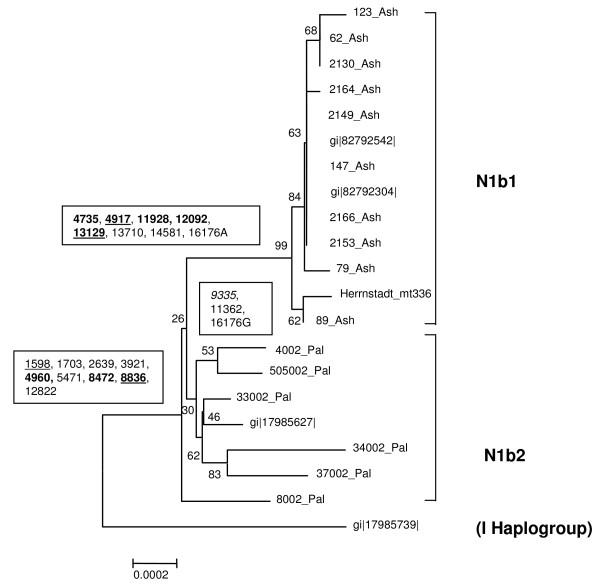
We have analyzed the mitochondrial DNA (mtDNA) genetic variability in Ashkenazi (Ash), Sephardic (Seph) and North African (NAF) Jewish populations (total n = 1179). Our analysis showed significant differences (p < 0.001) in the distribution of mtDNA genetic backgrounds (haplogroups) among the studied populations. To test whether these differences alter the pattern of disease susceptibility, we have screened our three Jewish populations for an association of mtDNA genetic haplogroups with T2DM complications. Our results identified population-specific susceptibility factors of which the best example is the Ashkenazi Jewish specific haplogroup N1b1, having an apparent protective effect against T2DM complications in Ash (p = 0.006), being absent in the NAF population and under-represented in the Seph population. We have generated and analyzed whole mtDNA sequences from the disease associated haplogroups revealing mutations in highly conserved positions that are good candidates to explain the phenotypic effect of these genetic backgrounds.
CONCLUSION
Our findings support the possibility that recent bottleneck events leading to over-representation of minor mtDNA alleles in specific genetic isolates, could result in population-specific susceptibility loci to complex disorders.
背景
近期全基因组关联研究旨在寻找常见复杂疾病(如2型糖尿病(T2DM)及其常见并发症)的候选易感基因座,发现了新的疾病相关基因。然而,这些大规模人群筛查往往忽视了线粒体基因组(mtDNA)的巨大变异及其在复杂疾病中的作用。
结果
我们分析了德系犹太人(Ash)、西班牙系犹太人(Seph)和北非犹太人(NAF)群体(共1179人)的线粒体DNA(mtDNA)遗传变异性。我们的分析显示,在所研究的群体中,mtDNA遗传背景(单倍群)的分布存在显著差异(p < 0.001)。为了测试这些差异是否会改变疾病易感性模式,我们在三个犹太人群体中筛查了mtDNA遗传单倍群与T2DM并发症的关联。我们的结果确定了群体特异性的易感因素,其中最好的例子是德系犹太人特有的单倍群N1b1,它对德系犹太人的T2DM并发症具有明显的保护作用(p = 0.006),在北非犹太人群体中不存在,在西班牙系犹太人群体中代表性不足。我们生成并分析了与疾病相关的单倍群的完整mtDNA序列,发现了高度保守位置的突变,这些突变很可能解释了这些遗传背景的表型效应。
结论
我们的研究结果支持这样一种可能性,即近期的瓶颈事件导致特定遗传隔离群体中次要mtDNA等位基因的过度代表,可能导致群体特异性的复杂疾病易感基因座。

 Zotero 插件