
柳氮磺胺吡啶可阻止糖尿病大鼠触觉异常性疼痛的发展。
Sulfasalazine blocks the development of tactile allodynia in diabetic rats.
作者信息
Berti-Mattera Liliana N, Kern Timothy S, Siegel Ruth E, Nemet Ina, Mitchell Rochanda
机构信息
Department of Pathology, Case Western Reserve University School of Medicine, Cleveland, Ohio, USA.
出版信息
Diabetes. 2008 Oct;57(10):2801-8. doi: 10.2337/db07-1274. Epub 2008 Jul 15.
OBJECTIVE
Diabetic neuropathy is manifested either by loss of nociception (painless syndrome) or by mechanical hyperalgesia and tactile allodynia (pain in response to nonpainful stimuli). While therapies with vasodilators or neurotrophins reverse some functional and metabolic abnormalities in diabetic nerves, they only partially ameliorate neuropathic pain. The reported link between nociception and targets of the anti-inflammatory drug sulfasalazine prompted us to investigate its effect on neuropathic pain in diabetes.
RESEARCH DESIGN AND METHODS
We examined the effects of sulfasalazine, salicylates, and the poly(ADP-ribose) polymerase-1 inhibitor PJ34 on altered nociception in streptozotocin-induced diabetic rats. We also evaluated the levels of sulfasalazine targets in sciatic nerves and dorsal root ganglia (DRG) of treated animals. Finally, we analyzed the development of tactile allodynia in diabetic mice lacking expression of the sulfasalazine target nuclear factor-kappaB (NF-kappaB) p50.
RESULTS
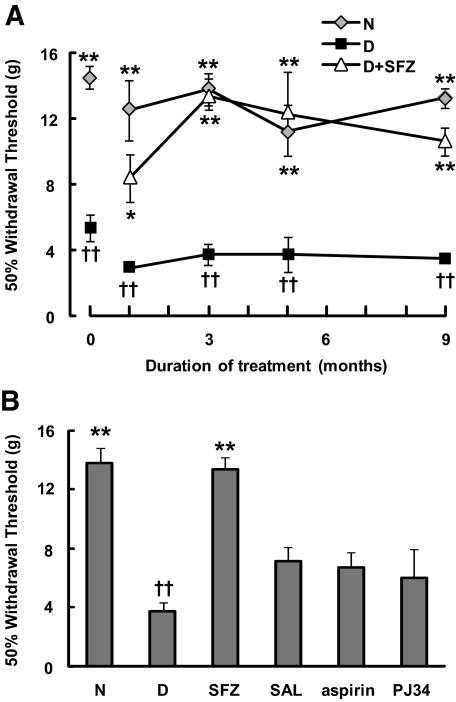
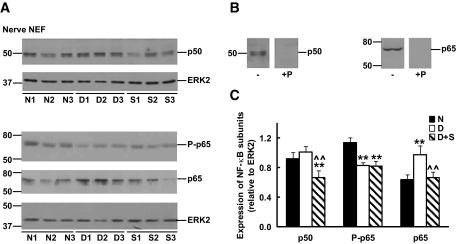
Sulfasalazine completely blocked the development of tactile allodynia in diabetic rats, whereas relatively minor effects were observed with other salicylates and PJ34. Along with the behavioral findings, sciatic nerves and DRG from sulfasalazine-treated diabetic rats displayed a decrease in NF-kappaB p50 expression compared with untreated diabetic animals. Importantly, the absence of tactile allodynia in diabetic NF-kappaB p50(-/-) mice supported a role for NF-kappaB in diabetic neuropathy. Sulfasalazine treatment also increased inosine levels in sciatic nerves of diabetic rats.
CONCLUSIONS
The complete inhibition of tactile allodynia in experimental diabetes by sulfasalazine may stem from its ability to regulate both NF-kappaB and inosine. Sulfasalazine might be useful in the treatment of nociceptive alterations in diabetic patients.
目的
糖尿病性神经病变表现为伤害感受缺失(无痛综合征)或机械性痛觉过敏及触觉异常性疼痛(对非疼痛性刺激产生疼痛反应)。虽然使用血管扩张剂或神经营养因子进行治疗可逆转糖尿病神经中的一些功能和代谢异常,但它们只能部分改善神经性疼痛。抗炎药物柳氮磺胺吡啶的伤害感受与靶点之间的报道联系促使我们研究其对糖尿病神经性疼痛的影响。
研究设计与方法
我们研究了柳氮磺胺吡啶、水杨酸盐和聚(ADP - 核糖)聚合酶 - 1抑制剂PJ34对链脲佐菌素诱导的糖尿病大鼠伤害感受改变的影响。我们还评估了治疗动物坐骨神经和背根神经节(DRG)中柳氮磺胺吡啶靶点的水平。最后,我们分析了缺乏柳氮磺胺吡啶靶点核因子 - κB(NF - κB)p50表达的糖尿病小鼠触觉异常性疼痛的发展情况。
结果
柳氮磺胺吡啶完全阻断了糖尿病大鼠触觉异常性疼痛的发展,而其他水杨酸盐和PJ34的作用相对较小。与行为学结果一致,与未治疗的糖尿病动物相比,柳氮磺胺吡啶治疗的糖尿病大鼠的坐骨神经和DRG中NF - κB p50表达降低。重要的是,糖尿病NF - κB p50( - / - )小鼠不存在触觉异常性疼痛,这支持了NF - κB在糖尿病性神经病变中的作用。柳氮磺胺吡啶治疗还增加了糖尿病大鼠坐骨神经中的肌苷水平。
结论
柳氮磺胺吡啶对实验性糖尿病触觉异常性疼痛的完全抑制可能源于其调节NF - κB和肌苷的能力。柳氮磺胺吡啶可能对治疗糖尿病患者的伤害感受改变有用。

 Zotero 插件