
高细胞密度培养基通常用于需氧培养大肠杆菌——对大规模生物工艺和摇瓶培养的影响。
High cell density media for Escherichia coli are generally designed for aerobic cultivations - consequences for large-scale bioprocesses and shake flask cultures.
机构信息
Bioprocess Engineering Laboratory, Dept, of Process and Environmental Engineering, University of Oulu, P, O, Box 4300, FIN-90014 Oulu, Finland.
出版信息
Microb Cell Fact. 2008 Aug 7;7:26. doi: 10.1186/1475-2859-7-26.
BACKGROUND
For the cultivation of Escherichia coli in bioreactors trace element solutions are generally designed for optimal growth under aerobic conditions. They do normally not contain selenium and nickel. Molybdenum is only contained in few of them. These elements are part of the formate hydrogen lyase (FHL) complex which is induced under anaerobic conditions. As it is generally known that oxygen limitation appears in shake flask cultures and locally in large-scale bioreactors, function of the FHL complex may influence the process behaviour. Formate has been described to accumulate in large-scale cultures and may have toxic effects on E. coli.Although the anaerobic metabolism of E. coli is well studied, reference data which estimate the impact of the FHL complex on bioprocesses of E. coli with oxygen limitation have so far not been published, but are important for a better process understanding.
RESULTS
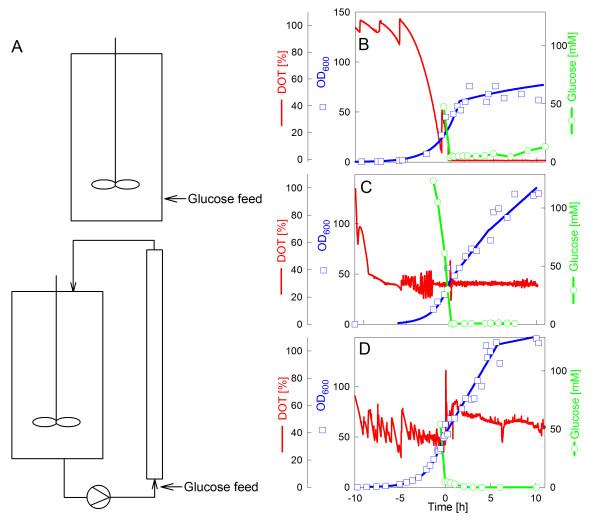
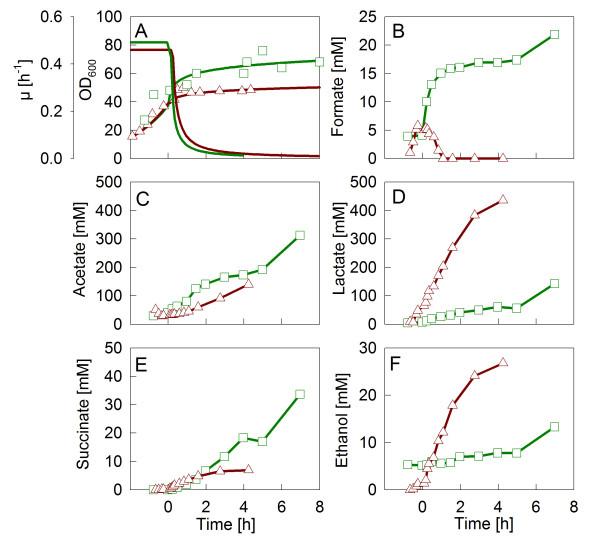
Two sets of fed-batch cultures with conditions triggering oxygen limitation and formate accumulation were performed. Permanent oxygen limitation which is typical for shake flask cultures was caused in a bioreactor by reduction of the agitation rate. Transient oxygen limitation, which has been described to eventually occur in the feed-zone of large-scale bioreactors, was mimicked in a two-compartment scale-down bioreactor consisting of a stirred tank reactor and a plug flow reactor (PFR) with continuous glucose feeding into the PFR.In both models formate accumulated up to about 20 mM in the culture medium without addition of selenium, molybdenum and nickel. By addition of these trace elements the formate accumulation decreased below the level observed in well-mixed laboratory-scale cultures. Interestingly, addition of the extra trace elements caused accumulation of large amounts of lactate and reduced biomass yield in the simulator with permanent oxygen limitation, but not in the scale-down two-compartment bioreactor.
CONCLUSION
The accumulation of formate in oxygen limited cultivations of E. coli can be fully prevented by addition of the trace elements selenium, nickel and molybdenum, necessary for the function of FHL complex. For large-scale cultivations, if glucose gradients are likely, the results from the two-compartment scale-down bioreactor indicate that the addition of the extra trace elements is beneficial. No negative effects on the biomass yield or on any other bioprocess parameters could be observed in cultures with the extra trace elements if the cells were repeatedly exposed to transient oxygen limitation.
背景
在生物反应器中培养大肠杆菌时,微量元素溶液通常是为在有氧条件下的最佳生长而设计的。它们通常不含有硒和镍。钼只存在于其中的一些溶液中。这些元素是甲酸氢裂解酶(FHL)复合物的一部分,该复合物在厌氧条件下诱导产生。由于众所周知,在摇瓶培养和大规模生物反应器的局部区域中会出现氧气限制,因此 FHL 复合物的功能可能会影响工艺过程。已经描述了在大规模培养物中积累甲酸盐,并且它可能对大肠杆菌产生毒性作用。尽管大肠杆菌的厌氧代谢已得到很好的研究,但迄今为止尚未发表有关 FHL 复合物对具有氧气限制的大肠杆菌生物过程影响的参考数据,但这些数据对于更好地了解工艺过程非常重要。
结果
进行了两组触发氧气限制和甲酸盐积累的分批补料培养。通过降低搅拌速度,在生物反应器中引起了典型的摇瓶培养中的永久性氧气限制。在由连续向 PFR 中进料葡萄糖的搅拌罐反应器和推流反应器(PFR)组成的两室缩小生物反应器中模拟了瞬态氧气限制,据描述该限制最终会在大规模生物反应器的进料区发生。在没有添加硒、钼和镍的情况下,两种模型中甲酸盐在培养基中积累到约 20mM。通过添加这些痕量元素,甲酸盐的积累量减少到在充分混合的实验室规模培养物中观察到的水平以下。有趣的是,在具有永久性氧气限制的模拟器中,添加额外的痕量元素会导致大量乳酸的积累和生物质产量的降低,但在两室缩小生物反应器中则不会。
结论
通过添加硒、镍和钼等 FHL 复合物功能所必需的痕量元素,可以完全防止大肠杆菌在氧气限制培养物中积累甲酸盐。对于大规模培养,如果存在葡萄糖梯度,则两室缩小生物反应器的结果表明添加额外的痕量元素是有益的。如果细胞反复暴露于瞬态氧气限制,则在添加额外痕量元素的培养物中,没有观察到对生物质产量或任何其他生物过程参数的负面影响。


 Zotero 插件