
尽管酮症倾向型糖尿病非洲患者血糖接近正常缓解,但仍存在多组织胰岛素抵抗。
Multitissue insulin resistance despite near-normoglycemic remission in Africans with ketosis-prone diabetes.
作者信息
Choukem Simeon-Pierre, Sobngwi Eugene, Fetita Lila-Sabrina, Boudou Philippe, De Kerviler Eric, Boirie Yves, Hainault Isabelle, Vexiau Patrick, Mauvais-Jarvis Franck, Calvo Fabien, Gautier Jean-François
机构信息
Department of Diabetes and Endocrinology, Saint-Louis Hospital, Assistance Publique-Hôpitaux de Paris, University Paris-Diderot Paris 7, Paris, France.
出版信息
Diabetes Care. 2008 Dec;31(12):2332-7. doi: 10.2337/dc08-0914. Epub 2008 Sep 22.
OBJECTIVE
To characterize insulin action in Africans with ketosis-prone diabetes (KPD) during remission.
RESEARCH DESIGN AND METHODS
At Saint-Louis Hospital, Paris, France, 15 African patients with KPD with an average 10.5-month insulin-free near-normoglycemic remission period (mean A1C 6.2%) were compared with 17 control subjects matched for age, sex, BMI, and geographical origin. Insulin stimulation of glucose disposal, and insulin suppression of endogenous glucose production (EGP) and nonesterified fatty acids (NEFAs), was studied using a 200-min two-step (10 mU x m(-2) body surface x min(-1) and 80 mU x m(-2) x min (-1) insulin infusion rates) euglycemic clamp with [6,6-(2)H(2)]glucose as the tracer. Early-phase insulin secretion was determined during an oral glucose tolerance test.
RESULTS
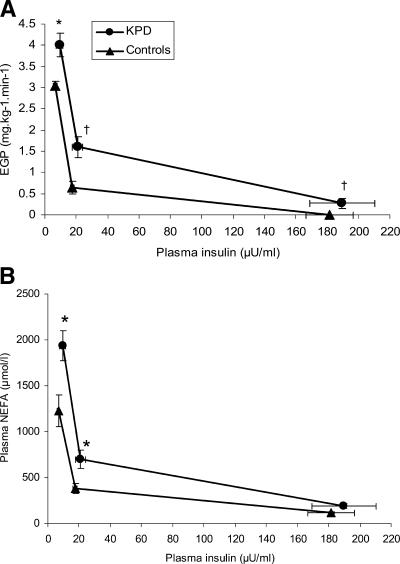
The total glucose disposal was reduced in patients compared with control subjects (7.5 +/- 0.8 [mean +/- SE] vs. 10.5 +/- 0.9 mg x kg(-1) x min(-1); P = 0.018). EGP rate was higher in patients than control subjects at baseline (4.0 +/- 0.3 vs. 3.0 +/- 0.1 mg x kg(-1) x min(-1); P = 0.001) and after 200-min insulin infusion (10 mU x m(-2) x min(-1): 1.6 +/- 0.2 vs. 0.6 +/- 0.1, P = 0.004; 80 mU x m(-2) x min(-1): 0.3 +/- 0.1 vs. 0 mg x kg(-1) x min(-1), P = 0.007). Basal plasma NEFA concentrations were also higher in patients (1,936.7 +/- 161.4 vs. 1,230.0 +/- 174.1 micromol/l; P = 0.002) and remained higher after 100-min 10 mU x m(-2) x min(-1) insulin infusion (706.6 +/- 96.5 vs. 381.6 +/- 55.9 micromol/l; P = 0.015).
CONCLUSIONS
The triad hepatic, adipose tissue, and skeletal muscle insulin resistance is observed in patients with KPD during near-normoglycemic remission, suggesting that KPD is a form of type 2 diabetes.
目的
描述缓解期易发生酮症糖尿病(KPD)的非洲人的胰岛素作用特征。
研究设计与方法
在法国巴黎圣路易医院,将15例平均无胰岛素近正常血糖缓解期为10.5个月(平均糖化血红蛋白A1C为6.2%)的KPD非洲患者与17例年龄、性别、体重指数和地理来源相匹配的对照者进行比较。使用以[6,6-(2)H(2)]葡萄糖为示踪剂的200分钟两步法(胰岛素输注速率分别为10 mU·m(-2)体表·min(-1)和80 mU·m(-2)·min(-1))正常血糖钳夹技术研究胰岛素对葡萄糖处置的刺激作用,以及胰岛素对内源性葡萄糖生成(EGP)和非酯化脂肪酸(NEFA)的抑制作用。在口服葡萄糖耐量试验期间测定早期胰岛素分泌。
结果
与对照者相比,患者的总葡萄糖处置减少(7.5±0.8[平均值±标准误]对10.5±0.9 mg·kg(-1)·min(-1);P = 0.018)。患者的EGP速率在基线时高于对照者(4.0±0.3对3.0±0.1 mg·kg(-1)·min(-1);P = 0.001),在200分钟胰岛素输注后也更高(10 mU·m(-2)·min(-1)时:1.6±0.2对0.6±0.1,P = 0.004;80 mU·m(-2)·min(-1)时:0.3±0.1对0 mg·kg(-1)·min(-1),P = 0.007)。患者的基础血浆NEFA浓度也更高(1936.7±161.4对1230.0±174.1 μmol/L;P = 0.002),在100分钟10 mU·m(-2)·min(-1)胰岛素输注后仍较高(706.6±96.5对381.6±55.9 μmol/L;P = 0.015)。
结论
在近正常血糖缓解期的KPD患者中观察到肝脏、脂肪组织和骨骼肌三联胰岛素抵抗,提示KPD是2型糖尿病的一种形式。
 Zotero 插件