
富含胆固醇的膜微区在严重急性呼吸综合征冠状病毒S蛋白与细胞受体血管紧张素转换酶2相互作用中的重要性。
Importance of cholesterol-rich membrane microdomains in the interaction of the S protein of SARS-coronavirus with the cellular receptor angiotensin-converting enzyme 2.
作者信息
Glende Joerg, Schwegmann-Wessels Christel, Al-Falah Marwan, Pfefferle Susanne, Qu Xiuxia, Deng Hongkui, Drosten Christian, Naim Hassan Y, Herrler Georg
机构信息
Institut für Virologie, Stiftung Tierärztliche Hochschule Hannover, 30559 Hannover, Germany.
出版信息
Virology. 2008 Nov 25;381(2):215-21. doi: 10.1016/j.virol.2008.08.026. Epub 2008 Sep 23.
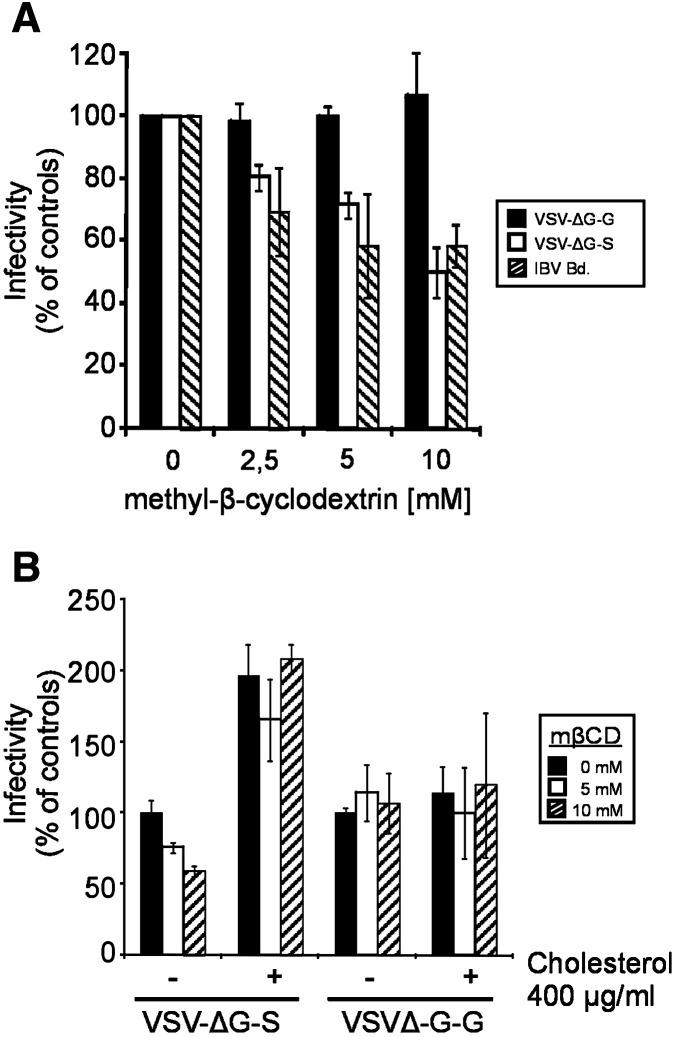
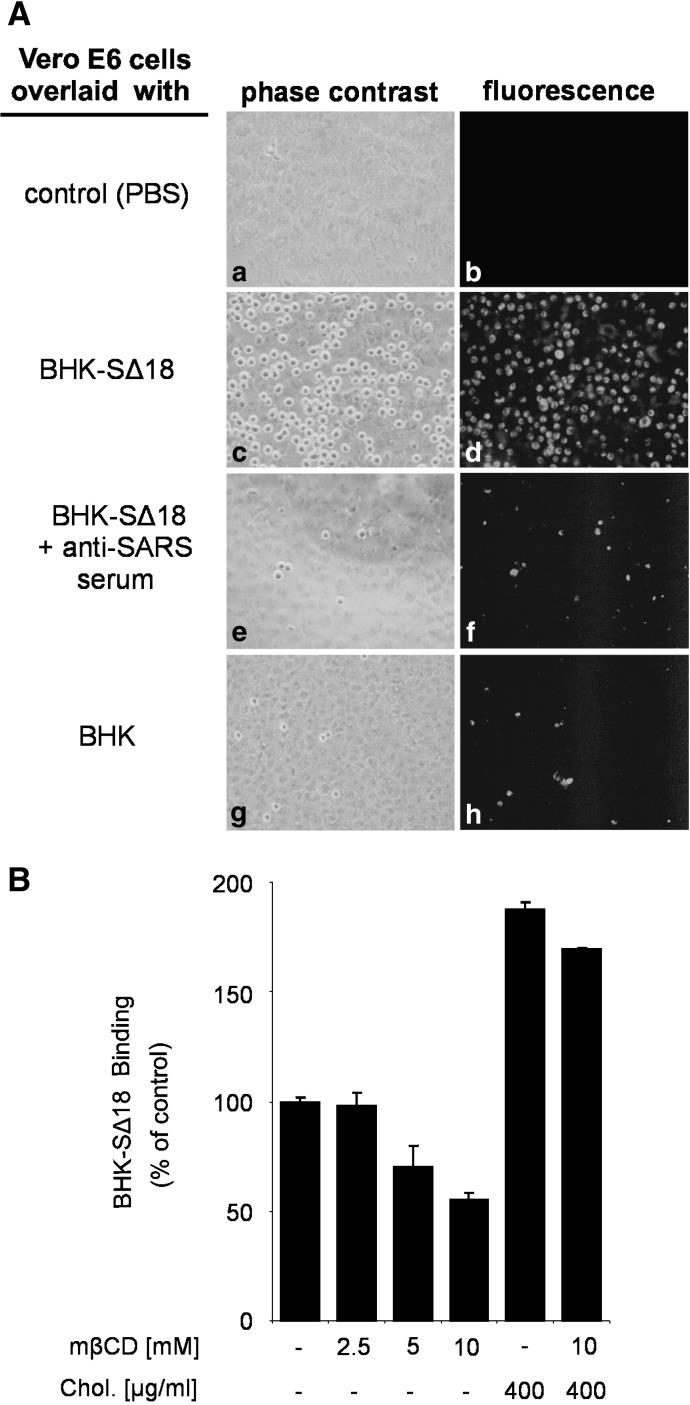
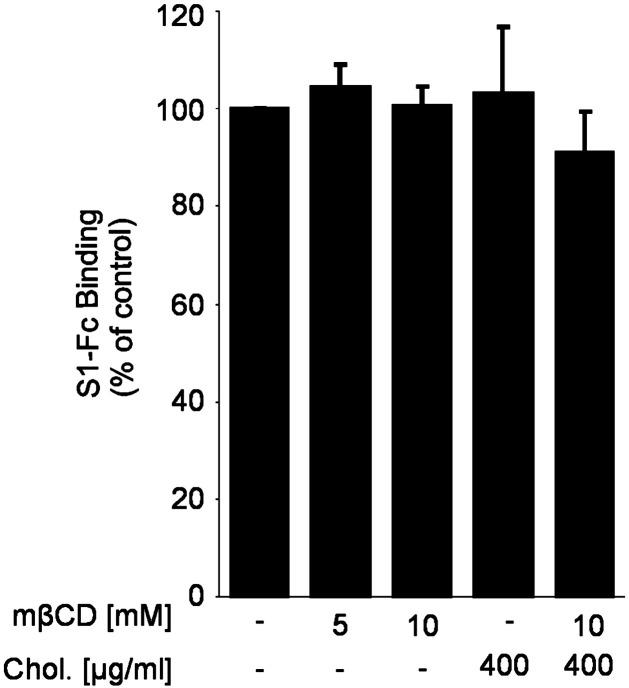
Cholesterol present in the plasma membrane of target cells has been shown to be important for the infection by SARS-CoV. We show that cholesterol depletion by treatment with methyl-beta-cyclodextrin (m beta CD) affects infection by SARS-CoV to the same extent as infection by vesicular stomatitis virus-based pseudotypes containing the surface glycoprotein S of SARS-CoV (VSV-Delta G-S). Therefore, the role of cholesterol for SARS-CoV infection can be assigned to the S protein and is unaffected by other coronavirus proteins. There have been contradictory reports whether or not angiotensin-converting enzyme 2 (ACE2), the cellular receptor for SARS-CoV, is present in detergent-resistant membrane domains. We found that ACE2 of both Vero E6 and Caco-2 cells co-purifies with marker proteins of detergent-resistant membranes supporting the notion that cholesterol-rich microdomains provide a platform facilitating the efficient interaction of the S protein with the cellular receptor ACE2. To understand the involvement of cholesterol in the initial steps of the viral life cycle, we applied a cell-based binding assay with cells expressing the S protein and cells containing angiotensin-converting enzyme 2 (ACE2). Alternatively, we used a soluble S protein as interaction partner. Depletion of cholesterol from the ACE2-expressing cells reduced the binding of S-expressing cells by 50% whereas the binding of soluble S protein was not affected. This result suggests that optimal infection requires a multivalent interaction between viral attachment protein and cellular receptors.
已证明靶细胞质膜中存在的胆固醇对于严重急性呼吸综合征冠状病毒(SARS-CoV)的感染很重要。我们发现,用甲基-β-环糊精(mβCD)处理使胆固醇耗竭,对SARS-CoV感染的影响程度与对含有SARS-CoV表面糖蛋白S的水泡性口炎病毒假型(VSV-ΔG-S)感染的影响程度相同。因此,胆固醇对SARS-CoV感染的作用可归因于S蛋白,且不受其他冠状病毒蛋白的影响。关于血管紧张素转换酶2(ACE2),即SARS-CoV的细胞受体,是否存在于抗去污剂膜结构域中,一直存在相互矛盾的报道。我们发现,Vero E6细胞和Caco-2细胞的ACE2都与抗去污剂膜的标记蛋白共纯化,这支持了富含胆固醇的微结构域提供了一个促进S蛋白与细胞受体ACE2有效相互作用的平台这一观点。为了了解胆固醇在病毒生命周期初始阶段的作用,我们对表达S蛋白的细胞和含有血管紧张素转换酶2(ACE2)的细胞进行了基于细胞的结合试验。或者,我们使用可溶性S蛋白作为相互作用伙伴。从表达ACE2的细胞中去除胆固醇可使表达S蛋白的细胞的结合减少50%,而可溶性S蛋白的结合不受影响。这一结果表明,最佳感染需要病毒附着蛋白与细胞受体之间的多价相互作用。


 Zotero 插件