
全基因组单核苷酸多态性基因分型揭示了自然选择在恶性疟原虫种群分化中的作用。
Genome-wide SNP genotyping highlights the role of natural selection in Plasmodium falciparum population divergence.
作者信息
Neafsey Daniel E, Schaffner Stephen F, Volkman Sarah K, Park Daniel, Montgomery Philip, Milner Danny A, Lukens Amanda, Rosen David, Daniels Rachel, Houde Nathan, Cortese Joseph F, Tyndall Erin, Gates Casey, Stange-Thomann Nicole, Sarr Ousmane, Ndiaye Daouda, Ndir Omar, Mboup Soulyemane, Ferreira Marcelo U, Moraes Sandra do Lago, Dash Aditya P, Chitnis Chetan E, Wiegand Roger C, Hartl Daniel L, Birren Bruce W, Lander Eric S, Sabeti Pardis C, Wirth Dyann F
机构信息
Broad Institute of MIT and Harvard, 7 Cambridge Center, Cambridge, MA 02142, USA.
出版信息
Genome Biol. 2008;9(12):R171. doi: 10.1186/gb-2008-9-12-r171. Epub 2008 Dec 15.
BACKGROUND
The malaria parasite Plasmodium falciparum exhibits abundant genetic diversity, and this diversity is key to its success as a pathogen. Previous efforts to study genetic diversity in P. falciparum have begun to elucidate the demographic history of the species, as well as patterns of population structure and patterns of linkage disequilibrium within its genome. Such studies will be greatly enhanced by new genomic tools and recent large-scale efforts to map genomic variation. To that end, we have developed a high throughput single nucleotide polymorphism (SNP) genotyping platform for P. falciparum.
RESULTS
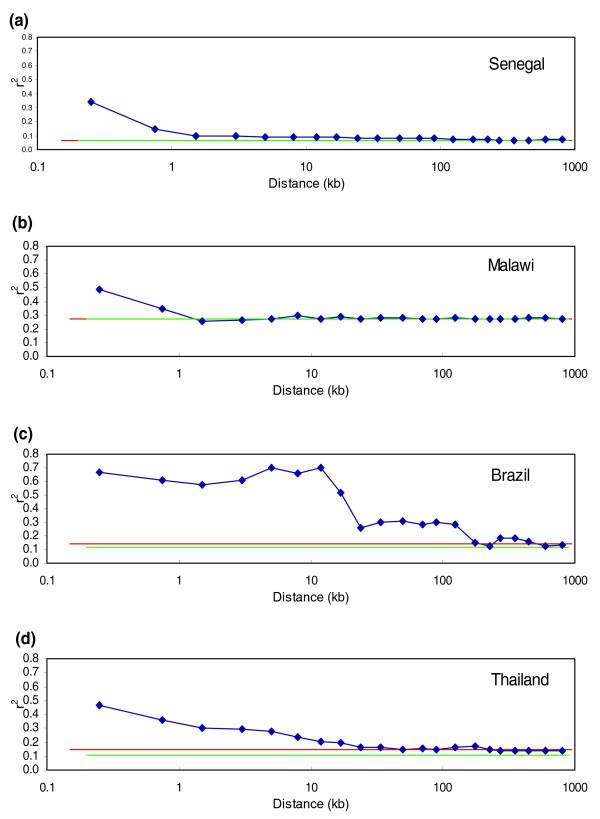
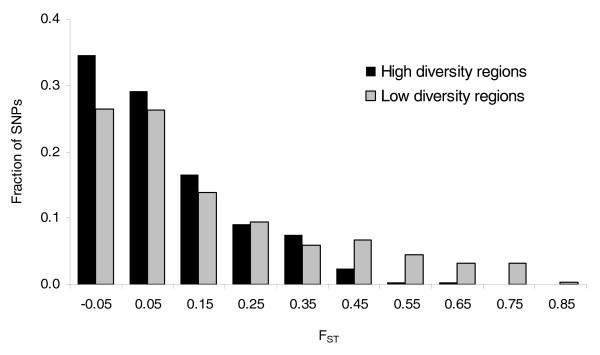
Using an Affymetrix 3,000 SNP assay array, we found roughly half the assays (1,638) yielded high quality, 100% accurate genotyping calls for both major and minor SNP alleles. Genotype data from 76 global isolates confirm significant genetic differentiation among continental populations and varying levels of SNP diversity and linkage disequilibrium according to geographic location and local epidemiological factors. We further discovered that nonsynonymous and silent (synonymous or noncoding) SNPs differ with respect to within-population diversity, inter-population differentiation, and the degree to which allele frequencies are correlated between populations.
CONCLUSIONS
The distinct population profile of nonsynonymous variants indicates that natural selection has a significant influence on genomic diversity in P. falciparum, and that many of these changes may reflect functional variants deserving of follow-up study. Our analysis demonstrates the potential for new high-throughput genotyping technologies to enhance studies of population structure, natural selection, and ultimately enable genome-wide association studies in P. falciparum to find genes underlying key phenotypic traits.
背景
恶性疟原虫表现出丰富的遗传多样性,这种多样性是其作为病原体成功的关键。此前对恶性疟原虫遗传多样性的研究已开始阐明该物种的种群历史,以及其基因组内的种群结构模式和连锁不平衡模式。新的基因组工具和近期绘制基因组变异图谱的大规模努力将极大地加强此类研究。为此,我们开发了一种用于恶性疟原虫的高通量单核苷酸多态性(SNP)基因分型平台。
结果
使用Affymetrix 3000 SNP检测阵列,我们发现大约一半的检测(1638个)对主要和次要SNP等位基因都产生了高质量、100%准确的基因分型结果。来自76个全球分离株的基因型数据证实了不同大陆种群之间存在显著的遗传分化,并且根据地理位置和当地流行病学因素,SNP多样性和连锁不平衡水平各不相同。我们进一步发现,非同义SNP和沉默(同义或非编码)SNP在种群内多样性、种群间分化以及种群间等位基因频率的相关程度方面存在差异。
结论
非同义变异独特的种群特征表明,自然选择对恶性疟原虫的基因组多样性有重大影响,而且其中许多变化可能反映了值得后续研究的功能变异。我们的分析表明,新的高通量基因分型技术有潜力加强对种群结构、自然选择的研究,并最终使恶性疟原虫的全基因组关联研究能够找到关键表型性状背后的基因。




 Zotero 插件