
非HLA基因是否会影响具有高危HLA-DR、DQ基因型的儿童持续性胰岛自身免疫和1型糖尿病的发展?
Do non-HLA genes influence development of persistent islet autoimmunity and type 1 diabetes in children with high-risk HLA-DR,DQ genotypes?
作者信息
Steck Andrea K, Zhang Weiming, Bugawan Teodorica L, Barriga Katherine J, Blair Alan, Erlich Henry A, Eisenbarth George S, Norris Jill M, Rewers Marian J
机构信息
Barbara Davis Center for Childhood Diabetes, University of Colorado-Denver, Aurora, Colorado, USA.
出版信息
Diabetes. 2009 Apr;58(4):1028-33. doi: 10.2337/db08-1179. Epub 2009 Feb 2.
OBJECTIVE
Specific alleles of non-HLA genes INS, CTLA-4, and PTPN22 have been associated with type 1 diabetes. We examined whether some of these alleles influence development of islet autoimmunity or progression from persistent islet autoimmunity to type 1 diabetes in children with high-risk HLA-DR,DQ genotypes.
RESEARCH DESIGN AND METHODS
Since 1993, the Diabetes Autoimmunity Study in the Young (DAISY) has followed 2,449 young children carrying HLA-DR,DQ genotypes associated with type 1 diabetes. Of those, 112 have developed islet autoimmunity (persistent autoantibodies to insulin, GAD65, and/or IA-2), and 47 of these have progressed to type 1 diabetes. The influence of polymorphisms of INS(-23Hph1), CTLA-4(T17A), and PTPN22(R620W) on development of persistent islet autoimmunity and progression to type 1 diabetes was evaluated by parametric models and by survival analyses.
RESULTS
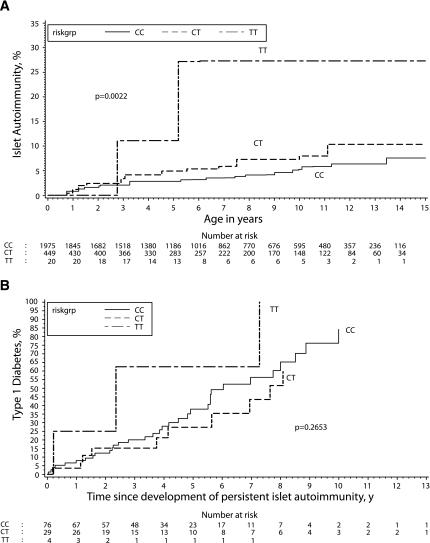
PTPN22(R620W) allele T was associated with development of persistent islet autoimmunity (hazard ratio 1.83 [95% CI 1.27-2.63]) controlling for ethnicity, presence of HLA-DR3/4,DQB1*0302, and having a first-degree relative with type 1 diabetes. Survival analyses showed a significantly (P = 0.002) higher risk of persistent islet autoimmunity by age 10 years for the TT genotype (27.3%) than for the CT or CC genotype (7.9 and 5.3%, respectively). Cumulative risk of persistent islet autoimmunity was slightly higher (P = 0.02) for the INS(-23Hph1) AA genotype (7.8%) than for the AT or TT genotype (4.2 and 6.4% risk by age 10 years, respectively).
CONCLUSIONS
Whereas the HLA-DR3/4,DQB1*0302 genotype had a dramatic influence on both development of islet autoimmunity and progression to type 1 diabetes, the PTPN22(R620W) T allele significantly influences progression to persistent islet autoimmunity in the DAISY cohort.
目的
非HLA基因INS、CTLA - 4和PTPN22的特定等位基因与1型糖尿病相关。我们研究了这些等位基因中的一些是否会影响高危HLA - DR、DQ基因型儿童的胰岛自身免疫发展或从持续性胰岛自身免疫发展为1型糖尿病。
研究设计与方法
自1993年以来,青少年糖尿病自身免疫研究(DAISY)对2449名携带与1型糖尿病相关的HLA - DR、DQ基因型的幼儿进行了随访。其中,112人出现了胰岛自身免疫(对胰岛素、GAD65和/或IA - 2的持续性自身抗体),其中47人进展为1型糖尿病。通过参数模型和生存分析评估了INS(-23Hph1)、CTLA - 4(T17A)和PTPN22(R620W)多态性对持续性胰岛自身免疫发展和进展为1型糖尿病的影响。
结果
在控制种族、HLA - DR3/4、DQB1*0302的存在以及有1型糖尿病一级亲属的情况下,PTPN22(R620W)等位基因T与持续性胰岛自身免疫的发展相关(风险比1.83 [95% CI 1.27 - 2.63])。生存分析显示,TT基因型在10岁时出现持续性胰岛自身免疫的风险(27.3%)显著高于CT或CC基因型(分别为7.9%和5.3%,P = 0.002)。INS(-23Hph1)AA基因型出现持续性胰岛自身免疫的累积风险(7.8%)略高于AT或TT基因型(10岁时风险分别为4.2%和6.4%,P = 0.02)。
结论
虽然HLA - DR3/4、DQB1*0302基因型对胰岛自身免疫发展和进展为1型糖尿病都有显著影响,但在DAISY队列中,PTPN22(R620W)T等位基因对进展为持续性胰岛自身免疫有显著影响。

 Zotero 插件