
雷尼司他用于治疗糖尿病性感觉运动性多发性神经病变
Ranirestat for the management of diabetic sensorimotor polyneuropathy.
作者信息
Bril Vera, Hirose Toshiyuki, Tomioka Sasagu, Buchanan Robert
机构信息
University Health Network, University of Toronto, Toronto, Ontario, Canada.
出版信息
Diabetes Care. 2009 Jul;32(7):1256-60. doi: 10.2337/dc08-2110. Epub 2009 Apr 14.
OBJECTIVE
Aldose reductase inhibitors (ARIs) are potential disease modifiers for diabetes complications. We aimed to determine whether ranirestat, an ARI, could slow or reverse the course of diabetic sensorimotor polyneuropathy (DSP).
RESEARCH DESIGN AND METHODS
A total of 549 patients with DSP were randomly assigned to treatment with placebo or 10, 20, or 40 mg/day ranirestat for 52 weeks in this multicenter, double-blind study. Efficacy was evaluated by nerve conduction studies, the modified Toronto Clinical Neuropathy Score (mTCNS), and quantitative sensory tests (QSTs).
RESULTS
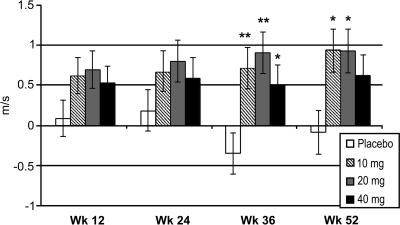
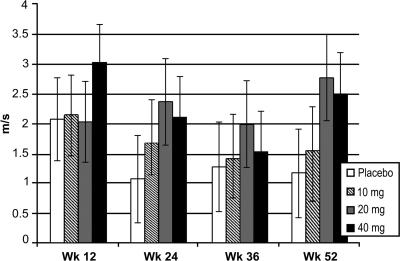
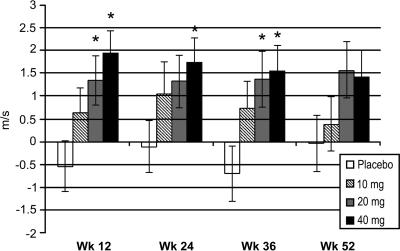
At week 52, the summed sensory (bilateral sural plus proximal median sensory) nerve conduction velocity (NCV) did not show significant changes from baseline (2.0 m/s for placebo compared with 3.2-3.8 m/s for ranirestat). Significant improvement in the summed motor (peroneal, tibial, and median) NCV was observed with 20 and 40 mg/day ranirestat treatment at week 12 (P <or= 0.05) and at weeks 24 and 36 and in peroneal motor NCV at weeks 36 and 52 (P <or= 0.05) for the 20 mg/day ranirestat group. The mTCNS and QST results did not differ among the groups during the study. Ranirestat was well tolerated with no pertinent differences in drug-related adverse events or in effects on clinical laboratory parameters, vital signs, or electrocardiograms among the four groups.
CONCLUSIONS
Treatment with ranirestat appears to have an effect on motor nerve function in mild to moderate DSP, but the results of this study failed to show a statistically significant difference in sensory nerve function relative to placebo.
目的
醛糖还原酶抑制剂(ARIs)是糖尿病并发症潜在的疾病改善药物。我们旨在确定ARI类药物雷尼司他是否能延缓或逆转糖尿病感觉运动性多发性神经病变(DSP)的病程。
研究设计与方法
在这项多中心、双盲研究中,共549例DSP患者被随机分配接受安慰剂或每日10、20或40毫克雷尼司他治疗,为期52周。通过神经传导研究、改良的多伦多临床神经病变评分(mTCNS)和定量感觉测试(QST)评估疗效。
结果
在第52周时,总的感觉(双侧腓肠神经加近端正中感觉神经)神经传导速度(NCV)与基线相比无显著变化(安慰剂组为2.0米/秒,雷尼司他组为3.2 - 3.8米/秒)。在第12周,每日20毫克和40毫克雷尼司他治疗组的总的运动(腓总神经、胫神经和正中神经)NCV有显著改善(P≤0.05),在第24周和36周时也是如此;对于每日20毫克雷尼司他组,在第36周和52周时腓总运动神经NCV也有显著改善(P≤0.05)。在研究期间,各组间mTCNS和QST结果无差异。雷尼司他耐受性良好,四组在药物相关不良事件或对临床实验室参数、生命体征或心电图的影响方面无显著差异。
结论
雷尼司他治疗似乎对轻至中度DSP的运动神经功能有影响,但本研究结果未能显示相对于安慰剂,感觉神经功能有统计学上的显著差异。
 Zotero 插件