
自然杀伤细胞裂解受体(NKLR)/NKLR配体匹配作为增强同种异体自然杀伤细胞抗肿瘤活性的新方法。
Natural killer lysis receptor (NKLR)/NKLR-ligand matching as a novel approach for enhancing anti-tumor activity of allogeneic NK cells.
作者信息
Markel Gal, Seidman Rachel, Besser Michal J, Zabari Naama, Ortenberg Rona, Shapira Ronnie, Treves Avraham J, Loewenthal Ron, Orenstein Arie, Nagler Arnon, Schachter Jacob
机构信息
Ella Institute of Melanoma, Cancer Research Center, Sheba Medical Center, Ramat Gan, Israel.
出版信息
PLoS One. 2009;4(5):e5597. doi: 10.1371/journal.pone.0005597. Epub 2009 May 19.
BACKGROUND
NK cells are key players in anti tumor immune response, which can be employed in cell-based therapeutic modalities. One of the suggested ways to amplify their anti tumor effect, especially in the field of stem cell transplantation, is by selecting donor/recipient mismatches in specific HLA, to reduce the inhibitory effect of killer Ig-like receptors (KIRs). Here we suggest an alternative approach for augmentation of anti tumor effect of allogeneic NK cells, which is founded on profile matching of donor NK lysis receptors (NKLR) phenotype with tumor lysis-ligands.
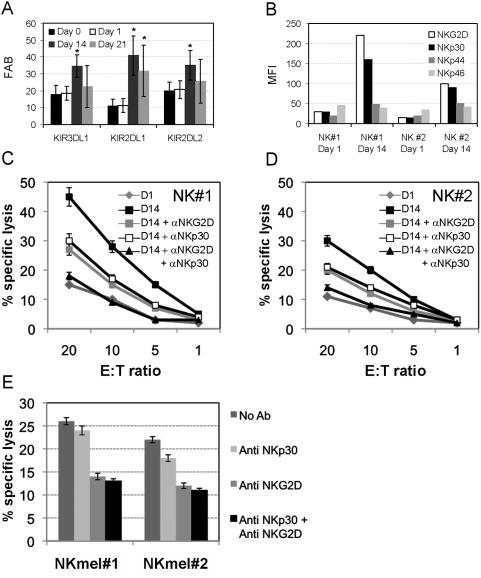
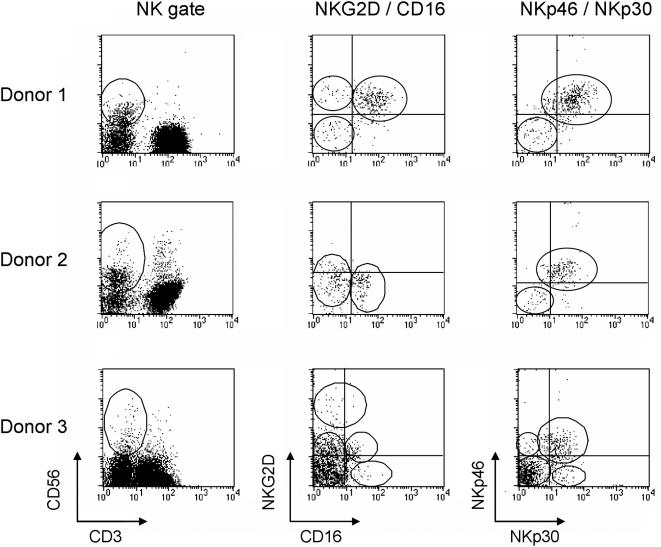
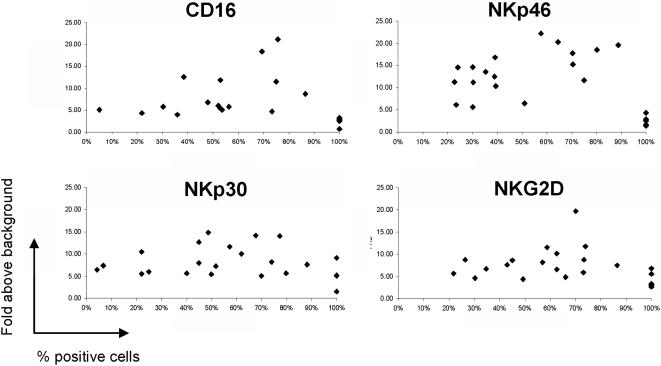
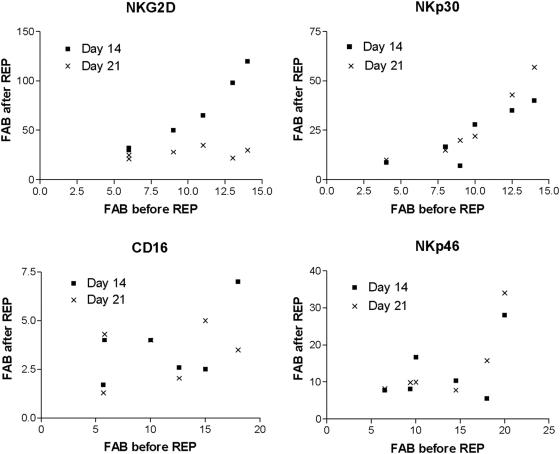
METHODOLOGY/PRINCIPAL FINDINGS: We show that an NKLR-mediated killing directly correlates with the NKLR expression intensity on NK cells. Considerable donor variability in the expression of CD16, NKp46, NKG2D and NKp30 on circulating NK cells, combined with the stability of phenotype in several independently performed tests over two months, indicates that NKLR-guided selection of donors is feasible. As a proof of concept, we show that melanoma cells are dominantly recognized by three NKLRs: NKG2D, NKp30 and NKp44. Notably, the expression of NKp30 on circulating NK cells among metastatic melanoma patients was significantly decreased, which diminishes their ability to kill melanoma cells. Ex vivo expansion of NK cells results not only in increased amount of cells but also in a consistently superior and predictable expression of NKG2D, NKp30 and NKp44. Moreover, expanded NK cultures with high expression of NKG2D or NKp30 were mostly derived from the corresponding NKG2D(high) or NK30(high) donors. These NK cultures subsequently displayed an improved cytotoxic activity against melanoma in a HLA/KIR-ligand mismatched setup, which was NKLR-dependent, as demonstrated with blocking anti-NKG2D antibodies.
CONCLUSIONS/SIGNIFICANCE: NKLR/NKLR-ligand matching reproducibly elicits enhanced NK anti-tumor response. Common NKLR recognition patterns of tumors, as demonstrated here in melanoma, would allow implementation of this approach in solid malignancies and potentially in hematological malignancies, either independently or in adjunction to other modalities.
背景
自然杀伤(NK)细胞是抗肿瘤免疫反应的关键参与者,可用于基于细胞的治疗方式。增强其抗肿瘤作用的一种建议方法,尤其是在干细胞移植领域,是通过选择特定人类白细胞抗原(HLA)中的供体/受体错配,以降低杀伤细胞免疫球蛋白样受体(KIR)的抑制作用。在此,我们提出一种增强同种异体NK细胞抗肿瘤作用的替代方法,该方法基于供体NK裂解受体(NKLR)表型与肿瘤裂解配体的谱匹配。
方法/主要发现:我们表明,NKLR介导的杀伤与NK细胞上NKLR的表达强度直接相关。循环NK细胞上CD16、NKp46、NKG2D和NKp30表达的供体差异相当大,再加上在两个月内多次独立进行的测试中表型的稳定性,表明基于NKLR的供体选择是可行的。作为概念验证,我们表明黑色素瘤细胞主要被三种NKLR识别:NKG2D、NKp30和NKp44。值得注意的是,转移性黑色素瘤患者循环NK细胞上NKp30的表达显著降低,这削弱了它们杀伤黑色素瘤细胞的能力。NK细胞的体外扩增不仅导致细胞数量增加,而且导致NKG2D、NKp30和NKp44的表达始终更高且可预测。此外,NKG2D或NKp30高表达的扩增NK培养物大多源自相应的NKG2D(高)或NK30(高)供体。这些NK培养物随后在HLA/KIR配体错配的设置中对黑色素瘤显示出增强的细胞毒性活性,这是NKLR依赖性 的,如用抗NKG2D阻断抗体所证明的。
结论/意义:NKLR/NKLR配体匹配可重复性地引发增强的NK抗肿瘤反应。如在黑色素瘤中所示,肿瘤常见的NKLR识别模式将允许在实体恶性肿瘤中独立或与其他方式联合实施这种方法,并且可能在血液系统恶性肿瘤中实施。



 Zotero 插件