
人神经母细胞瘤细胞中MYCN表达的调控
Regulation of MYCN expression in human neuroblastoma cells.
作者信息
Jacobs Joannes F M, van Bokhoven Hans, van Leeuwen Frank N, Hulsbergen-van de Kaa Christina A, de Vries I Jolanda M, Adema Gosse J, Hoogerbrugge Peter M, de Brouwer Arjan P M
机构信息
Department of Human Genetics, Radboud University Nijmegen Medical Centre, Nijmegen Centre for Molecular Life Sciences, Donders Institute for Brain, Cognition and Behaviour, P.O. Box 9101, 6500 HB Nijmegen, the Netherlands.
出版信息
BMC Cancer. 2009 Jul 18;9:239. doi: 10.1186/1471-2407-9-239.
BACKGROUND
Amplification of the MYCN gene in neuroblastoma (NB) is associated with a poor prognosis. However, MYCN-amplification does not automatically result in higher expression of MYCN in children with NB. We hypothesized that the discrepancy between MYCN gene expression and prognosis in these children might be explained by the expression of either MYCN-opposite strand (MYCNOS) or the shortened MYCN-isoform (DeltaMYCN) that was recently identified in fetal tissues. Both MYCNOS and DeltaMYCN are potential inhibitors of MYCN either at the mRNA or at the protein level.
METHODS
Expression of MYCN, MYCNOS and DeltaMYCN was measured in human NB tissues of different stages. Transcript levels were quantified using a real-time reverse transcriptase polymerase chain reaction assay (QPCR). In addition, relative expression of these three transcripts was compared to the number of MYCN copies, which was determined by genomic real-time PCR (gQPCR).
RESULTS
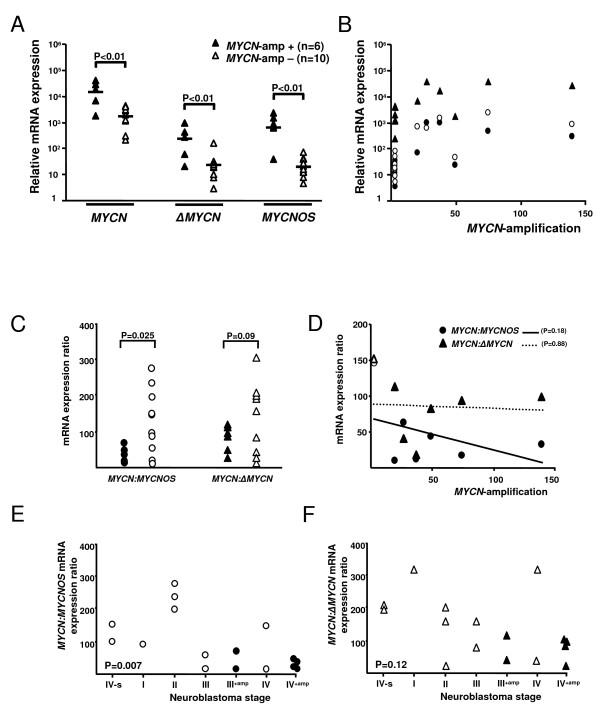
Both DeltaMYCN and MYCNOS are expressed in all NBs examined. In NBs with MYCN-amplification, these transcripts are significantly higher expressed. The ratio of MYCN:DeltaMYCN expression was identical in all tested NBs. This indicates that DeltaMYCN and MYCN are co-regulated, which suggests that DeltaMYCN is not a regulator of MYCN in NB. However, the ratio of MYCNOS:MYCN expression is directly correlated with NB disease stage (p = 0.007). In the more advanced NB stages and NBs with MYCN-amplification, relatively more MYCNOS is present as compared to MYCN. Expression of the antisense gene MYCNOS might be relevant to the progression of NB, potentially by directly inhibiting MYCN transcription by transcriptional interference at the DNA level.
CONCLUSION
The MYCNOS:MYCN-ratio in NBs is significantly correlated with both MYCN-amplification and NB-stage. Our data indicate that in NB, MYCN expression levels might be influenced by MYCNOS but not by DeltaMYCN.
背景
神经母细胞瘤(NB)中MYCN基因的扩增与预后不良相关。然而,在NB患儿中,MYCN扩增并不一定会导致MYCN表达升高。我们推测,这些患儿中MYCN基因表达与预后之间的差异可能是由最近在胎儿组织中发现的MYCN反义链(MYCNOS)或缩短的MYCN异构体(DeltaMYCN)的表达所解释。MYCNOS和DeltaMYCN在mRNA或蛋白质水平上均可能是MYCN的潜在抑制剂。
方法
检测不同阶段人NB组织中MYCN、MYCNOS和DeltaMYCN的表达。使用实时逆转录聚合酶链反应测定法(QPCR)对转录水平进行定量。此外,将这三种转录本的相对表达与通过基因组实时PCR(gQPCR)确定的MYCN拷贝数进行比较。
结果
DeltaMYCN和MYCNOS在所有检测的NB中均有表达。在MYCN扩增的NB中,这些转录本的表达明显更高。在所有测试的NB中,MYCN:DeltaMYCN表达的比例是相同的。这表明DeltaMYCN和MYCN是共同调控的,这表明DeltaMYCN不是NB中MYCN的调节因子。然而,MYCNOS:MYCN表达的比例与NB疾病分期直接相关(p = 0.007)。在更晚期的NB阶段和MYCN扩增的NB中,与MYCN相比,MYCNOS的含量相对更多。反义基因MYCNOS的表达可能与NB的进展相关,可能是通过在DNA水平上的转录干扰直接抑制MYCN转录。
结论
NB中的MYCNOS:MYCN比例与MYCN扩增和NB分期均显著相关。我们的数据表明,在NB中,MYCN的表达水平可能受MYCNOS影响,但不受DeltaMYCN影响。

 Zotero 插件