
从药用植物莪术(Curcuma comosa)中分离出的二芳基庚烷类植物雌激素:体内外生物学作用表明其作用机制依赖雌激素受体。
Diarylheptanoid phytoestrogens isolated from the medicinal plant Curcuma comosa: biologic actions in vitro and in vivo indicate estrogen receptor-dependent mechanisms.
作者信息
Winuthayanon Wipawee, Piyachaturawat Pawinee, Suksamrarn Apichart, Ponglikitmongkol Mathurose, Arao Yukitomo, Hewitt Sylvia C, Korach Kenneth S
机构信息
Department of Physiology, Faculty of Science, Mahidol University, Bangkok, Thailand.
出版信息
Environ Health Perspect. 2009 Jul;117(7):1155-61. doi: 10.1289/ehp.0900613. Epub 2009 Mar 23.
BACKGROUND
Diarylheptanoids isolated from Curcuma comosa Roxb. have been recently identified as phyto estrogens. However, the mechanism underlying their actions has not yet been identified.
OBJECTIVES
We characterized the estrogenic activity of three active naturally occurring diarylheptanoids both in vitro and in vivo.
METHODS
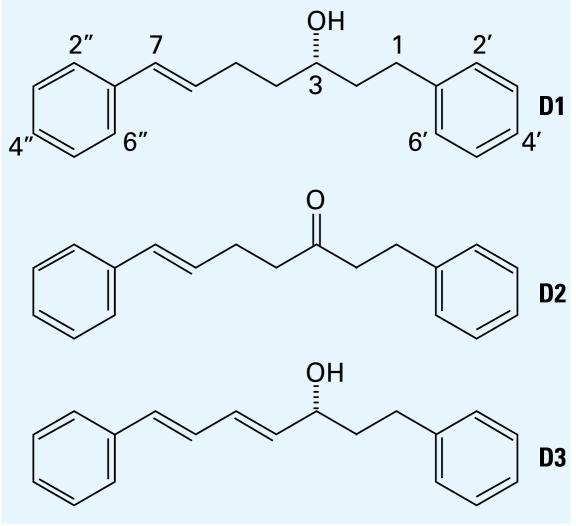
We characterized mechanisms of estrogenic action of the diarylheptanoids (3S)-1,7-diphenyl-(6E)-6-hepten-3-ol (D1), 1,7-diphenyl-(6E)-6-hepten-3-one (D2), and (3R)-1,7-diphenyl-(4E,6E)-4,6-heptadien-3-ol (D3) by using a real-time polymerase chain reaction assay, a mammalian transfection model, and a uterotrophic assay in mice.
RESULTS
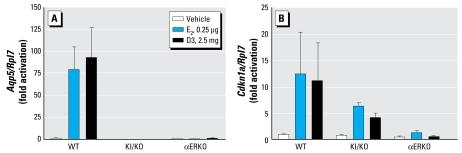
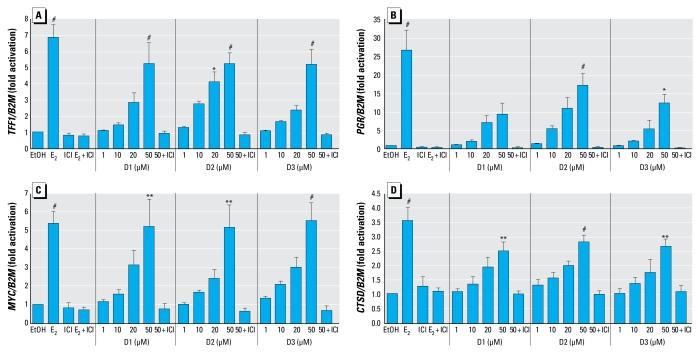
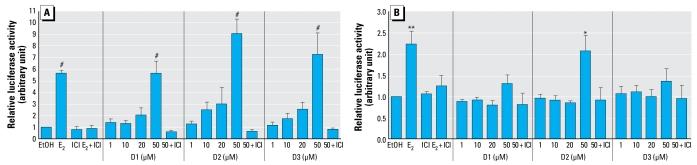
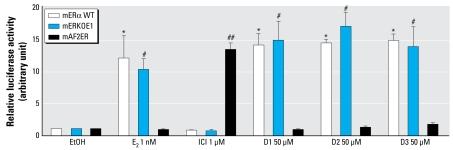
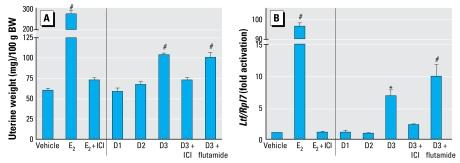
All diarylheptanoids up-regulated estrogen-responsive genes in estrogen-responsive breast cancer cells (MCF-7). In HepG2 cells transfected with estrogen receptor (ER) beta or different ERalpha functional receptor mutants and the Vit-ERE-TATA-Luc reporter gene, all diarylheptanoids induced transcription through a ligand-dependent human ERalpha-ERE-driven pathway, which was abolished with ICI 182,780 (ER antagonist), whereas only D2 was active with ERbeta. An ERalpha mutant lacking the functional AF2 (activation function 2) region was not responsive to 17beta-estradiol (E(2)) or to any of the diarylheptanoids, whereas ERalpha lacking the AF1 domain exhibited wild-type-like activity. D3 markedly increased uterine weight and proliferation of the uterine epithelium in ovariectomized mice, whereas D1 and D2 were inactive. D3, like E(2), up-regulated lactoferrin (Ltf) gene expression. The responses to D3 in the uterus were inhibited by ICI 182,780. In addition, D3 stimulated both classical (Aqp5) and nonclassical (Cdkn1a) ER-mediated gene regulation.
CONCLUSIONS
The results suggest that the D3 diarylheptanoid is an agonist for ER both in vitro and in vivo, and its biological action is ERalpha selective, specifically requiring AF2 function, and involves direct binding via ER as well as ERE-independent gene regulation.
背景
从莪术(Curcuma comosa Roxb.)中分离出的二芳基庚烷类化合物最近被鉴定为植物雌激素。然而,其作用机制尚未明确。
目的
我们在体外和体内对三种具有活性的天然二芳基庚烷类化合物的雌激素活性进行了表征。
方法
我们通过实时聚合酶链反应分析、哺乳动物转染模型以及小鼠子宫增重试验,对二芳基庚烷类化合物(3S)-1,7-二苯基-(6E)-6-庚烯-3-醇(D1)、1,7-二苯基-(6E)-6-庚烯-3-酮(D2)和(3R)-1,7-二苯基-(4E,6E)-4,6-庚二烯-3-醇(D3)的雌激素作用机制进行了表征。
结果
所有二芳基庚烷类化合物均上调雌激素反应性乳腺癌细胞(MCF-7)中雌激素反应性基因的表达。在用雌激素受体(ER)β或不同的ERα功能受体突变体以及Vit-ERE-TATA-Luc报告基因转染的HepG2细胞中,所有二芳基庚烷类化合物均通过配体依赖性人ERα-ERE驱动途径诱导转录,ICI 182,780(ER拮抗剂)可消除这种转录,而只有D2对ERβ有活性。缺乏功能性AF2(激活功能2)区域的ERα突变体对17β-雌二醇(E₂)或任何二芳基庚烷类化合物均无反应,而缺乏AF1结构域的ERα表现出野生型样活性。D3显著增加去卵巢小鼠的子宫重量和子宫上皮细胞增殖,而D1和D2无此活性。D3与E₂一样,上调乳铁蛋白(Ltf)基因表达。子宫对D3的反应受到ICI 182,780的抑制。此外,D3刺激经典(Aqp5)和非经典(Cdkn1a)ER介导的基因调控。
结论
结果表明,二芳基庚烷类化合物D3在体外和体内均为ER激动剂,其生物学作用具有ERα选择性,特别需要AF2功能,并且涉及通过ER的直接结合以及不依赖ERE的基因调控。

 Zotero 插件