
俄罗斯采用液体培养和分子方法快速诊断结核病和耐多药结核病的综合方法。
An integrated approach to rapid diagnosis of tuberculosis and multidrug resistance using liquid culture and molecular methods in Russia.
机构信息
National Mycobacterium Reference Laboratory, Institute of Cell and Molecular Sciences, Queen Mary College, Barts and the London School of Medicine, University of London, London, United Kingdom.
出版信息
PLoS One. 2009 Sep 23;4(9):e7129. doi: 10.1371/journal.pone.0007129.
OBJECTIVE
To analyse the feasibility, cost and performance of rapid tuberculosis (TB) molecular and culture systems, in a high multidrug-resistant TB (MDR TB) middle-income region (Samara, Russia) and provide evidence for WHO policy change.
METHODS
Performance and cost evaluation was conducted to compare the BACTEC MGIT 960 system for culture and drug susceptibility testing (DST) and molecular systems for TB diagnosis, resistance to isoniazid and rifampin, and MDR TB identification compared to conventional Lowenstein-Jensen culture assays.
FINDINGS
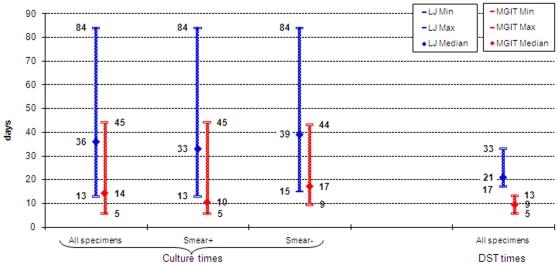
698 consecutive patients (2487 sputum samples) with risk factors for drug-resistant tuberculosis were recruited. Overall M. tuberculosis complex culture positivity rates were 31.6% (787/2487) in MGIT and 27.1% (675/2487) in LJ (90.5% and 83.2% for smear-positive specimens). In total, 809 cultures of M. tuberculosis complex were isolated by any method. Median time to detection was 14 days for MGIT and 36 days for LJ (10 and 33 days for smear positive specimens) and indirect DST in MGIT took 9 days compared to 21 days on LJ. There was good concordance between DST on LJ and MGIT (96.8% for rifampin and 95.6% for isoniazid). Both molecular hybridization assay results correlated well with MGIT DST results, although molecular assays generally yielded higher rates of resistance (by approximately 3% for both isoniazid and rifampin).
CONCLUSION
With effective planning and logistics, the MGIT 960 and molecular based methodologies can be successfully introduced into a reference laboratory setting in a middle incidence country. High rates of MDR TB in the Russian Federation make the introduction of such assays particularly useful.
目的
分析快速结核分枝杆菌(TB)分子和培养系统在高耐多药结核(MDR-TB)中低收入地区(俄罗斯萨马拉)的可行性、成本和性能,并为世界卫生组织的政策改变提供证据。
方法
对 BACTEC MGIT 960 系统进行培养和药敏试验(DST)以及用于 TB 诊断、异烟肼和利福平耐药性以及 MDR-TB 鉴定的分子系统进行了性能和成本评估,与传统的 Lowenstein-Jensen 培养检测方法进行了比较。
结果
共纳入 698 例(2487 份痰标本)有耐药结核危险因素的连续患者。MGIT 和 LJ 的 MTBC 总体培养阳性率分别为 31.6%(787/2487)和 27.1%(675/2487)(涂片阳性标本分别为 90.5%和 83.2%)。总共通过任何方法分离出 809 株 MTBC。MGIT 的中位检测时间为 14 天,LJ 为 36 天(涂片阳性标本为 10 天和 33 天),MGIT 间接 DST 耗时 9 天,LJ 耗时 21 天。LJ 和 MGIT 的 DST 之间具有良好的一致性(利福平为 96.8%,异烟肼为 95.6%)。两种分子杂交检测结果与 MGIT DST 结果相关性良好,尽管分子检测通常会产生更高的耐药率(异烟肼和利福平各约 3%)。
结论
通过有效的规划和物流,MGIT 960 和基于分子的方法可以成功引入中发病率国家的参考实验室设置。俄罗斯联邦的 MDR-TB 发病率较高,因此引入此类检测方法尤其有用。

 Zotero 插件