
盐摄入量、中风与心血管疾病:前瞻性研究的荟萃分析
Salt intake, stroke, and cardiovascular disease: meta-analysis of prospective studies.
作者信息
Strazzullo Pasquale, D'Elia Lanfranco, Kandala Ngianga-Bakwin, Cappuccio Francesco P
机构信息
Department of Clinical and Experimental Medicine, Federico II University of Naples Medical School, Naples, Italy.
出版信息
BMJ. 2009 Nov 24;339:b4567. doi: 10.1136/bmj.b4567.
OBJECTIVE
To assess the relation between the level of habitual salt intake and stroke or total cardiovascular disease outcome.
DESIGN
Systematic review and meta-analysis of prospective studies published 1966-2008.
DATA SOURCES
Medline (1966-2008), Embase (from 1988), AMED (from 1985), CINAHL (from 1982), Psychinfo (from 1985), and the Cochrane Library. Review methods For each study, relative risks and 95% confidence intervals were extracted and pooled with a random effect model, weighting for the inverse of the variance. Heterogeneity, publication bias, subgroup, and meta-regression analyses were performed. Criteria for inclusion were prospective adult population study, assessment of salt intake as baseline exposure, assessment of either stroke or total cardiovascular disease as outcome, follow-up of at least three years, indication of number of participants exposed and number of events across different salt intake categories.
RESULTS
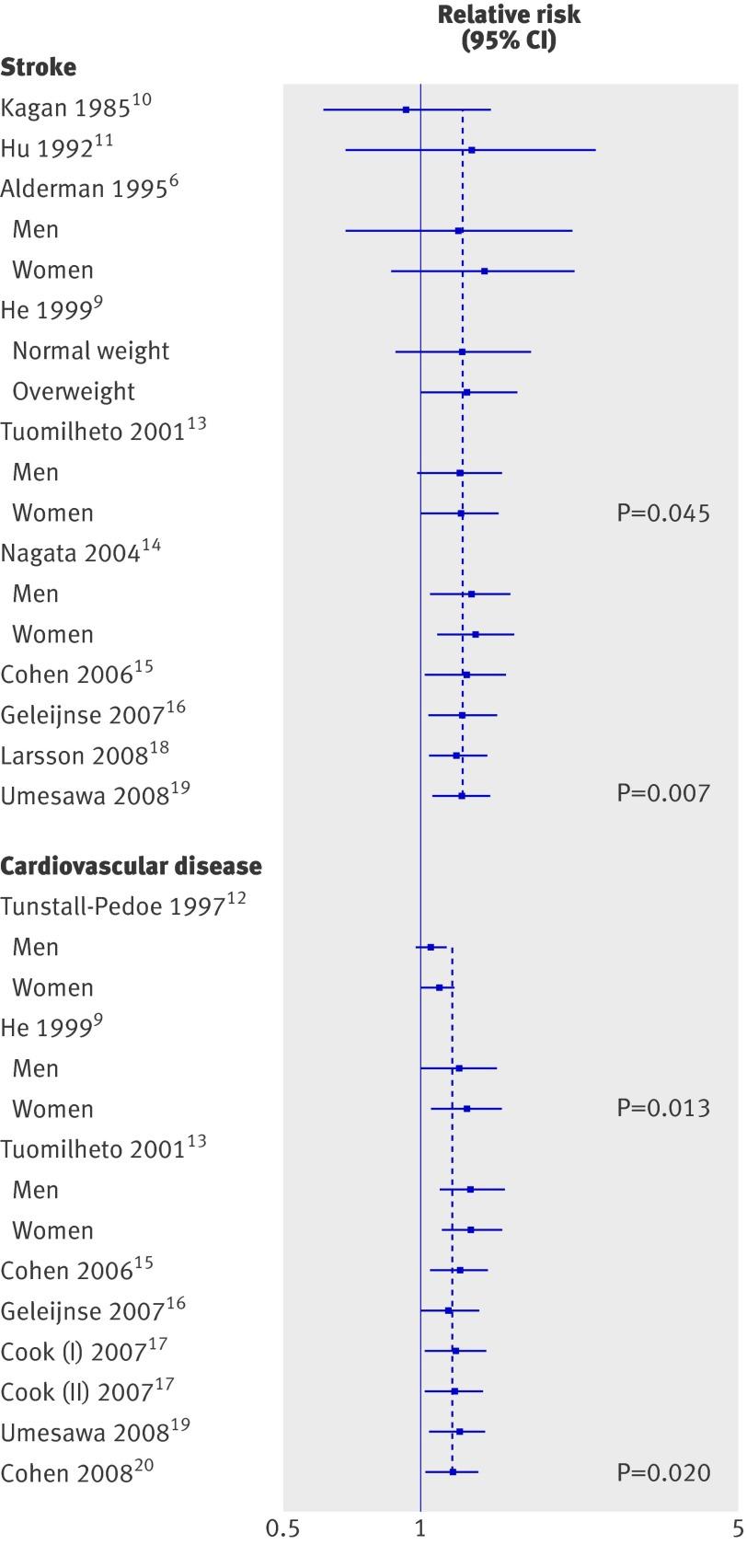
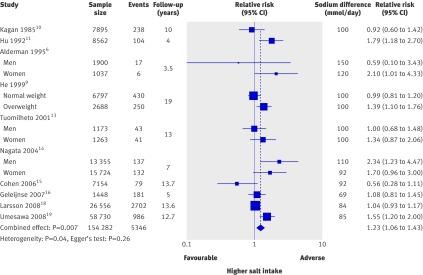
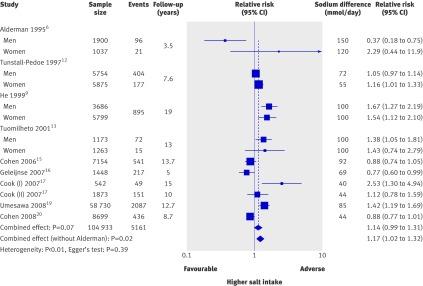
There were 19 independent cohort samples from 13 studies, with 177 025 participants (follow-up 3.5-19 years) and over 11 000 vascular events. Higher salt intake was associated with greater risk of stroke (pooled relative risk 1.23, 95% confidence interval 1.06 to 1.43; P=0.007) and cardiovascular disease (1.14, 0.99 to 1.32; P=0.07), with no significant evidence of publication bias. For cardiovascular disease, sensitivity analysis showed that the exclusion of a single study led to a pooled estimate of 1.17 (1.02 to 1.34; P=0.02). The associations observed were greater the larger the difference in sodium intake and the longer the follow-up.
CONCLUSIONS
High salt intake is associated with significantly increased risk of stroke and total cardiovascular disease. Because of imprecision in measurement of salt intake, these effect sizes are likely to be underestimated. These results support the role of a substantial population reduction in salt intake for the prevention of cardiovascular disease.
目的
评估习惯性盐摄入量水平与中风或总体心血管疾病结局之间的关系。
设计
对1966年至2008年发表的前瞻性研究进行系统评价和荟萃分析。
数据来源
医学文献数据库(1966年至2008年)、荷兰医学文摘数据库(自1988年起)、联合和补充医学数据库(自1985年起)、护理学与健康领域数据库(自1982年起)、心理学文摘数据库(自1985年起)以及考克兰图书馆。综述方法:对于每项研究,提取相对风险和95%置信区间,并采用随机效应模型进行汇总,以方差的倒数作为权重。进行了异质性、发表偏倚、亚组分析和Meta回归分析。纳入标准为前瞻性成人人群研究、将盐摄入量作为基线暴露因素进行评估、将中风或总体心血管疾病作为结局进行评估、至少随访三年、表明不同盐摄入量类别下的暴露参与者数量和事件数量。
结果
来自13项研究的19个独立队列样本,共177025名参与者(随访3.5至19年)以及超过11000例血管事件。较高的盐摄入量与中风风险增加相关(汇总相对风险1.23,95%置信区间1.06至1.43;P=0.007)以及心血管疾病风险增加相关(1.14,0.99至1.32;P=0.07),无明显的发表偏倚证据。对于心血管疾病,敏感性分析表明排除一项研究后汇总估计值为1.17(1.02至1.34;P=0.02)。观察到的关联在钠摄入量差异越大和随访时间越长时越明显。
结论
高盐摄入量与中风和总体心血管疾病风险显著增加相关。由于盐摄入量测量存在不精确性,这些效应大小可能被低估。这些结果支持大幅降低人群盐摄入量对预防心血管疾病的作用。
 Zotero 插件