
TP53 R72P 单核苷酸多态性与 MDM2 SNP309 联合作用及 p53 表达对乳腺癌患者生存的影响。
Combined effects of single nucleotide polymorphisms TP53 R72P and MDM2 SNP309, and p53 expression on survival of breast cancer patients.
机构信息
Departments of Epidemiology, Experimental Therapy and Pathology, Netherlands Cancer Institute, The Netherlands.
出版信息
Breast Cancer Res. 2009;11(6):R89. doi: 10.1186/bcr2460. Epub 2009 Dec 18.
INTRODUCTION
Somatic inactivation of the TP53 gene in breast tumors is a marker for poor outcome, and breast cancer outcome might also be affected by germ-line variation in the TP53 gene or its regulators. We investigated the effects of the germ-line single nucleotide polymorphisms TP53 R72P (215G>C) and MDM2 SNP309 (-410T>G), and p53 protein expression in breast tumors on survival.
METHODS
We pooled data from four breast cancer cohorts within the Breast Cancer Association Consortium for which both TP53 R72P and MDM2 SNP309 were genotyped and follow-up was available (n = 3,749). Overall and breast cancer-specific survival analyses were performed using Kaplan-Meier analysis and multivariate Cox's proportional hazards regression models.
RESULTS
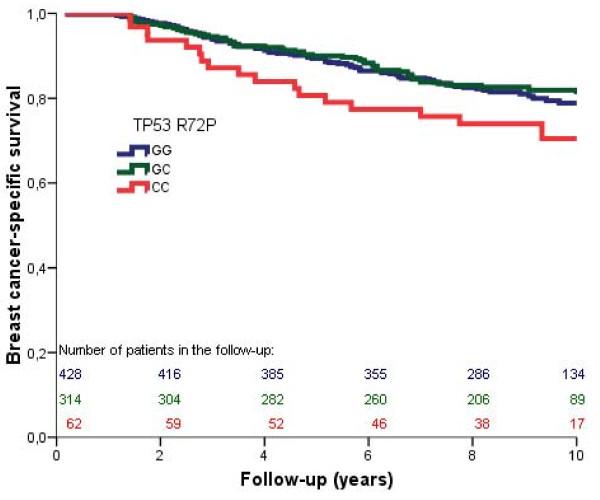
Survival of patients did not differ by carriership of either germ-line variant, R72P (215G>C) or SNP309 (-410G>T) alone. Immunohistochemical p53 staining of the tumor was available for two cohorts (n = 1,109 patients). Survival was worse in patients with p53-positive tumors (n = 301) compared to patients with p53-negative tumors (n = 808); breast cancer-specific survival: HR 1.6 (95% CI 1.2 to 2.1), P = 0.001. Within the patient group with p53-negative tumors, TP53 rare homozygous (CC) carriers had a worse survival than G-allele (GG/GC) carriers; actuarial breast cancer-specific survival 71% versus 80%, P = 0.07; HR 1.8 (1.1 to 3.1), P = 0.03. We also found a differential effect of combinations of the two germ-line variants on overall survival; homozygous carriers of the G-allele in MDM2 had worse survival only within the group of TP53 C-allele carriers; actuarial overall survival (GG versus TT/TG) 64% versus 75%, P = 0.001; HR (GG versus TT) 1.5 (1.1 to 2.0), P = 0.01. We found no evidence for a differential effect of MDM2 SNP309 by p53 protein expression on survival.
CONCLUSIONS
The TP53 R72P variant may be an independent predictor for survival of patients with p53-negative tumors. The combined effect of TP53 R72P and MDM2 SNP309 on survival is in line with our a priori biologically-supported hypothesis, that is, the role of enhanced DNA repair function of the TP53 Pro-variant, combined with increased expression of the Mdm2 protein, and thus overall attenuation of the p53 pathway in the tumor cells.
简介
乳腺癌肿瘤中 TP53 基因的体细胞失活是预后不良的标志物,乳腺癌的预后也可能受到 TP53 基因或其调节因子的种系变异的影响。我们研究了种系单核苷酸多态性 TP53 R72P(215G>C)和 MDM2 SNP309(-410T>G)以及乳腺癌肿瘤中 p53 蛋白表达对生存的影响。
方法
我们汇集了乳腺癌协会联盟内四个乳腺癌队列的数据,这些队列均对 TP53 R72P 和 MDM2 SNP309 进行了基因分型,并可获得随访结果(n=3749)。使用 Kaplan-Meier 分析和多变量 Cox 比例风险回归模型进行总生存和乳腺癌特异性生存分析。
结果
单独携带种系变异体 R72P(215G>C)或 SNP309(-410G>T)的患者生存情况无差异。两个队列(n=1109 例患者)可进行肿瘤 p53 免疫组化染色。与 p53 阴性肿瘤患者(n=808)相比,p53 阳性肿瘤患者(n=301)的生存情况较差;乳腺癌特异性生存:HR 1.6(95%CI 1.2 至 2.1),P=0.001。在 p53 阴性肿瘤患者组中,TP53 罕见纯合子(CC)携带者的生存情况较 G 等位基因(GG/GC)携带者差;实际乳腺癌特异性生存 71%对 80%,P=0.07;HR 1.8(1.1 至 3.1),P=0.03。我们还发现,两种种系变异体的组合对总生存有不同的影响;MDM2 中 G 等位基因的纯合子携带者仅在 TP53 C 等位基因携带者的组中生存情况较差;实际总生存(GG 对 TT/TG)64%对 75%,P=0.001;HR(GG 对 TT)1.5(1.1 至 2.0),P=0.01。我们没有发现 MDM2 SNP309 对生存的影响因 p53 蛋白表达而存在差异的证据。
结论
TP53 R72P 变体可能是 p53 阴性肿瘤患者生存的独立预测因子。TP53 R72P 和 MDM2 SNP309 联合对生存的影响符合我们先验的生物学支持假设,即 TP53 Pro 变体增强的 DNA 修复功能,与 Mdm2 蛋白表达增加相结合,从而减弱肿瘤细胞中 p53 通路的整体作用。

 Zotero 插件