
塔利班政权下的疟疾控制:阿富汗东部男女使用杀虫剂处理过的蚊帐的购买、覆盖和使用情况。
Malaria control under the Taliban regime: insecticide-treated net purchasing, coverage, and usage among men and women in eastern Afghanistan.
机构信息
London School of Hygiene and Tropical Medicine, London, UK.
出版信息
Malar J. 2010 Jan 6;9:7. doi: 10.1186/1475-2875-9-7.
BACKGROUND
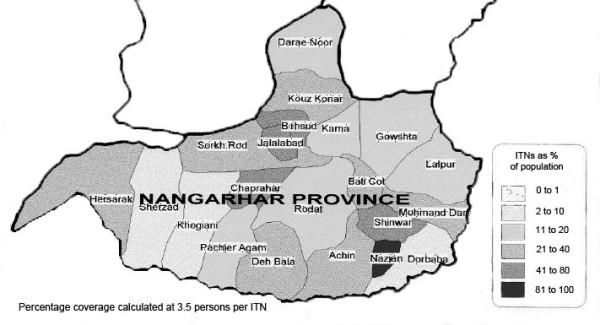
Scaling up insecticide-treated mosquito net (ITN) coverage is a key malaria control strategy even in conflict-affected countries 12. Socio-economic factors influence access to ITNs whether subsidized or provided free to users. This study examines reported ITN purchasing, coverage, and usage in eastern Afghanistan and explores women's access to health information during the Taliban regime (1996-2001). This strengthens the knowledge base on household-level health choices in complex-emergency settings.
METHODS
Fifteen focus group discussions (FGDs) and thirty in-depth interviews were conducted with men and women from ITN-owning and non-owning households. FGDs included rank ordering, pile sorting and focused discussion of malaria knowledge and ITN purchasing. Interviews explored general health issues, prevention and treatment practices, and women's malaria knowledge and concerns. Seven key informant interviews with health-related workers and a concurrent survey of 200 ITN-owning and 214 non-owning households were used to clarify or quantify findings.
RESULTS
Malaria knowledge was similar among men and women and ITN owners and non-owners. Women reported obtaining health information through a variety of sources including clinic staff, their husbands who had easier access to information, and particularly female peers. Most participants considered ITNs very desirable, though not usually household necessities. ITN owners reported more household assets than non-owners. Male ITN owners and non-owners ranked rugs and ITNs as most desired, while women ranked personal assets such as jewellery highest. While men were primarily responsible for household decision-making and purchasing, older women exerted considerable influence. Widow-led and landless households reported most difficulties purchasing ITNs. Most participants wanted to buy ITNs only if they could cover all household members. When not possible, preferential usage was given to women and children.
CONCLUSIONS
Despite restricted access to health facilities and formal education, Afghan women were surprisingly knowledgeable about the causes of malaria and the value of ITNs in prevention. Inequities in ITN usage were noted between rather than within households, with some unable to afford even one ITN and others not wanting ITNs unless all household members could be protected. Malaria knowledge thus appears a lesser barrier to ITN purchasing and coverage in eastern Afghanistan than are pricing and distribution strategies.
背景
在受冲突影响的国家中,扩大经杀虫剂处理的蚊帐(ITN)的覆盖范围是疟疾控制的关键策略。社会经济因素会影响到 ITN 的获取,无论这些 ITN 是补贴给用户还是免费提供。本研究考察了阿富汗东部报告的 ITN 购买、覆盖和使用情况,并探讨了在塔利班政权(1996-2001 年)期间妇女获取健康信息的情况。这加强了在复杂紧急情况下对家庭层面健康选择的知识基础。
方法
对来自拥有和不拥有 ITN 的家庭的男性和女性进行了 15 次焦点小组讨论(FGD)和 30 次深入访谈。FGD 包括等级排序、堆积排序和疟疾知识以及 ITN 购买的重点讨论。访谈探讨了一般健康问题、预防和治疗做法,以及妇女的疟疾知识和关注点。对 7 名与卫生相关的工作人员进行了 7 次关键知情人访谈,并对 200 个拥有 ITN 的家庭和 214 个不拥有 ITN 的家庭进行了同期调查,以澄清或量化研究结果。
结果
男性和女性以及 ITN 拥有者和非拥有者的疟疾知识相似。女性表示通过各种来源获取健康信息,包括诊所工作人员、更容易获得信息的丈夫,以及特别受女性欢迎的同龄人。大多数参与者认为 ITN 非常理想,尽管通常不是家庭必需品。拥有 ITN 的家庭报告的家庭资产比没有 ITN 的家庭多。男性 ITN 拥有者和非拥有者将地毯和 ITN 列为最理想的物品,而女性则将珠宝等个人资产列为最高。虽然男性主要负责家庭决策和购买,但年长的女性也具有相当大的影响力。寡妇领导的和无地的家庭报告购买 ITN 遇到的困难最大。大多数参与者只有在能够覆盖所有家庭成员的情况下才愿意购买 ITN,如果不可能,则优先考虑妇女和儿童使用 ITN。
结论
尽管获得卫生设施和正规教育的机会有限,但阿富汗妇女对疟疾的病因和 ITN 在预防中的价值的了解令人惊讶。ITN 使用的不平等是在家庭之间而不是家庭内部出现的,有些家庭甚至买不起一个 ITN,而有些家庭则不想要 ITN,除非所有家庭成员都能得到保护。因此,在阿富汗东部,疟疾知识似乎对 ITN 的购买和覆盖范围的影响小于定价和分配策略。
 Zotero 插件