
脂联素-2 缺乏可减轻与衰老和肥胖相关的胰岛素抵抗。
Lipocalin-2 deficiency attenuates insulin resistance associated with aging and obesity.
机构信息
Department of Pharmacology and Pharmacy, the University of Hong Kong, Hong Kong, China.
出版信息
Diabetes. 2010 Apr;59(4):872-82. doi: 10.2337/db09-1541. Epub 2010 Jan 12.
OBJECTIVE
The proinflammatory cytokines/adipokines produced from adipose tissue act in an autocrine and/or endocrine manner to perpetuate local inflammation and to induce peripheral insulin resistance. The present study investigates whether lipocalin-2 deficiency or replenishment with this adipokine has any impact on systemic insulin sensitivity and the underlying mechanisms.
METHODS AND RESULTS
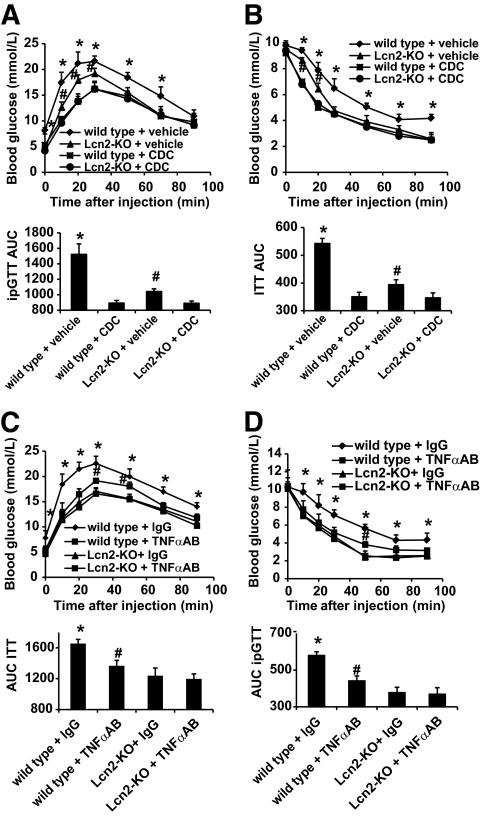
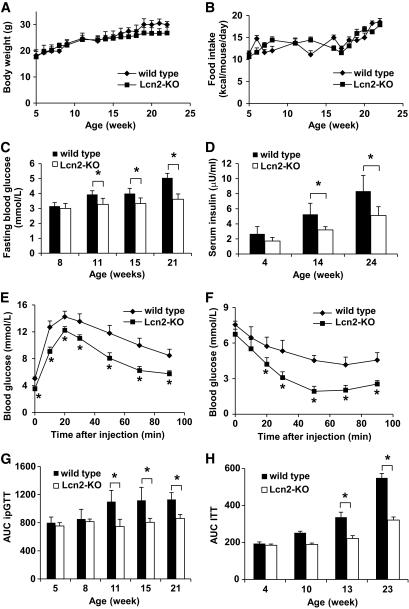
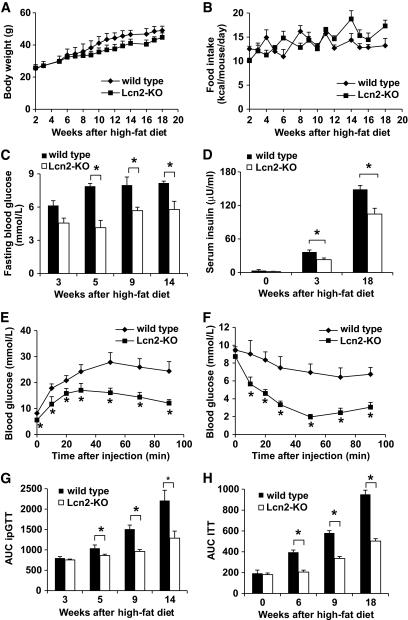
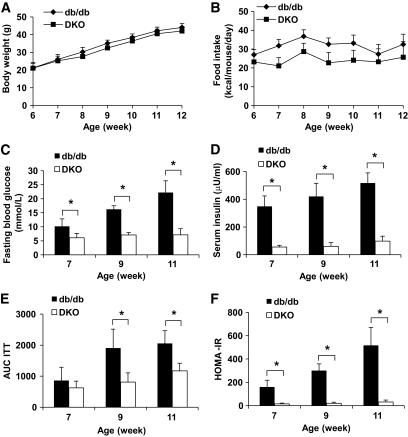
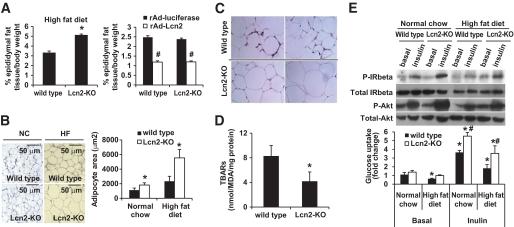
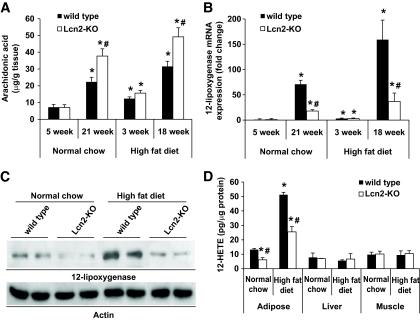
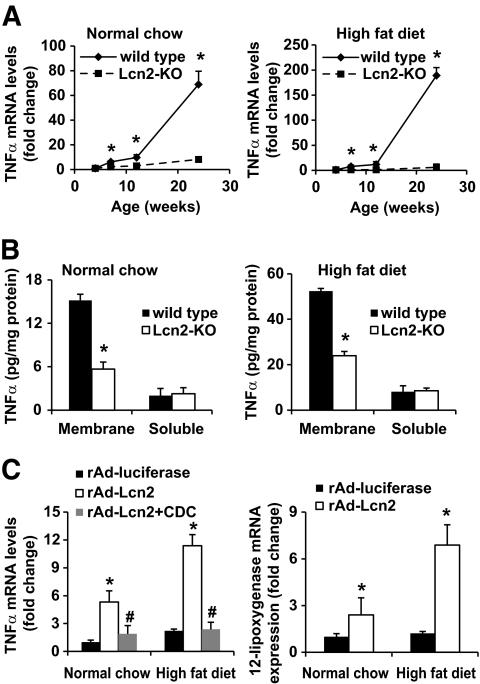
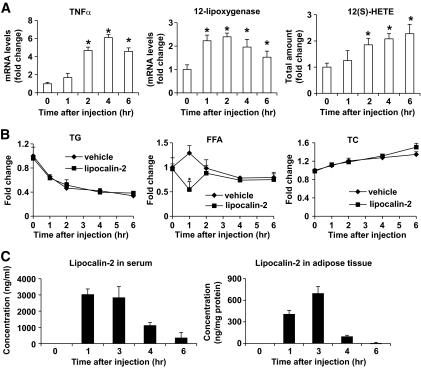
Under conditions of aging or dietary-/genetic-induced obesity, lipocalin-2 knockout (Lcn2-KO) mice show significantly decreased fasting glucose and insulin levels and improved insulin sensitivity compared with their wild-type littermates. Despite enlarged fat mass, inflammation and the accumulation of lipid peroxidation products are significantly attenuated in the adipose tissues of Lcn2-KO mice. Adipose fatty acid composition of these mice varies significantly from that in wild-type animals. The amounts of arachidonic acid (C20:4 n6) are elevated by aging and obesity and are paradoxically further increased in adipose tissue, but not skeletal muscle and liver of Lcn2-KO mice. On the other hand, the expression and activity of 12-lipoxygenase, an enzyme responsible for metabolizing arachidonic acid, and the production of tumor necrosis factor-alpha (TNF-alpha), a critical insulin resistance-inducing factor, are largely inhibited by lipocalin-2 deficiency. Lipocalin-2 stimulates the expression and activity of 12-lipoxygenase and TNF-alpha production in fat tissues. Cinnamyl-3,4-dihydroxy-alpha-cyanocinnamate (CDC), an arachidonate lipoxygenase inhibitor, prevents TNF-alpha expression induced by lipocalin-2. Moreover, treatment with TNF-alpha neutralization antibody or CDC significantly attenuated the differences of insulin sensitivity between wild-type and Lcn2-KO mice.
CONCLUSIONS
Lipocalin-2 deficiency protects mice from developing aging- and obesity-induced insulin resistance largely by modulating 12-lipoxygenase and TNF-alpha levels in adipose tissue.
目的
脂肪组织产生的促炎细胞因子/脂肪因子以自分泌和/或内分泌的方式发挥作用,以维持局部炎症并诱导外周胰岛素抵抗。本研究探讨脂肪因子脂联素-2 缺乏或补充脂联素-2 是否对全身胰岛素敏感性及其潜在机制有任何影响。
方法和结果
在衰老或饮食/遗传诱导肥胖的情况下,脂联素-2 敲除(Lcn2-KO)小鼠的空腹血糖和胰岛素水平显著降低,胰岛素敏感性得到改善,与野生型同窝仔相比。尽管脂肪量增大,但 Lcn2-KO 小鼠的脂肪组织中的炎症和脂质过氧化产物的积累明显减轻。这些小鼠的脂肪脂肪酸组成与野生型动物有很大不同。随着衰老和肥胖,花生四烯酸(C20:4 n6)的含量增加,并且在 Lcn2-KO 小鼠的脂肪组织中,而不是在骨骼肌和肝脏中,进一步增加。另一方面,负责代谢花生四烯酸的 12-脂氧合酶的表达和活性以及肿瘤坏死因子-α(TNF-α)的产生,一种关键的胰岛素抵抗诱导因子,在很大程度上受到脂联素-2 缺乏的抑制。脂联素-2 刺激脂肪组织中 12-脂氧合酶的表达和活性以及 TNF-α的产生。肉桂酰基-3,4-二羟基-α-氰基肉桂酸(CDC),一种花生四烯酸脂氧合酶抑制剂,可阻止脂联素-2 诱导的 TNF-α表达。此外,TNF-α中和抗体或 CDC 的治疗显著减轻了野生型和 Lcn2-KO 小鼠之间胰岛素敏感性的差异。
结论
脂联素-2 缺乏通过调节脂肪组织中的 12-脂氧合酶和 TNF-α水平,在很大程度上保护小鼠免受衰老和肥胖引起的胰岛素抵抗。
 Zotero 插件