
乳腺密度与社会经济地位标志物:一项横断面研究。
Mammographic density and markers of socioeconomic status: a cross-sectional study.
机构信息
Cancer Research UK Epidemiology and Genetics Group, Department of Epidemiology and Population Health, London School of Hygiene and Tropical Medicine, Keppel Street, London WC1E 7HT, UK.
出版信息
BMC Cancer. 2010 Feb 9;10:35. doi: 10.1186/1471-2407-10-35.
BACKGROUND
Socioeconomic status (SES) is known to be positively associated with breast cancer risk but its relationship with mammographic density, a marker of susceptibility to breast cancer, is unclear. This study aims to investigate whether mammographic density varies by SES and to identify the underlying anthropometric, lifestyle and reproductive factors leading to such variation.
METHODS
In a cross-sectional study of mammographic density in 487 pre-menopausal women, SES was assessed from questionnaire data using highest achieved level of formal education, quintiles of Census-derived Townsend scores and urban/rural classification of place of residence. Mammographic density was measured on digitised films using a computer-assisted method. Linear regression models were fitted to assess the association between SES variables and mammographic density, adjusting for correlated variables.
RESULTS
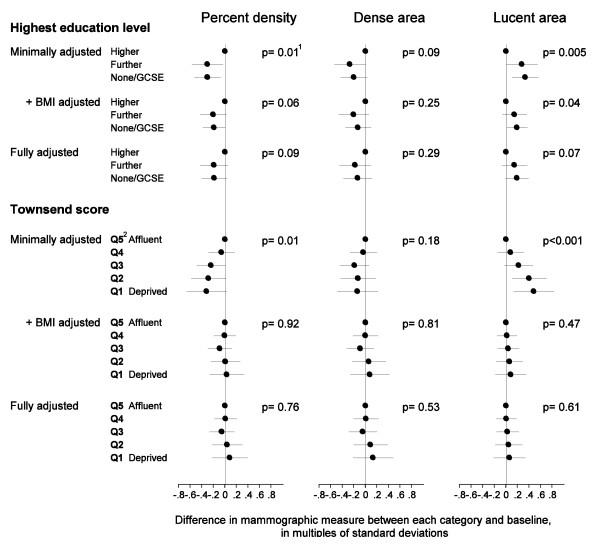
In unadjusted models, percent density was positively associated with SES, with an absolute difference in percent density of 6.3% (95% CI 1.6%, 10.5%) between highest and lowest educational categories, and of 6.6% (95% CI -0.7%, 12.9%) between highest and lowest Townsend quintiles. These associations were mainly driven by strong negative associations between these SES variables and lucent area and were attenuated upon adjustment for body mass index (BMI). There was little evidence that reproductive factors explained this association. SES was not associated with the amount of dense tissue in the breast before or after BMI adjustment. The effect of education on percent density persisted after adjustment for Townsend score. Mammographic measures did not vary according to urban/rural place of residence.
CONCLUSIONS
The observed SES gradients in percent density paralleled known SES gradients in breast cancer risk. Although consistent with the hypothesis that percent density may be a mediator of the SES differentials in breast cancer risk, the SES gradients in percent density were mainly driven by the negative association between SES and BMI. Nevertheless, as density affects the sensitivity of screen-film mammography, the higher percent density found among high SES women would imply that these women have a higher risk of developing cancer but a lower likelihood of having it detected earlier.
背景
社会经济地位(SES)与乳腺癌风险呈正相关,但它与乳房 X 光密度(乳腺癌易感性的标志物)的关系尚不清楚。本研究旨在调查 SES 是否与乳房 X 光密度有关,并确定导致这种差异的潜在人体测量、生活方式和生殖因素。
方法
在对 487 名绝经前妇女的乳房 X 光密度进行的横断面研究中,SES 是根据问卷调查数据评估的,使用最高学历、人口普查衍生的汤森五分位数和居住地的城乡分类。使用计算机辅助方法在数字化胶片上测量乳房 X 光密度。线性回归模型用于评估 SES 变量与乳房 X 光密度之间的关系,调整了相关变量。
结果
在未调整的模型中,密度百分比与 SES 呈正相关,最高和最低教育类别之间的密度百分比绝对差异为 6.3%(95%CI 1.6%,10.5%),最高和最低汤森五分位数之间的差异为 6.6%(95%CI -0.7%,12.9%)。这些关联主要是由于 SES 变量与透明区域之间存在强烈的负相关,并且在调整了体重指数(BMI)后减弱。几乎没有证据表明生殖因素可以解释这种关联。SES 与调整 BMI 前后乳房中致密组织的量无关。在调整汤森得分后,教育对密度百分比的影响仍然存在。乳房 X 光测量结果与城乡居住地无关。
结论
观察到的密度百分比 SES 梯度与已知的乳腺癌风险 SES 梯度相似。尽管这与密度百分比可能是 SES 差异导致乳腺癌风险的中介假说一致,但密度百分比的 SES 梯度主要是由于 SES 与 BMI 之间的负相关。尽管如此,由于密度会影响屏片乳房 X 光的灵敏度,较高 SES 女性的密度百分比较高意味着这些女性患癌症的风险较高,但早期发现癌症的可能性较低。
 Zotero 插件