
基于 toxR 的环介导等温扩增检测技术用于检测副溶血性弧菌的研究。
Development of a toxR-based loop-mediated isothermal amplification assay for detecting Vibrio parahaemolyticus.
机构信息
Department of Food Science, Louisiana State University Agricultural Center, Baton Rouge, Louisiana 70803, USA.
出版信息
BMC Microbiol. 2010 Feb 10;10:41. doi: 10.1186/1471-2180-10-41.
BACKGROUND
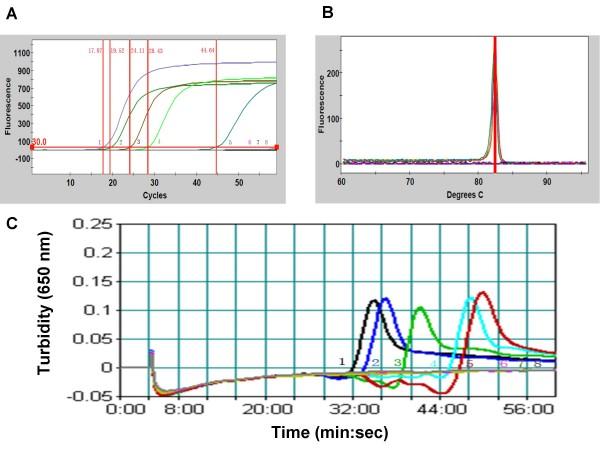
Vibrio parahaemolyticus is a leading cause of seafood-related bacterial gastroenteritis and outbreaks worldwide. Sensitive and specific detection methods are needed to better control V. parahaemolyticus infections. This study aimed at developing a highly specific and sensitive loop-mediated isothermal amplification (LAMP) assay for detecting V. parahaemolyticus in oysters. A set of five LAMP primers, two outer, two inner, and one loop were designed based on the published V. parahaemolyticus toxR sequence. Specificity of the assay was evaluated using a panel of 36 V. parahaemolyticus and 39 other strains. The assay sensitivity was determined using serial dilutions of V. parahaemolyticus ATCC 27969 culture ranging from 10(8) CFU/ml to extinction. The assay was also tested in experimentally inoculated oyster samples.
RESULTS
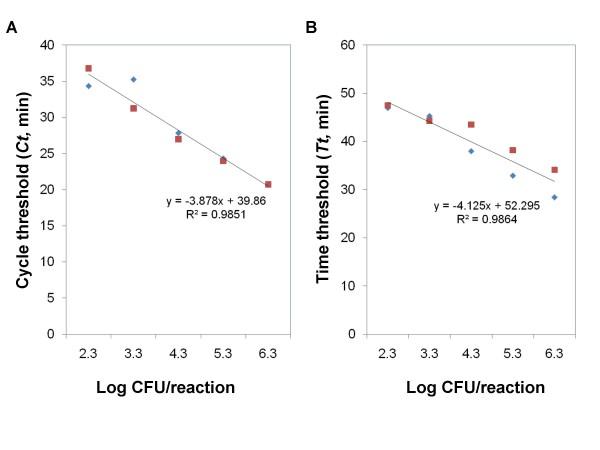
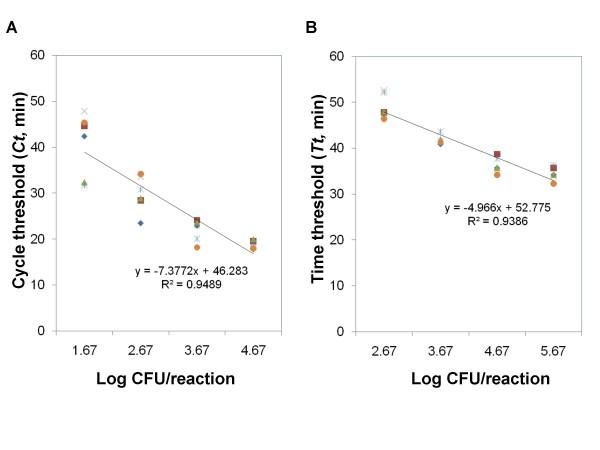
The toxR-based LAMP assay was able to specifically detect all of the 36 V. parahaemolyticus strains without amplification from 39 other strains. The detection limit was 47-470 cells per reaction in pure culture, up to 100-fold more sensitive than that of toxR-PCR. When applied in spiked oysters, the assay was able to detect 1.1 x 10(5) V. parahaemolyticus cells per gram of oyster without enrichment, up to 100-fold more sensitive than that of toxR-PCR. Standard curves generated for detecting V. parahaemolyticus in both pure culture and spiked oyster samples showed good linear relationship between cell numbers and the fluorescence or turbidity signals.
CONCLUSIONS
The toxR-based LAMP assay developed in this study was sensitive, specific, and quantitative, holding great potential for future field detection of V. parahaemolyticus in raw oysters.
背景
副溶血性弧菌是导致食源性细菌性肠胃炎和世界范围内暴发的主要原因。需要敏感和特异的检测方法来更好地控制副溶血性弧菌感染。本研究旨在开发一种高度特异和敏感的环介导等温扩增(LAMP)检测方法,用于检测牡蛎中的副溶血性弧菌。根据已发表的副溶血性弧菌 toxR 序列,设计了一组 5 个 LAMP 引物,包括 2 个外引物、2 个内引物和 1 个环引物。该方法的特异性通过 36 株副溶血性弧菌和 39 株其他菌株的检测来评估。通过从 10(8)CFU/ml 到稀释终点的副溶血性弧菌 ATCC 27969 连续稀释液来确定检测的灵敏度。该方法还在实验接种的牡蛎样本中进行了测试。
结果
基于 toxR 的 LAMP 检测方法能够特异性地检测到所有 36 株副溶血性弧菌,而不会从 39 株其他菌株中扩增。在纯培养物中,检测限为每个反应 47-470 个细胞,比 toxR-PCR 灵敏 100 倍。当应用于加标牡蛎时,该方法能够在未经富集的情况下检测到每克牡蛎中 1.1 x 10(5)个副溶血性弧菌细胞,比 toxR-PCR 灵敏 100 倍。在纯培养物和加标牡蛎样本中检测副溶血性弧菌的标准曲线显示,细胞数量与荧光或浊度信号之间具有良好的线性关系。
结论
本研究中开发的基于 toxR 的 LAMP 检测方法具有敏感性、特异性和定量性,在未来对生牡蛎中副溶血性弧菌的现场检测具有很大的潜力。
 Zotero 插件