
利用小表位标签在大脑中检测转基因表达的免疫组织化学方法。
Immunohistochemical detection of transgene expression in the brain using small epitope tags.
机构信息
Laboratory for Neurobiology and Gene Therapy, Division of Molecular Medicine, Department of Molecular and Cellular Medicine, Katholieke Universiteit Leuven, Leuven, Belgium.
出版信息
BMC Biotechnol. 2010 Feb 18;10:16. doi: 10.1186/1472-6750-10-16.
BACKGROUND
In vivo overexpression of proteins is a powerful approach to study their biological function, generate disease models or evaluate gene therapy approaches. In order to investigate an exogenously expressed protein, specific and sensitive detection is essential. Unfortunately, antibodies that allow histological detection of the protein of interest are not always readily available. The use of an epitope tag fused to the protein can circumvent this problem as well as provide the possibility to discriminate endogenous from overexpressed proteins. In order to minimize impact on the bioactivity and biodistribution of the overexpressed protein, preference is given to small tags.
RESULTS
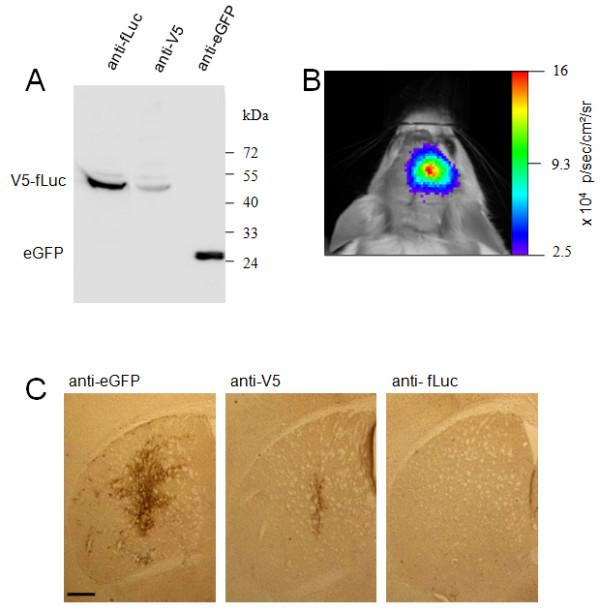
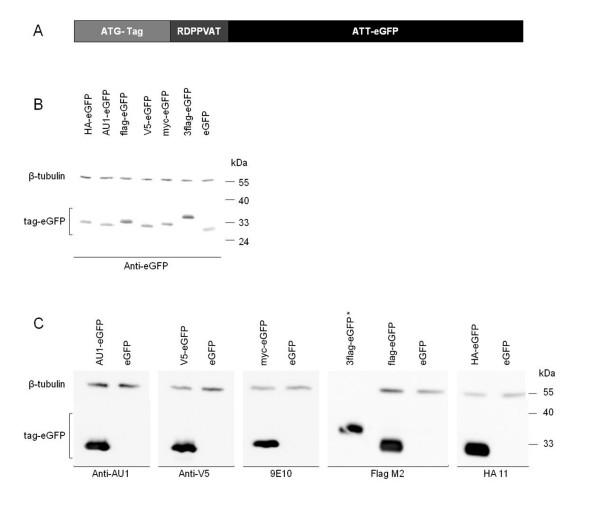
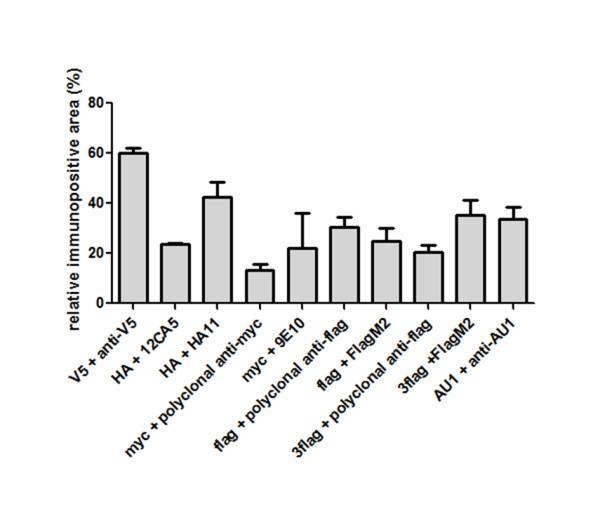
In the present study, we evaluated several small epitope tags together with corresponding anti-tag antibodies for the detection of overexpressed proteins in rat brain, using eGFP as a reference. We generated several lentiviral vectors encoding eGFP with different N-terminally fused small epitope tags (AU1, flag, 3flag, HA, myc and V5). After confirmation of their functionality in cell culture, we injected these lentiviral vectors stereotactically into the striatum of rats and prepared paraformaldehyde fixed floating sections for immunohistochemical analysis. Using multiple antibodies and antibody dilutions per epitope tag, we extensively assessed the efficiency of several anti-tag antibodies for chromogenic immunohistochemical detection of the epitope tagged eGFPs by determining the proportion of immunoreactivity detected by anti-tag antibodies compared to anti-GFP antibody. Using fluorescence immunohistochemistry and confocal microscopy, we also quantified the proportion of eGFP-positive cells detected by anti-tag antibodies. Our results show that all the examined small epitope tags could be detected by anti-tag antibodies both in cell extracts as well as in vivo, although to varying degrees depending on the tag and antibody used. Using the presented protocol, V5/anti-V5 and HA/HA11 tag/antibody combinations provided the most sensitive detection in brain tissue. We confirmed the applicability of these optimized in vivo tag detection conditions for a difficult to detect protein, firefly luciferase (fLuc), using lentiviral vector constructs expressing V5 tagged and 3flag tagged fLuc protein.
CONCLUSIONS
We show here that several small epitope tags are useful for immunohistochemical detection of exogenous proteins in vivo. Our study also provides a generic methodology which is broadly applicable for the detection of overexpressed transgenes in mammalian brain tissue.
背景
在体内过表达蛋白质是研究其生物学功能、产生疾病模型或评估基因治疗方法的有力手段。为了研究外源表达的蛋白质,特异性和敏感性检测是必不可少的。遗憾的是,并非总是能够获得允许对感兴趣的蛋白质进行组织学检测的抗体。融合到蛋白质上的表位标签的使用不仅可以解决这个问题,还可以提供区分内源性和过表达蛋白质的可能性。为了使过表达蛋白质的生物活性和生物分布的影响最小化,优先选择小标签。
结果
在本研究中,我们评估了几种小表位标签及其相应的抗标签抗体,用于检测大鼠脑中过表达的蛋白质,以 eGFP 作为参考。我们生成了几种编码带有不同 N 端融合的小表位标签(AU1、flag、3flag、HA、myc 和 V5)的 eGFP 的慢病毒载体。在细胞培养中确认其功能后,我们将这些慢病毒载体立体定向注射到大鼠纹状体中,并制备多聚甲醛固定的漂浮切片进行免疫组织化学分析。使用多种抗体和每种表位标签的抗体稀释度,我们通过确定抗标签抗体检测到的免疫反应比例与抗 GFP 抗体进行了多种抗标签抗体用于检测表位标记的 eGFP 的显色免疫组织化学的效率评估。使用荧光免疫组织化学和共聚焦显微镜,我们还量化了抗标签抗体检测到的 eGFP 阳性细胞的比例。我们的结果表明,所有检查的小表位标签都可以通过抗标签抗体在细胞提取物和体内检测到,尽管根据所使用的标签和抗体,检测程度有所不同。使用所提出的方案,V5/抗 V5 和 HA/HA11 标签/抗体组合在脑组织中提供了最敏感的检测。我们使用表达 V5 标记和 3flag 标记 fLuc 蛋白的慢病毒载体构建体证实了这些优化的体内标签检测条件对难以检测的蛋白质(萤火虫荧光素酶(fLuc))的适用性。
结论
我们在这里表明,几种小表位标签可用于体内过表达蛋白质的免疫组织化学检测。我们的研究还提供了一种通用方法,可广泛应用于哺乳动物脑组织中转基因的过表达检测。


 Zotero 插件