
论非洲猿类中的疟原虫多样性以及从倭黑猩猩起源的恶性疟原虫。
On the diversity of malaria parasites in African apes and the origin of Plasmodium falciparum from Bonobos.
机构信息
UMR 7206-USM 104, Eco-Anthropologie et Ethnobiologie, Muséum National d'Histoire Naturelle, Paris, France.
出版信息
PLoS Pathog. 2010 Feb 12;6(2):e1000765. doi: 10.1371/journal.ppat.1000765.
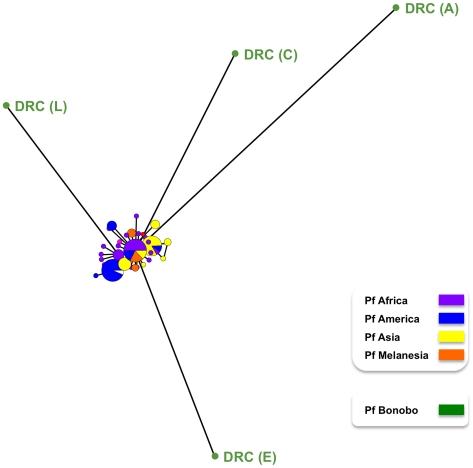
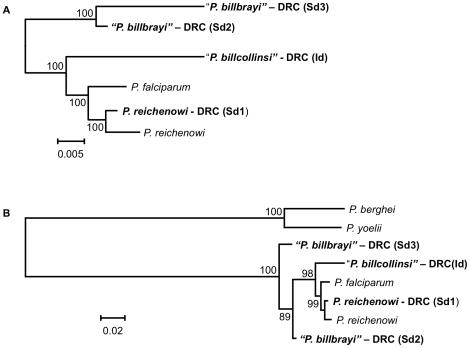
The origin of Plasmodium falciparum, the etiological agent of the most dangerous forms of human malaria, remains controversial. Although investigations of homologous parasites in African Apes are crucial to resolve this issue, studies have been restricted to a chimpanzee parasite related to P. falciparum, P. reichenowi, for which a single isolate was available until very recently. Using PCR amplification, we detected Plasmodium parasites in blood samples from 18 of 91 individuals of the genus Pan, including six chimpanzees (three Pan troglodytes troglodytes, three Pan t. schweinfurthii) and twelve bonobos (Pan paniscus). We obtained sequences of the parasites' mitochondrial genomes and/or from two nuclear genes from 14 samples. In addition to P. reichenowi, three other hitherto unknown lineages were found in the chimpanzees. One is related to P. vivax and two to P. falciparum that are likely to belong to distinct species. In the bonobos we found P. falciparum parasites whose mitochondrial genomes indicated that they were distinct from those present in humans, and another parasite lineage related to P. malariae. Phylogenetic analyses based on this diverse set of Plasmodium parasites in African Apes shed new light on the evolutionary history of P. falciparum. The data suggested that P. falciparum did not originate from P. reichenowi of chimpanzees (Pan troglodytes), but rather evolved in bonobos (Pan paniscus), from which it subsequently colonized humans by a host-switch. Finally, our data and that of others indicated that chimpanzees and bonobos maintain malaria parasites, to which humans are susceptible, a factor of some relevance to the renewed efforts to eradicate malaria.
疟原虫恶性疟原虫是最危险的人类疟疾病原体,其起源仍然存在争议。尽管对非洲猿猴中同源寄生虫的调查对于解决这个问题至关重要,但研究一直仅限于与恶性疟原虫相关的一种黑猩猩寄生虫——彭氏疟原虫,直到最近才有一个单一的分离株。使用 PCR 扩增,我们从 91 只大猿属个体(包括 6 只黑猩猩[普通黑猩猩(Pan troglodytes troglodytes)和桑给巴尔黑猩猩(Pan t. schweinfurthii)]和 12 只倭黑猩猩(Pan paniscus))的血液样本中检测到了疟原虫寄生虫。我们从 14 个样本中获得了寄生虫线粒体基因组和/或两个核基因的序列。除了彭氏疟原虫,在黑猩猩中还发现了另外三种迄今未知的谱系。一种与间日疟原虫有关,两种与恶性疟原虫有关,可能属于不同的物种。在倭黑猩猩中,我们发现了恶性疟原虫寄生虫,它们的线粒体基因组表明它们与人类的寄生虫不同,还有一种与疟原虫有关的寄生虫谱系。基于非洲猿猴中这一组多样化的疟原虫寄生虫的系统发育分析为恶性疟原虫的进化史提供了新的线索。这些数据表明,恶性疟原虫并非起源于黑猩猩(普通黑猩猩)的彭氏疟原虫(Pan troglodytes),而是在倭黑猩猩(Pan paniscus)中进化而来,随后通过宿主转换从倭黑猩猩传播到人类。最后,我们的数据和其他人的数据表明,黑猩猩和倭黑猩猩维持着对人类易感的疟疾寄生虫,这一因素与根除疟疾的新努力有一定的相关性。


 Zotero 插件