
希瓦氏菌属基因组的演化适应了寒冷的海洋生活方式和原位爆炸式生物降解。
Shewanella spp. genomic evolution for a cold marine lifestyle and in-situ explosive biodegradation.
机构信息
Biotechnology Research Institute, National Research Council Canada, Montreal, Quebec, Canada.
出版信息
PLoS One. 2010 Feb 8;5(2):e9109. doi: 10.1371/journal.pone.0009109.
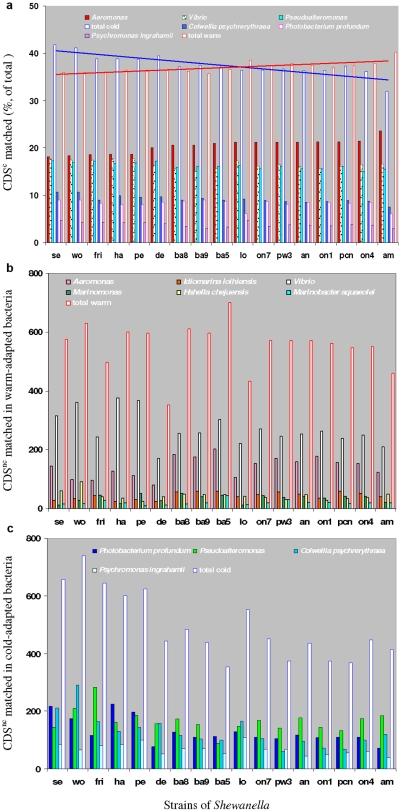
Shewanella halifaxensis and Shewanella sediminis were among a few aquatic gamma-proteobacteria that were psychrophiles and the first anaerobic bacteria that degraded hexahydro-1,3,5-trinitro-1,3,5-triazine (RDX). Although many mesophilic or psychrophilic strains of Shewanella and gamma-proteobacteria were sequenced for their genomes, the genomic evolution pathways for temperature adaptation were poorly understood. On the other hand, the genes responsible for anaerobic RDX mineralization pathways remain unknown. To determine the unique genomic properties of bacteria responsible for both cold-adaptation and RDX degradation, the genomes of S. halifaxensis and S. sediminis were sequenced and compared with 108 other gamma-proteobacteria including Shewanella that differ in temperature and Na+ requirements, as well as RDX degradation capability. Results showed that for coping with marine environments their genomes had extensively exchanged with deep sea bacterial genomes. Many genes for Na+-dependent nutrient transporters were recruited to use the high Na+ content as an energy source. For coping with low temperatures, these two strains as well as other psychrophilic strains of Shewanella and gamma-proteobacteria were found to decrease their genome G+C content and proteome alanine, proline and arginine content (p-value <0.01) to increase protein structural flexibility. Compared to poorer RDX-degrading strains, S. halifaxensis and S. sediminis have more number of genes for cytochromes and other enzymes related to RDX metabolic pathways. Experimentally, one cytochrome was found induced in S. halifaxensis by RDX when the chemical was the sole terminal electron acceptor. The isolated protein degraded RDX by mono-denitration and was identified as a multiheme 52 kDa cytochrome using a proteomic approach. The present analyses provided the first insight into divergent genomic evolution of bacterial strains for adaptation to the specific cold marine conditions and to the degradation of the pollutant RDX. The present study also provided the first evidence for the involvement of a specific c-type cytochrome in anaerobic RDX metabolism.
希瓦氏菌属和海栖希瓦氏菌是水生γ-变形菌中的几种嗜冷菌,也是首例能够降解六氢-1,3,5-三硝基-1,3,5-三嗪(RDX)的厌氧菌。尽管许多嗜温或嗜冷的希瓦氏菌和γ-变形菌菌株已经测序并构建了其基因组图谱,但对于温度适应的基因组进化途径却知之甚少。另一方面,负责厌氧 RDX 矿化途径的基因仍然未知。为了确定负责冷适应和 RDX 降解的细菌的独特基因组特性,对 S. halifaxensis 和 S. sediminis 的基因组进行了测序,并与 108 种其他 γ-变形菌进行了比较,这些菌株在温度和 Na+需求方面存在差异,并且具有 RDX 降解能力。结果表明,为了适应海洋环境,它们的基因组与深海细菌基因组广泛交换。许多 Na+依赖性营养物转运基因被招募来利用高 Na+含量作为能量来源。为了适应低温,这两种菌株以及其他嗜冷的希瓦氏菌和 γ-变形菌菌株发现它们的基因组 G+C 含量和蛋白质组丙氨酸、脯氨酸和精氨酸含量降低(p 值 <0.01),以增加蛋白质结构的灵活性。与较差的 RDX 降解菌株相比,S. halifaxensis 和 S. sediminis 具有更多与 RDX 代谢途径相关的细胞色素和其他酶的基因。实验发现,当 RDX 是唯一的末端电子受体时,RDX 诱导 S. halifaxensis 中一种细胞色素的表达。分离出的蛋白通过单硝化作用降解 RDX,并使用蛋白质组学方法鉴定为一种多血红素 52 kDa 细胞色素。本分析首次深入了解了细菌菌株适应特定的冷海洋条件和降解污染物 RDX 的不同基因组进化。本研究还首次提供了证据表明,特定的 c 型细胞色素参与了厌氧 RDX 代谢。




 Zotero 插件