
脉压能否预测高危高血压患者新发糖尿病?:坎地沙坦降压生存评估在日本(CASE-J)试验的亚分析。
Is pulse pressure a predictor of new-onset diabetes in high-risk hypertensive patients?: a subanalysis of the Candesartan Antihypertensive Survival Evaluation in Japan (CASE-J) trial.
机构信息
EBM Research Center, Kyoto University Graduate School of Medicine, Kyoto, Japan.
出版信息
Diabetes Care. 2010 May;33(5):1122-7. doi: 10.2337/dc09-1447. Epub 2010 Feb 25.
OBJECTIVE
Hypertensive patients have an increased risk of developing diabetes. Accumulating evidence suggests a close relation between metabolic disturbance and increased arterial stiffness. Here, we examined the association between pulse pressure and the risk of new-onset diabetes in high-risk Japanese hypertensive patients.
RESEARCH DESIGN AND METHODS
The Candesartan Antihypertensive Survival Evaluation in Japan (CASE-J) trial examined the effects of candesartan and amlodipine on the incidence of cardiovascular events in 4,728 high-risk Japanese hypertensive patients. In the present study, we analyzed the relationship between pulse pressure at baseline and new-onset diabetes in 2,685 patients without diabetes at baseline (male 1,471; mean age 63.7 years; mean BMI 24.8 kg/m(2)) as a subanalysis of the CASE-J trial.
RESULTS
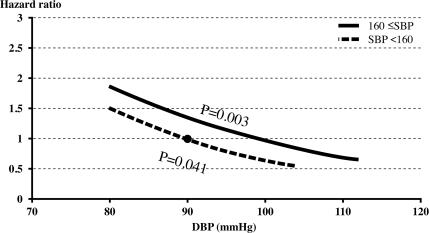
During 3.3 +/- 0.8 years of follow-up, 97 patients (3.6%) developed diabetes. In multiple Cox regression analysis, pulse pressure was an independent predictor for new-onset diabetes (hazard ratio [HR] per 1 SD increase 1.44 [95% CI 1.15-1.79]) as were male sex, BMI, and additional use of diuretics, whereas age and heart rate were not. Plots of HRs for new-onset diabetes considering both systolic and diastolic blood pressure (DBP) revealed that a higher pulse pressure with a lower DBP, indicating that the increased pulse pressure was largely due to increased arterial stiffness, was strongly associated with the risk of new-onset diabetes.
CONCLUSIONS
Pulse pressure is an independent predictor of new-onset diabetes in high-risk Japanese hypertensive patients. Increased arterial stiffness may be involved in the development of diabetes.
目的
高血压患者患糖尿病的风险增加。越来越多的证据表明代谢紊乱与动脉僵硬程度增加密切相关。在这里,我们研究了脉压与日本高危高血压患者新发糖尿病风险之间的关系。
研究设计和方法
坎地沙坦降压生存评估在日本(CASE-J)试验研究了坎地沙坦和氨氯地平对 4728 例高危日本高血压患者心血管事件发生率的影响。在本研究中,我们分析了基线时脉压与基线时无糖尿病的 2685 例患者(男性 1471 例;平均年龄 63.7 岁;平均 BMI 24.8kg/m2)新发糖尿病之间的关系,这是 CASE-J 试验的一个亚分析。
结果
在 3.3±0.8 年的随访期间,97 例(3.6%)患者发生糖尿病。在多 Cox 回归分析中,脉压是新发糖尿病的独立预测因素(每增加 1 SD 的风险比[HR]为 1.44[95%CI 1.15-1.79]),男性、BMI 和利尿剂的额外使用也是如此,而年龄和心率则不是。考虑到收缩压和舒张压(DBP)的 HR 图显示,脉压升高且 DBP 降低,表明脉压升高主要是由于动脉僵硬程度增加,与新发糖尿病的风险密切相关。
结论
脉压是日本高危高血压患者新发糖尿病的独立预测因素。动脉僵硬程度增加可能与糖尿病的发生有关。

 Zotero 插件