
PPS,一种大型多功能蛋白,与 sex-lethal 一起在果蝇中发挥作用,调节选择性剪接。
PPS, a large multidomain protein, functions with sex-lethal to regulate alternative splicing in Drosophila.
机构信息
Department of Genetics, Case Western Reserve University, School of Medicine, Cleveland, Ohio, United States of America.
出版信息
PLoS Genet. 2010 Mar 5;6(3):e1000872. doi: 10.1371/journal.pgen.1000872.
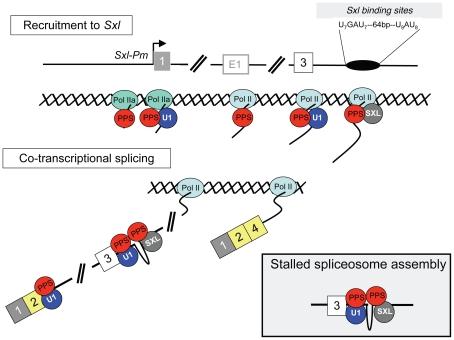
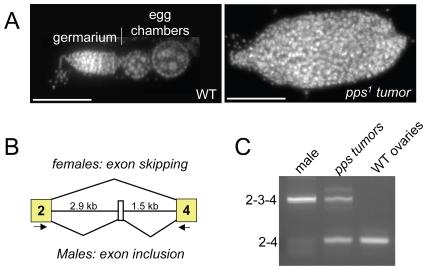
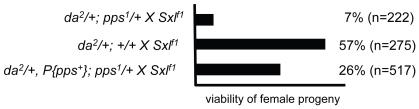
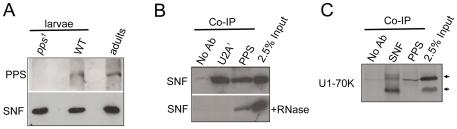
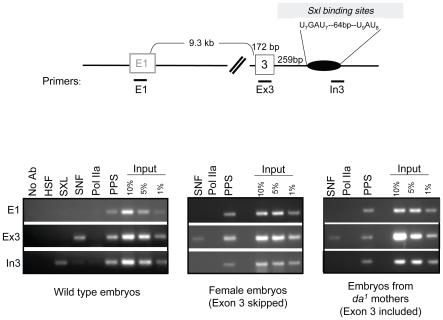
Alternative splicing controls the expression of many genes, including the Drosophila sex determination gene Sex-lethal (Sxl). Sxl expression is controlled via a negative regulatory mechanism where inclusion of the translation-terminating male exon is blocked in females. Previous studies have shown that the mechanism leading to exon skipping is autoregulatory and requires the SXL protein to antagonize exon inclusion by interacting with core spliceosomal proteins, including the U1 snRNP protein Sans-fille (SNF). In studies begun by screening for proteins that interact with SNF, we identified PPS, a previously uncharacterized protein, as a novel component of the machinery required for Sxl male exon skipping. PPS encodes a large protein with four signature motifs, PHD, BRK, TFS2M, and SPOC, typically found in proteins involved in transcription. We demonstrate that PPS has a direct role in Sxl male exon skipping by showing first that loss of function mutations have phenotypes indicative of Sxl misregulation and second that the PPS protein forms a complex with SXL and the unspliced Sxl RNA. In addition, we mapped the recruitment of PPS, SXL, and SNF along the Sxl gene using chromatin immunoprecipitation (ChIP), which revealed that, like many other splicing factors, these proteins bind their RNA targets while in close proximity to the DNA. Interestingly, while SNF and SXL are specifically recruited to their predicted binding sites, PPS has a distinct pattern of accumulation along the Sxl gene, associating with a region that includes, but is not limited to, the SxlPm promoter. Together, these data indicate that PPS is different from other splicing factors involved in male-exon skipping and suggest, for the first time, a functional link between transcription and SXL-mediated alternative splicing. Loss of zygotic PPS function, however, is lethal to both sexes, indicating that its role may be of broad significance.
可变剪接控制着许多基因的表达,包括果蝇性别决定基因 Sex-lethal (Sxl)。Sxl 的表达受负调控机制的控制,在雌性中阻止了翻译终止的雄性外显子的包含。先前的研究表明,导致外显子跳过的机制是自我调控的,需要 SXL 蛋白通过与核心剪接体蛋白相互作用来拮抗外显子的包含,包括 U1 snRNP 蛋白 Sans-fille (SNF)。在通过筛选与 SNF 相互作用的蛋白质的研究中,我们鉴定出 PPS 是一种以前未被表征的蛋白质,它是 Sxl 雄性外显子跳过所需机制的新组件。PPS 编码一种具有四个特征基序(PHD、BRK、TFS2M 和 SPOC)的大型蛋白质,这些基序通常存在于参与转录的蛋白质中。我们通过首先表明功能丧失突变具有指示 Sxl 调控异常的表型,其次表明 PPS 蛋白与 SXL 和未剪接的 Sxl RNA 形成复合物,证明 PPS 在外显子跳跃中具有直接作用。此外,我们使用染色质免疫沉淀 (ChIP) 沿 Sxl 基因定位 PPS、SXL 和 SNF 的募集,结果表明,与许多其他剪接因子一样,这些蛋白质在靠近 DNA 的位置与它们的 RNA 靶标结合。有趣的是,虽然 SNF 和 SXL 特异性地募集到它们的预测结合位点,但 PPS 在 Sxl 基因上具有独特的积累模式,与包括但不限于 SxlPm 启动子的区域相关联。总之,这些数据表明 PPS 与参与雄性外显子跳过的其他剪接因子不同,并首次表明转录和 SXL 介导的可变剪接之间存在功能联系。然而,合子 PPS 功能的丧失对两性都是致命的,这表明它的作用可能具有广泛的意义。




 Zotero 插件