
磺胺多辛耐药恶性疟原虫的起源与进化。
Origin and evolution of sulfadoxine resistant Plasmodium falciparum.
机构信息
Atlanta Research and Education Foundation, Atlanta, Georgia, United States of America.
出版信息
PLoS Pathog. 2010 Mar 26;6(3):e1000830. doi: 10.1371/journal.ppat.1000830.
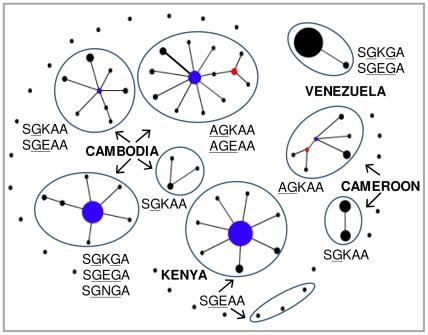
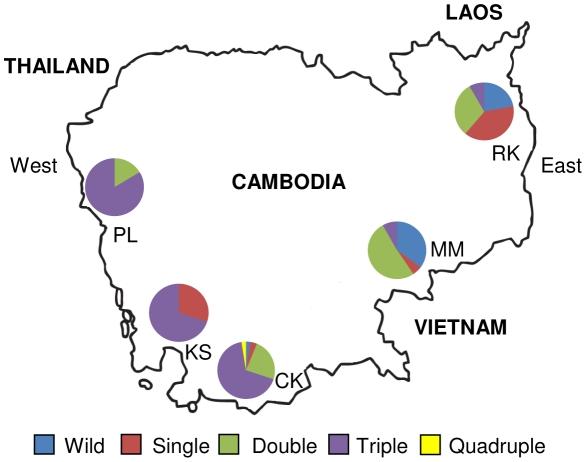
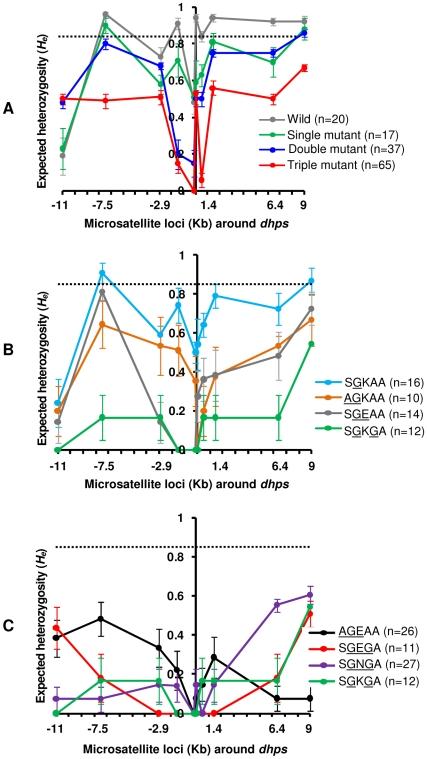
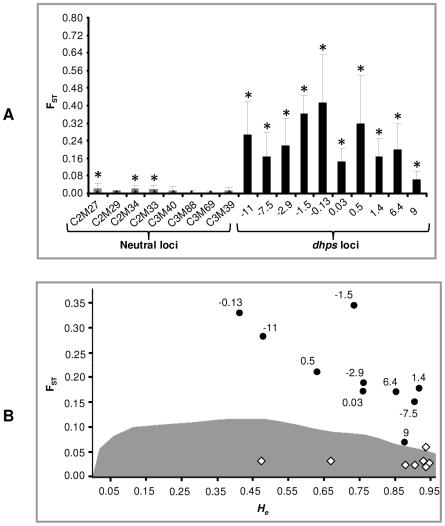
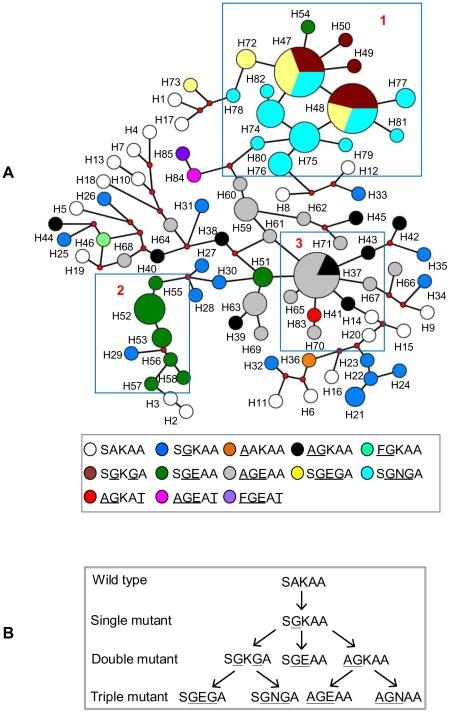
The Thailand-Cambodia border is the epicenter for drug-resistant falciparum malaria. Previous studies have shown that chloroquine (CQ) and pyrimethamine resistance originated in this region and eventually spread to other Asian countries and Africa. However, there is a dearth in understanding the origin and evolution of dhps alleles associated with sulfadoxine resistance. The present study was designed to reveal the origin(s) of sulfadoxine resistance in Cambodia and its evolutionary relationship to African and South American dhps alleles. We sequenced 234 Cambodian Plasmodium falciparum isolates for the dhps codons S436A/F, A437G, K540E, A581G and A613S/T implicated in sulfadoxine resistance. We also genotyped 10 microsatellite loci around dhps to determine the genetic backgrounds of various alleles and compared them with the backgrounds of alleles prevalent in Africa and South America. In addition to previously known highly-resistant triple mutant dhps alleles SGEGA and AGEAA (codons 436, 437, 540, 581, 613 are sequentially indicated), a large proportion of the isolates (19.3%) contained a 540N mutation in association with 437G/581G yielding a previously unreported triple mutant allele, SGNGA. Microsatellite data strongly suggest the strength of selection was greater on triple mutant dhps alleles followed by the double and single mutants. We provide evidence for at least three independent origins for the double mutants, one each for the SGKGA, AGKAA and SGEAA alleles. Our data suggest that the triple mutant allele SGEGA and the novel allele SGNGA have common origin on the SGKGA background, whereas the AGEAA triple mutant was derived from AGKAA on multiple, albeit limited, genetic backgrounds. The SGEAA did not share haplotypes with any of the triple mutants. Comparative analysis of the microsatellite haplotypes flanking dhps alleles from Cambodia, Kenya, Cameroon and Venezuela revealed an independent origin of sulfadoxine resistant alleles in each of these regions.
泰国-柬埔寨边境是耐青蒿素恶性疟的中心。以前的研究表明,氯喹(CQ)和乙胺嘧啶耐药性起源于该地区,最终传播到其他亚洲国家和非洲。然而,人们对磺胺多辛耐药相关 dhps 等位基因的起源和进化知之甚少。本研究旨在揭示柬埔寨磺胺多辛耐药的起源及其与非洲和南美洲 dhps 等位基因的进化关系。我们对 234 株柬埔寨恶性疟原虫分离株的 dhps 密码子 S436A/F、A437G、K540E、A581G 和 A613S/T 进行了测序,这些密码子与磺胺多辛耐药有关。我们还对 dhps 周围的 10 个微卫星位点进行了基因分型,以确定各种等位基因的遗传背景,并将其与非洲和南美洲流行的等位基因的背景进行比较。除了以前已知的高度耐药的三重突变 dhps 等位基因 SGEGA 和 AGEAA(依次表示密码子 436、437、540、581、613)外,很大一部分分离株(19.3%)含有与 437G/581G 相关的 540N 突变,产生了以前未报告的三重突变等位基因 SGNGA。微卫星数据强烈表明,三重突变 dhps 等位基因的选择强度大于双突变和单突变。我们提供了至少三个独立起源的双突变体的证据,分别为 SGKGA、AGKAA 和 SGEAA 等位基因。我们的数据表明,三重突变等位基因 SGEGA 和新的等位基因 SGNGA 具有共同的起源,而 SGEAA 三重突变是从 AGKAA 在多个遗传背景下产生的,尽管遗传背景有限。SGEAA 与任何三重突变体都没有共享单倍型。对来自柬埔寨、肯尼亚、喀麦隆和委内瑞拉的 dhps 等位基因侧翼微卫星单倍型的比较分析表明,这些地区的磺胺多辛耐药等位基因都有独立的起源。
 Zotero 插件