
电子断层成像技术揭示了丝状病毒出芽的步骤。
Electron tomography reveals the steps in filovirus budding.
机构信息
Structural and Computational Biology Unit, European Molecular Biology Laboratory, Heidelberg, Germany.
出版信息
PLoS Pathog. 2010 Apr 29;6(4):e1000875. doi: 10.1371/journal.ppat.1000875.
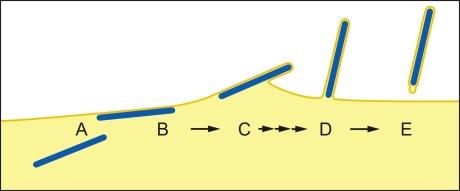
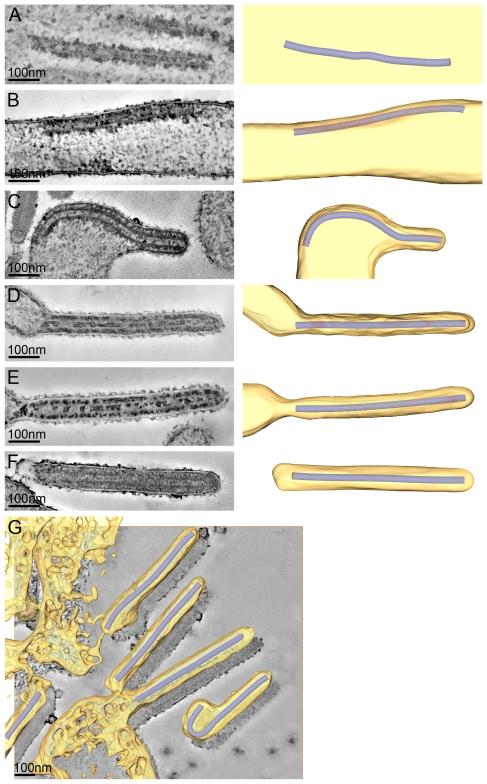
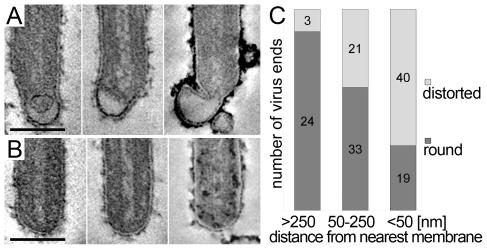
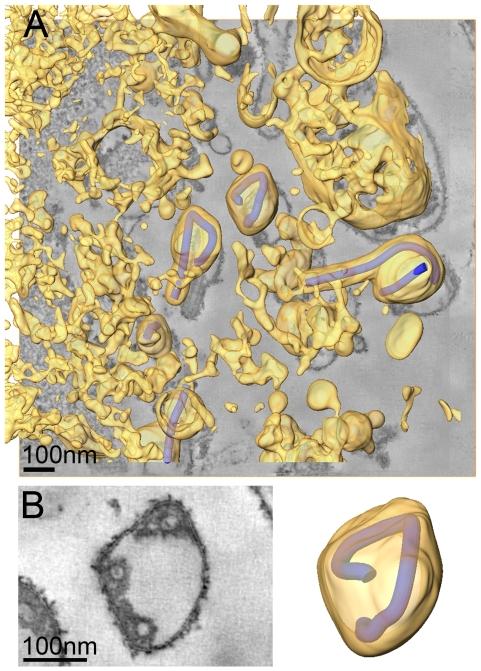
The filoviruses, Marburg and Ebola, are non-segmented negative-strand RNA viruses causing severe hemorrhagic fever with high mortality rates in humans and nonhuman primates. The sequence of events that leads to release of filovirus particles from cells is poorly understood. Two contrasting mechanisms have been proposed, one proceeding via a "submarine-like" budding with the helical nucleocapsid emerging parallel to the plasma membrane, and the other via perpendicular "rocket-like" protrusion. Here we have infected cells with Marburg virus under BSL-4 containment conditions, and reconstructed the sequence of steps in the budding process in three dimensions using electron tomography of plastic-embedded cells. We find that highly infectious filamentous particles are released at early stages in infection. Budding proceeds via lateral association of intracellular nucleocapsid along its whole length with the plasma membrane, followed by rapid envelopment initiated at one end of the nucleocapsid, leading to a protruding intermediate. Scission results in local membrane instability at the rear of the virus. After prolonged infection, increased vesiculation of the plasma membrane correlates with changes in shape and infectivity of released viruses. Our observations demonstrate a cellular determinant of virus shape. They reconcile the contrasting models of filovirus budding and allow us to describe the sequence of events taking place during budding and release of Marburg virus. We propose that this represents a general sequence of events also followed by other filamentous and rod-shaped viruses.
丝状病毒(马尔堡病毒和埃博拉病毒)是非节段负链 RNA 病毒,可引起人类和非人灵长类动物的严重出血热,死亡率很高。导致丝状病毒颗粒从细胞中释放的事件序列尚不清楚。已经提出了两种截然不同的机制,一种是通过“潜艇样”出芽进行,螺旋核衣壳与质膜平行出现,另一种是通过垂直的“火箭样”突出进行。在这里,我们在 BSL-4 条件下感染细胞,并使用塑料包埋细胞的电子断层扫描三维重建出芽过程中的步骤序列。我们发现,在感染的早期就会释放出高度传染性的丝状颗粒。出芽是通过沿着整个核衣壳的细胞内核衣壳与质膜的侧向关联进行的,然后在核衣壳的一端迅速进行包膜,导致突出的中间体。分裂导致病毒尾部的局部膜不稳定。在长时间感染后,质膜的囊泡化增加与释放病毒的形状和感染力的变化相关。我们的观察结果表明了病毒形状的细胞决定因素。它们调和了丝状病毒出芽的对比模型,并使我们能够描述出芽和释放马尔堡病毒过程中发生的事件序列。我们提出,这代表了其他丝状和杆状病毒也遵循的一般事件序列。

 Zotero 插件