
系统性筛选白念珠菌纯合缺失文库可分离出形态发生转换和致病性。
Systematic screens of a Candida albicans homozygous deletion library decouple morphogenetic switching and pathogenicity.
机构信息
Department of Microbiology and Immunology, University of California San Francisco, San Francisco, California, USA.
出版信息
Nat Genet. 2010 Jul;42(7):590-8. doi: 10.1038/ng.605. Epub 2010 Jun 13.
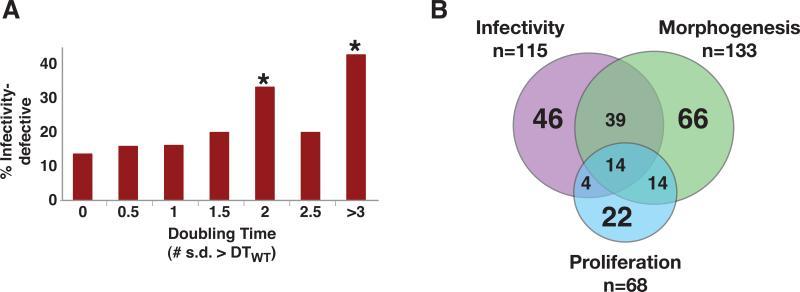
Candida albicans is the most common cause of serious fungal disease in humans. Creation of isogenic null mutants of this diploid organism, which requires sequential gene targeting, allows dissection of virulence mechanisms. Published analyses of such mutants show a near-perfect correlation between C. albicans pathogenicity and the ability to undergo a yeast-to-hypha morphological switch in vitro. However, most studies have used mutants constructed with a marker that is itself a virulence determinant and therefore complicates their interpretation. Using alternative markers, we created approximately 3,000 homozygous deletion strains affecting 674 genes, or roughly 11% of the C. albicans genome. Screening for infectivity in a mouse model and for morphological switching and cell proliferation in vitro, we identified 115 infectivity-attenuated mutants, of which nearly half demonstrated normal morphological switching and proliferation. Analysis of such mutants revealed that virulence requires the glycolipid glucosylceramide. To our knowledge, this is the first C. albicans small molecule that has been found to be required specifically for virulence.
白色念珠菌是人类最常见的严重真菌感染的病原体。该二倍体生物的同源缺失突变体的构建需要连续的基因靶向操作,这使得我们能够对其毒力机制进行剖析。已发表的对这些突变体的分析表明,白色念珠菌的致病性与其在体外进行酵母到菌丝形态转变的能力之间存在近乎完美的相关性。然而,大多数研究使用的突变体构建方法都使用了一种本身就是致病因素的标记物,这使得它们的解释变得复杂。我们使用替代标记物,构建了大约 3000 个影响 674 个基因的纯合缺失株,约占白色念珠菌基因组的 11%。我们通过在小鼠模型中进行感染性筛选,以及在体外进行形态转变和细胞增殖筛选,鉴定出了 115 个感染性减弱的突变体,其中近一半表现出正常的形态转变和增殖。对这些突变体的分析表明,毒力需要糖脂神经酰胺。据我们所知,这是首次发现的白色念珠菌小分子,其专门用于致病性。


 Zotero 插件