
内皮素-1 抑制脯氨酰羟化酶结构域 2 以激活黑素瘤细胞中的缺氧诱导因子-1α。
Endothelin-1 inhibits prolyl hydroxylase domain 2 to activate hypoxia-inducible factor-1alpha in melanoma cells.
机构信息
Laboratory of Molecular Pathology, Regina Elena National Cancer Institute, Rome, Italy.
出版信息
PLoS One. 2010 Jun 21;5(6):e11241. doi: 10.1371/journal.pone.0011241.
BACKGROUND
The endothelin B receptor (ET(B)R) promotes tumorigenesis and melanoma progression through activation by endothelin (ET)-1, thus representing a promising therapeutic target. The stability of hypoxia-inducible factor (HIF)-1alpha is essential for melanomagenesis and progression, and is controlled by site-specific hydroxylation carried out by HIF-prolyl hydroxylase domain (PHD) and subsequent proteosomal degradation.
PRINCIPAL FINDINGS
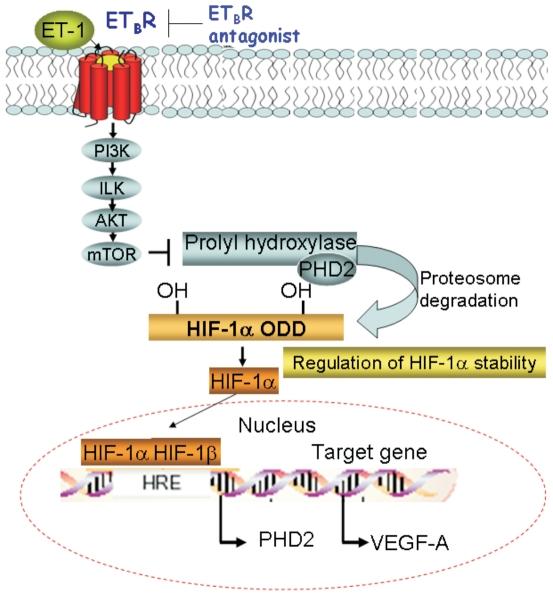
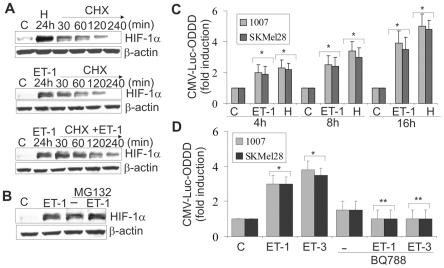
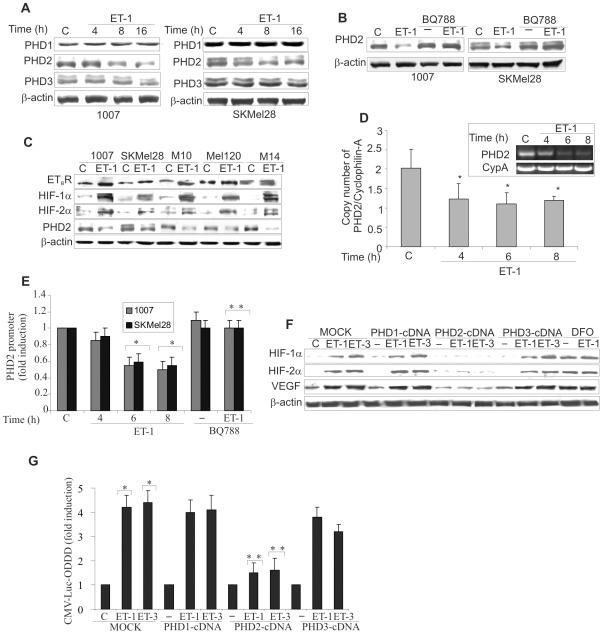
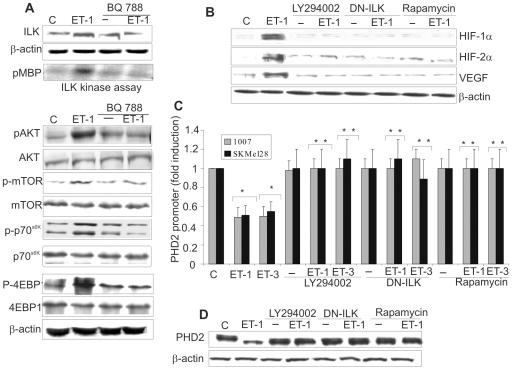
Here we found that in melanoma cells ET-1, ET-2, and ET-3 through ET(B)R, enhance the expression and activity of HIF-1alpha and HIF-2alpha that in turn regulate the expression of vascular endothelial growth factor (VEGF) in response to ETs or hypoxia. Under normoxic conditions, ET-1 controls HIF-alpha stability by inhibiting its degradation, as determined by impaired degradation of a reporter gene containing the HIF-1alpha oxygen-dependent degradation domain encompassing the PHD-targeted prolines. In particular, ETs through ET(B)R markedly decrease PHD2 mRNA and protein levels and promoter activity. In addition, activation of phosphatidylinositol 3-kinase (PI3K)-dependent integrin linked kinase (ILK)-AKT-mammalian target of rapamycin (mTOR) pathway is required for ET(B)R-mediated PHD2 inhibition, HIF-1alpha, HIF-2alpha, and VEGF expression. At functional level, PHD2 knockdown does not further increase ETs-induced in vitro tube formation of endothelial cells and melanoma cell invasiveness, demonstrating that these processes are regulated in a PHD2-dependent manner. In human primary and metastatic melanoma tissues as well as in cell lines, that express high levels of HIF-1alpha, ET(B)R expression is associated with low PHD2 levels. In melanoma xenografts, ET(B)R blockade by ET(B)R antagonist results in a concomitant reduction of tumor growth, angiogenesis, HIF-1alpha, and HIF-2alpha expression, and an increase in PHD2 levels.
CONCLUSIONS
In this study we identified the underlying mechanism by which ET-1, through the regulation of PHD2, controls HIF-1alpha stability and thereby regulates angiogenesis and melanoma cell invasion. These results further indicate that targeting ET(B)R may represent a potential therapeutic treatment of melanoma by impairing HIF-1alpha stability.
背景
内皮素 B 受体 (ET(B)R) 通过内皮素 (ET)-1 的激活促进肿瘤发生和黑色素瘤进展,因此成为有前途的治疗靶点。缺氧诱导因子 (HIF)-1alpha 的稳定性对于黑色素瘤的发生和进展至关重要,并且受到 HIF-脯氨酰羟化酶结构域 (PHD) 进行的特异性位点羟化和随后的蛋白体降解的控制。
主要发现
在这里,我们发现黑色素瘤细胞中的 ET-1、ET-2 和 ET-3 通过 ET(B)R 增强 HIF-1alpha 和 HIF-2alpha 的表达和活性,反过来又调节血管内皮生长因子 (VEGF) 的表达以响应 ET 或缺氧。在常氧条件下,ET-1 通过抑制其降解来控制 HIF-alpha 的稳定性,这可以通过包含 HIF-1alpha 氧依赖性降解结构域的报告基因的降解受损来确定,该结构域包含 PHD 靶向脯氨酸。特别是,ET 通过 ET(B)R 显著降低 PHD2 mRNA 和蛋白水平以及启动子活性。此外,激活磷脂酰肌醇 3-激酶 (PI3K) 依赖性整合素连接激酶 (ILK)-AKT-雷帕霉素 (mTOR) 途径是 ET(B)R 介导的 PHD2 抑制、HIF-1alpha、HIF-2alpha 和 VEGF 表达所必需的。在功能水平上,PHD2 的敲低不会进一步增加 ET 诱导的内皮细胞和黑色素瘤细胞体外管形成和侵袭,表明这些过程以 PHD2 依赖性方式受到调节。在表达高水平 HIF-1alpha 的人类原发性和转移性黑色素瘤组织和细胞系中,ET(B)R 表达与 PHD2 水平降低相关。在黑色素瘤异种移植物中,ET(B)R 拮抗剂阻断 ET(B)R 会导致肿瘤生长、血管生成、HIF-1alpha 和 HIF-2alpha 表达的同时减少,以及 PHD2 水平的增加。
结论
在这项研究中,我们确定了 ET-1 通过调节 PHD2 控制 HIF-1alpha 稳定性并从而调节血管生成和黑色素瘤细胞侵袭的潜在机制。这些结果进一步表明,通过损害 HIF-1alpha 的稳定性,靶向 ET(B)R 可能代表治疗黑色素瘤的潜在治疗方法。



 Zotero 插件