
快速评估初级保健中痴呆患者诊断和管理的障碍:系统评价。
Rapid appraisal of barriers to the diagnosis and management of patients with dementia in primary care: a systematic review.
机构信息
Department of Primary Care & Population Health, University College London, Royal Free & University College Medical School, Rowland Hill Street, London, NW3 2PF, UK.
出版信息
BMC Fam Pract. 2010 Jul 1;11:52. doi: 10.1186/1471-2296-11-52.
BACKGROUND
The diagnosis of dementia in primary care is perceived as a problem across countries and systems, resulting in delayed recognition and adverse outcomes for patients and their carers. Improving its early detection is an area identified for development in the English National Dementia Strategy 2009; there are thought to be multiple benefits to the patient, family, and resources by doing this. The aim of this review was to carry out a rapid appraisal in order to inform the implementation of this policy.
METHOD
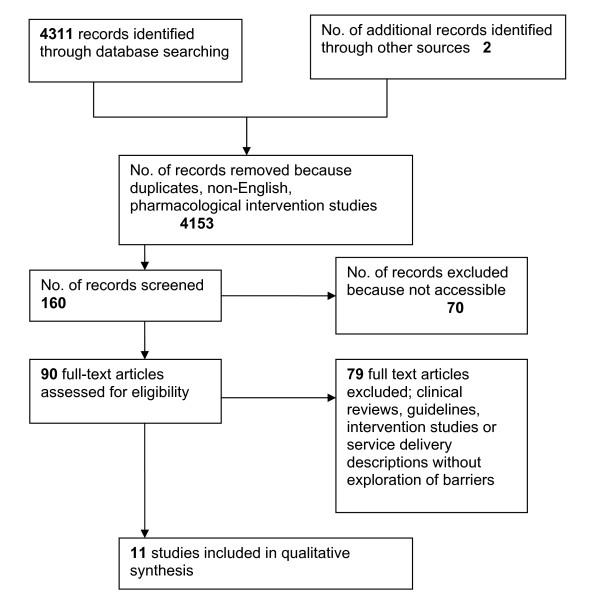
Publications in English up to August 2009 relating to barriers to the recognition of dementia, were identified by a broad search strategy, using electronic databases MEDLINE, EMBASE, and psycINFO. Exclusion criteria included non-English language, studies about pharmacological interventions or screening instruments, and settings without primary care.
RESULTS
Eleven empirical studies were found: 3 quantitative, 6 qualitative, and 2 with mixed methodologies. The main themes from the qualitative studies were found to be lack of support, time constraints, financial constraints, stigma, diagnostic uncertainty, and disclosing the diagnosis. Quantitative studies yielded diverse results about knowledge, service support, time constraints, and confidence. The factors identified in qualitative and quantitative studies were grouped into 3 categories: patient factors, GP factors and system characteristics.
CONCLUSION
Much can still be done in the way of service development and provision, GP training and education, and the eradication of stigma attached to dementia, to improve the early detection and management of dementia. Implementation of dementia strategies should include attention to all three categories of barriers. Further research should focus on their interaction, using different methods from studies to date.
背景
在不同国家和医疗体系中,初级保健中的痴呆诊断被认为是一个问题,导致患者及其照顾者的识别延迟和预后不良。改善早期检测是 2009 年英国国家痴呆症战略中确定的一个发展领域;这样做对患者、家庭和资源都有多重好处。本综述的目的是进行快速评估,为该政策的实施提供信息。
方法
使用广泛的搜索策略,通过电子数据库 MEDLINE、EMBASE 和 psycINFO,确定截至 2009 年 8 月与痴呆识别障碍相关的英文出版物。排除标准包括非英文语言、关于药物干预或筛查工具的研究以及没有初级保健的研究。
结果
发现 11 项实证研究:3 项定量研究、6 项定性研究和 2 项混合方法研究。定性研究的主要主题是缺乏支持、时间限制、经济限制、耻辱感、诊断不确定性和透露诊断。定量研究得出了关于知识、服务支持、时间限制和信心的不同结果。定性和定量研究中确定的因素分为三类:患者因素、全科医生因素和系统特征。
结论
在服务开发和提供、全科医生培训和教育以及消除与痴呆相关的耻辱感方面,仍有很多工作要做,以改善痴呆的早期发现和管理。痴呆策略的实施应包括关注所有三类障碍。进一步的研究应侧重于使用迄今为止研究中不同的方法来研究它们的相互作用。
 Zotero 插件