
普瑞巴林治疗纤维肌痛的应答者分析——来自个体患者数据。
Pregabalin in fibromyalgia--responder analysis from individual patient data.
机构信息
Department of Occupational and Social Medicine, University of Göttingen, Waldweg 37 B, D-37073 Göttingen, Germany.
出版信息
BMC Musculoskelet Disord. 2010 Jul 5;11:150. doi: 10.1186/1471-2474-11-150.
BACKGROUND
Population mean changes are difficult to use in clinical practice. Responder analysis may be better, but needs validating for level of response and treatment duration. A consensus group has defined what constitutes minimal, moderate, and substantial benefit based on pain intensity and Patient Global Impression of Change scores.
METHODS
We obtained individual patient data from four randomised double blind trials of pregabalin in fibromyalgia lasting eight to 14 weeks. We calculated response for all efficacy outcomes using any improvement (>or= 0%), minimal improvement (>or= 15%), moderate improvement (>or= 30%), substantial improvement (>or= 50%), and extensive improvement (>or= 70%), with numbers needed to treat (NNT) for pregabalin 300 mg, 450 mg, and 600 mg daily compared with placebo.
RESULTS
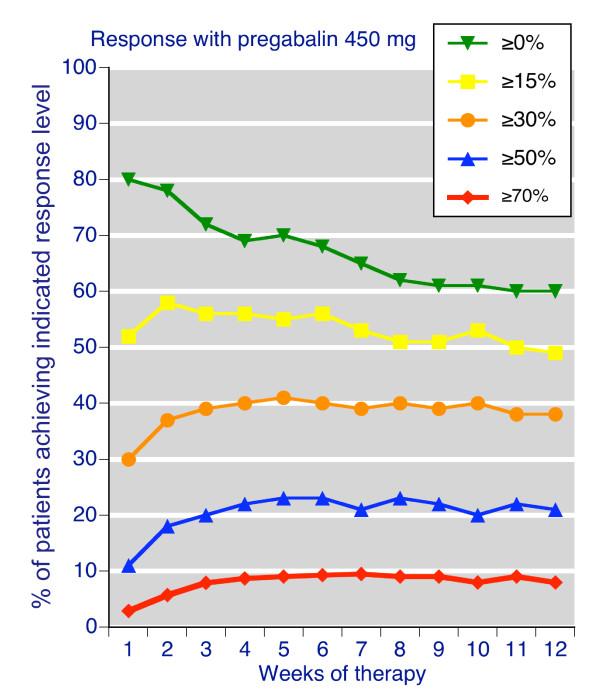
Information from 2,757 patients was available. Pain intensity and sleep interference showed reductions with increasing level of response, a significant difference between pregabalin and placebo, and a trend towards lower (better) NNTs at higher doses. Maximum response rates occurred at 4-6 weeks for higher levels of response, and were constant thereafter. NNTs (with 95% confidence intervals) for >or= 50% improvement in pain intensity compared with placebo after 12 weeks were 22 (11 to 870) for pregabalin 300 mg, 16 (9.3 to 59) for pregabalin 450 mg, and 13 (8.1 to 31) for pregabalin 600 mg daily. NNTs for >or= 50% improvement in sleep interference compared with placebo after 12 weeks were 13 (8.2 to 30) for pregabalin 300 mg, 8.4 (6.0 to 14) for pregabalin 450 mg, and 8.4 (6.1 to 14) for pregabalin 600 mg. Other outcomes had fewer respondents at higher response levels, but generally did not discriminate between pregabalin and placebo, or show any dose response. Shorter duration and use of 'any improvement' over-estimated treatment effect compared with longer duration and higher levels of response.
CONCLUSIONS
Responder analysis is useful in fibromyalgia, particularly for pain and sleep outcomes. Some fibromyalgia patients treated with pregabalin experience a moderate or substantial pain response that is consistent over time. Short trials using 'any improvement' as an outcome overestimate treatment effects.
背景
人群均值变化在临床实践中难以使用。应答分析可能更好,但需要验证其应答水平和治疗持续时间。一个共识小组根据疼痛强度和患者整体印象变化评分,定义了最小、中等和显著获益的标准。
方法
我们从四项为期 8 至 14 周的普瑞巴林治疗纤维肌痛的随机双盲试验中获得了个体患者数据。我们使用任何改善(≥0%)、最小改善(≥15%)、中度改善(≥30%)、显著改善(≥50%)和广泛改善(≥70%)来计算所有疗效结局的应答,并用数字需要治疗(NNT)来比较普瑞巴林 300mg、450mg 和 600mg 每日治疗与安慰剂的差异。
结果
共有 2757 名患者的信息可用。疼痛强度和睡眠干扰随着应答水平的增加而降低,普瑞巴林与安慰剂之间存在显著差异,并且随着剂量的增加,NNT(95%置信区间)越低(越好)。更高水平的应答在 4-6 周时达到最高应答率,此后保持不变。在 12 周时,与安慰剂相比,疼痛强度改善≥50%的 NNT(95%置信区间)分别为普瑞巴林 300mg 22(11 至 870)、普瑞巴林 450mg 16(9.3 至 59)和普瑞巴林 600mg 13(8.1 至 31)。在 12 周时,与安慰剂相比,睡眠干扰改善≥50%的 NNT(95%置信区间)分别为普瑞巴林 300mg 13(8.2 至 30)、普瑞巴林 450mg 8.4(6.0 至 14)和普瑞巴林 600mg 8.4(6.1 至 14)。其他结局的高应答率患者较少,但普瑞巴林与安慰剂之间通常没有差异,也没有表现出任何剂量反应。与较长的治疗时间和更高水平的应答相比,较短的治疗时间和使用“任何改善”作为结局会高估治疗效果。
结论
应答分析在纤维肌痛中很有用,特别是对疼痛和睡眠结局。一些接受普瑞巴林治疗的纤维肌痛患者出现了持续时间较长的中度或显著疼痛反应。使用“任何改善”作为结局的短期试验会高估治疗效果。

 Zotero 插件