
在恒化器培养中,通过蛋白质组学和转录组学观察丙酮丁醇梭菌的产酸和产溶剂稳态细胞。
A proteomic and transcriptional view of acidogenic and solventogenic steady-state cells of Clostridium acetobutylicum in a chemostat culture.
机构信息
Institut für Biowissenschaften, Universität Rostock, Germany.
出版信息
Appl Microbiol Biotechnol. 2010 Aug;87(6):2209-26. doi: 10.1007/s00253-010-2741-x. Epub 2010 Jul 9.
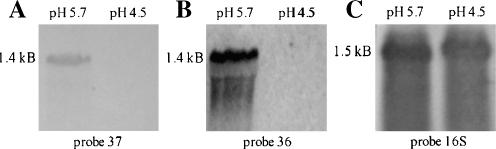
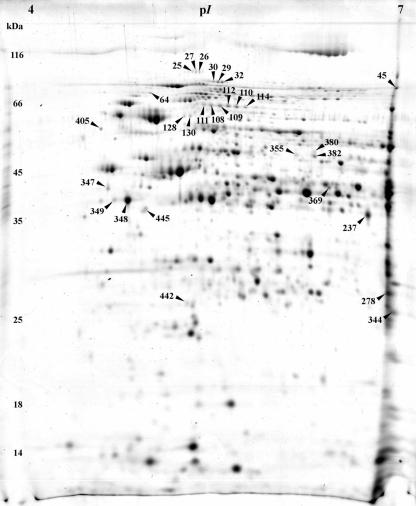
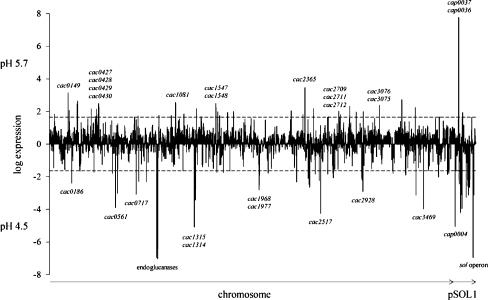
The complex changes in the life cycle of Clostridium acetobutylicum, a promising biofuel producer, are not well understood. During exponential growth, sugars are fermented to acetate and butyrate, and in the transition phase, the metabolism switches to the production of the solvents acetone and butanol accompanied by the initiation of endospore formation. Using phosphate-limited chemostat cultures at pH 5.7, C. acetobutylicum was kept at a steady state of acidogenic metabolism, whereas at pH 4.5, the cells showed stable solvent production without sporulation. Novel proteome reference maps of cytosolic proteins from both acidogenesis and solventogenesis with a high degree of reproducibility were generated. Yielding a 21% coverage, 15 protein spots were specifically assigned to the acidogenic phase, and 29 protein spots exhibited a significantly higher abundance in the solventogenic phase. Besides well-known metabolic proteins, unexpected proteins were also identified. Among these, the two proteins CAP0036 and CAP0037 of unknown function were found as major striking indicator proteins in acidogenic cells. Proteome data were confirmed by genome-wide DNA microarray analyses of the identical cultures. Thus, a first systematic study of acidogenic and solventogenic chemostat cultures is presented, and similarities as well as differences to previous studies of batch cultures are discussed.
丙酮丁醇梭菌(Clostridium acetobutylicum)是一种很有前途的生物燃料生产菌,其生命周期中的复杂变化尚未得到很好的理解。在指数生长期,糖被发酵为乙酸盐和丁酸盐,在过渡阶段,代谢会切换到生产溶剂丙酮和丁醇,同时开始形成芽孢。在 pH 值为 5.7 的磷酸盐限制恒化器培养物中,丙酮丁醇梭菌保持在产酸代谢的稳定状态,而在 pH 值为 4.5 时,细胞表现出稳定的溶剂生产而没有孢子形成。我们生成了具有高度重现性的细胞质蛋白的产酸和溶剂生成的新型蛋白质组参考图谱。其中,有 15 个蛋白点被特异性分配到产酸期,29 个蛋白点在溶剂生成期的丰度明显更高,达到了 21%的覆盖率。除了众所周知的代谢蛋白外,还鉴定到了一些意想不到的蛋白。其中,两个未知功能的蛋白 CAP0036 和 CAP0037 被发现是产酸细胞中的主要显著指示蛋白。通过对相同培养物的全基因组 DNA 微阵列分析,对蛋白质组数据进行了验证。因此,本文首次对产酸和溶剂恒化器培养物进行了系统研究,并讨论了其与批培养物先前研究的相似性和差异。


 Zotero 插件