
λ Red 同源重组中的单链异源双链中间体。
Single-stranded heteroduplex intermediates in lambda Red homologous recombination.
机构信息
Technische Universität Dresden, BioInnovationsZentrum, Dresden, Germany.
出版信息
BMC Mol Biol. 2010 Jul 29;11:54. doi: 10.1186/1471-2199-11-54.
BACKGROUND
The Red proteins of lambda phage mediate probably the simplest and most efficient homologous recombination reactions yet described. However the mechanism of dsDNA recombination remains undefined.
RESULTS
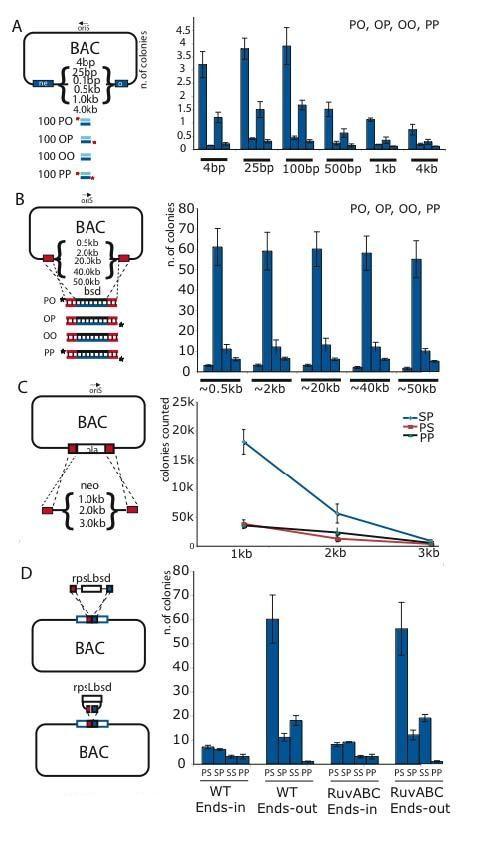
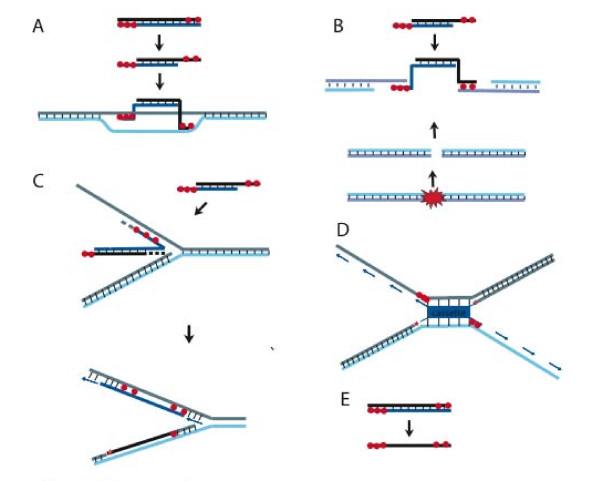
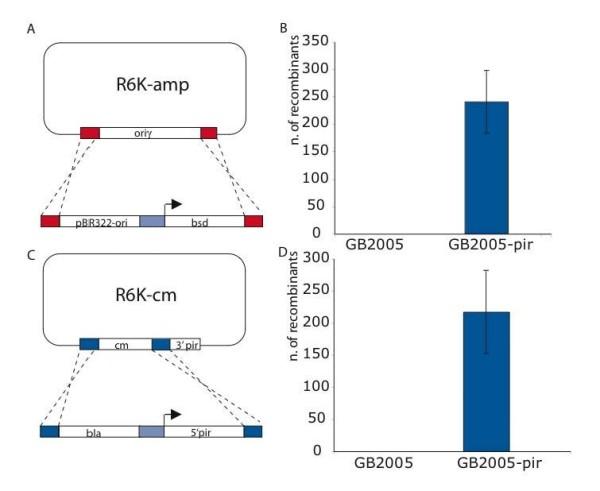
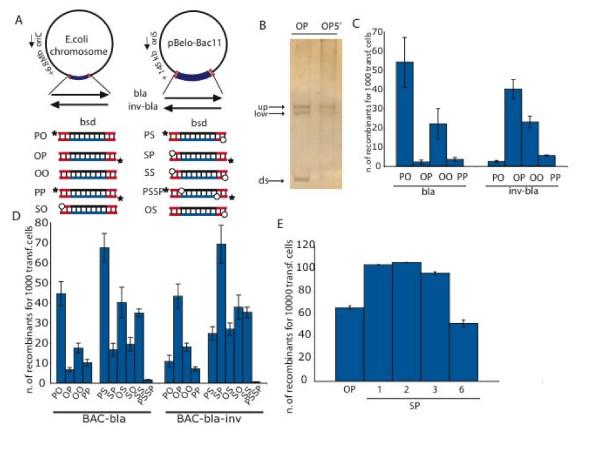
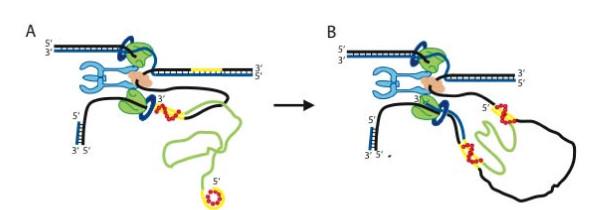
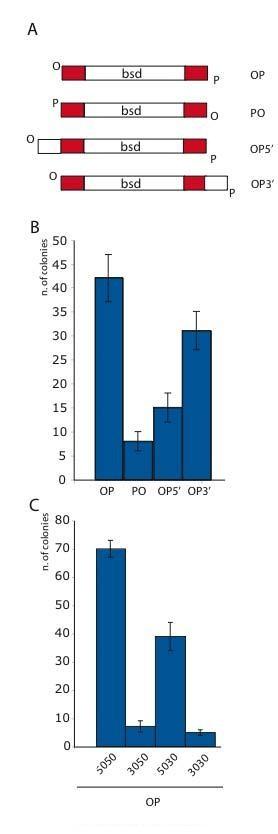
Here we show that the Red proteins can act via full length single stranded intermediates to establish single stranded heteroduplexes at the replication fork. We created asymmetrically digestible dsDNA substrates by exploiting the fact that Redalpha exonuclease activity requires a 5' phosphorylated end, or is blocked by phosphothioates. Using these substrates, we found that the most efficient configuration for dsDNA recombination occurred when the strand that can prime Okazaki-like synthesis contained both homology regions on the same ssDNA molecule. Furthermore, we show that Red recombination requires replication of the target molecule.
CONCLUSIONS
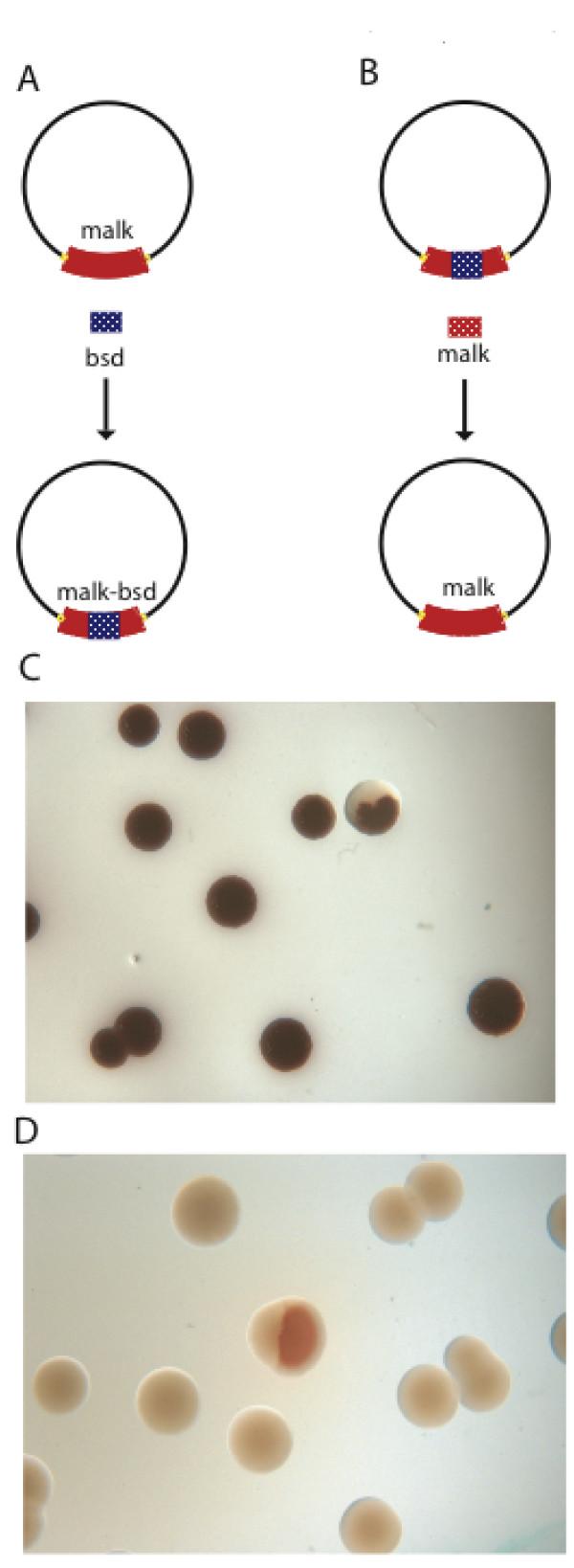
Hence we propose a new model for dsDNA recombination, termed 'beta' recombination, based on the formation of ssDNA heteroduplexes at the replication fork. Implications of the model were tested using (i) an in situ assay for recombination, which showed that recombination generated mixed wild type and recombinant colonies; and (ii) the predicted asymmetries of the homology arms, which showed that recombination is more sensitive to non-homologies attached to 5' than 3' ends. Whereas beta recombination can generate deletions in target BACs of at least 50 kb at about the same efficiency as small deletions, the converse event of insertion is very sensitive to increasing size. Insertions up to 3 kb are most efficiently achieved using beta recombination, however at greater sizes, an alternative Red-mediated mechanism(s) appears to be equally efficient. These findings define a new intermediate in homologous recombination, which also has practical implications for recombineering with the Red proteins.
背景
λ噬菌体的红色蛋白介导的可能是最简单和最有效的同源重组反应。然而,dsDNA 重组的机制尚未确定。
结果
在这里,我们表明红色蛋白可以通过全长单链中间体在复制叉处建立单链异源双链体。我们通过利用 Redalpha 外切核酸酶活性需要 5'磷酸化末端或被硫代磷酸酯阻断的事实来创建不对称可消化的 dsDNA 底物。使用这些底物,我们发现当能够引发类似 Okazaki 的合成的链在同一 ssDNA 分子上包含两个同源区时,dsDNA 重组的最有效构型发生。此外,我们表明 Red 重组需要靶分子的复制。
结论
因此,我们提出了一种新的 dsDNA 重组模型,称为“β”重组,基于在复制叉处形成 ssDNA 异源双链体。该模型的含义通过(i)重组的原位测定来测试,该测定表明重组产生了混合野生型和重组菌落;(ii)预测同源臂的不对称性,表明重组对附着在 5'而不是 3'末端的非同源性更敏感。虽然β重组可以以与小缺失相同的效率在靶 BAC 中产生至少 50kb 的缺失,但插入的相反事件对增加的大小非常敏感。通过β重组可以最有效地实现插入物高达 3kb,但在更大的尺寸下,替代的 Red 介导的机制似乎同样有效。这些发现定义了同源重组中的一个新中间体,这对使用 Red 蛋白进行重组也具有实际意义。


 Zotero 插件