
代谢指标预测 1 型糖尿病发病的预后性能。
Prognostic performance of metabolic indexes in predicting onset of type 1 diabetes.
机构信息
Department of Pediatrics, College of Medicine, University of South Florida, Tampa, Florida, USA.
出版信息
Diabetes Care. 2010 Dec;33(12):2508-13. doi: 10.2337/dc10-0802. Epub 2010 Aug 31.
OBJECTIVE
In this investigation we evaluated nine metabolic indexes from intravenous glucose tolerance tests (IVGTTs) and oral glucose tolerance tests (OGTTs) in an effort to determine their prognostic performance in predicting the development of type 1 diabetes in those with moderate risk, as defined by familial relation to a type 1 diabetic individual, a positive test for islet cell antibodies and insulin autoantibody, but normal glucose tolerance.
RESEARCH DESIGN AND METHODS
Subjects (n = 186) who had a projected risk of 25-50% for developing type 1 diabetes within 5 years were followed until clinical diabetes onset or the end of the study as part of the Diabetes Prevention Trial-Type 1. Prognostic performance of the metabolic indexes was determined using receiver operating characteristic (ROC) curve and survival analyses.
RESULTS
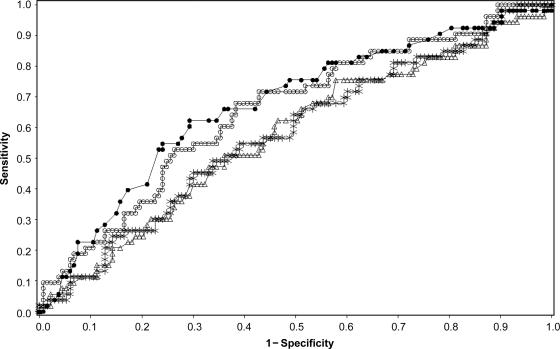
Two-hour glucose from an OGTT most accurately predicted progression to disease compared with all other metabolic indicators with an area under the ROC curve of 0.67 (95% CI 0.59-0.76), closely followed by the ratio of first-phase insulin response (FPIR) to homeostasis model assessment of insulin resistance (HOMA-IR) with an area under the curve value of 0.66. The optimal cutoff value for 2-h glucose (114 mg/dl) maintained sensitivity and specificity values >0.60. The hazard ratio for those with 2-h glucose ≥ 114 mg/dl compared with those with 2-h glucose <114 mg/dl was 2.96 (1.67-5.22).
CONCLUSIONS
The ratio of FPIR to HOMA-IR from an IVGTT provided accuracy in predicting the development of type 1 diabetes similar to that of 2-h glucose from an OGTT, which, because of its lower cost, is preferred. The optimal cutoff value determined for 2-h glucose provides additional guidance for clinicians to identify subjects for potential prevention treatments before the onset of impaired glucose tolerance.
目的
本研究通过静脉葡萄糖耐量试验(IVGTT)和口服葡萄糖耐量试验(OGTT)评估了 9 项代谢指标,旨在确定其在预测具有家族性 1 型糖尿病患者(个体存在胰岛细胞抗体和胰岛素自身抗体阳性,且葡萄糖耐量正常,但属于 1 型糖尿病高危人群)发生 1 型糖尿病方面的预后价值。
研究设计和方法
作为 1 型糖尿病预防试验 -1(Diabetes Prevention Trial-Type 1)的一部分,随访了 186 名预计在 5 年内发生 1 型糖尿病的风险为 25-50%的受试者,直至临床糖尿病发病或研究结束。采用受试者工作特征(ROC)曲线和生存分析来评估代谢指标的预后性能。
结果
OGTT 后 2 小时血糖较其他所有代谢指标更准确地预测疾病进展,ROC 曲线下面积为 0.67(95%CI 0.59-0.76),紧随其后的是胰岛素第一时相分泌指数(FPIR)与稳态模型评估胰岛素抵抗(HOMA-IR)的比值,曲线下面积值为 0.66。2 小时血糖最佳截断值(114mg/dl)的敏感性和特异性均>0.60。与 2 小时血糖<114mg/dl 的患者相比,2 小时血糖≥114mg/dl 的患者的风险比为 2.96(1.67-5.22)。
结论
IVGTT 的 FPIR 与 HOMA-IR 比值与 OGTT 的 2 小时血糖一样准确地预测 1 型糖尿病的发生,由于其成本较低,因此更受青睐。确定的 2 小时血糖最佳截断值为临床医生提供了额外的指导,以便在葡萄糖耐量受损之前识别出可能需要预防治疗的患者。
 Zotero 插件