
靶向 Tim-3 和 PD-1 通路逆转 T 细胞耗竭,恢复抗肿瘤免疫。
Targeting Tim-3 and PD-1 pathways to reverse T cell exhaustion and restore anti-tumor immunity.
机构信息
Center for Neurological Diseases, Brigham and Women's Hospital and Harvard Medical School, Boston, MA 02115, USA.
出版信息
J Exp Med. 2010 Sep 27;207(10):2187-94. doi: 10.1084/jem.20100643. Epub 2010 Sep 6.
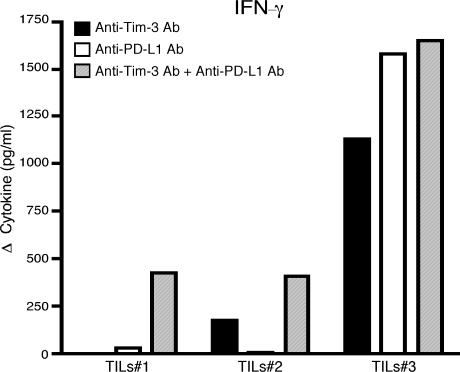
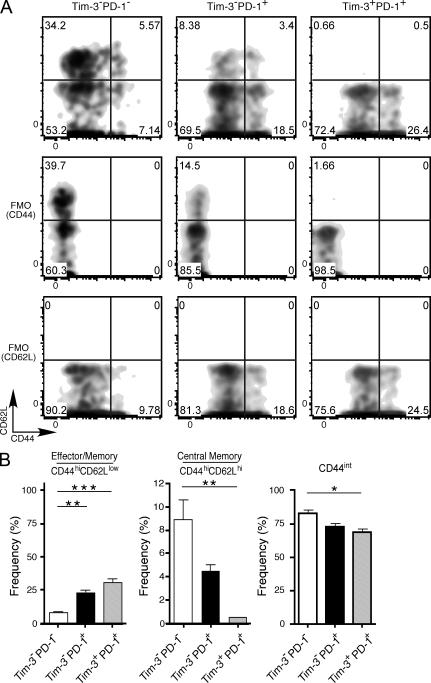
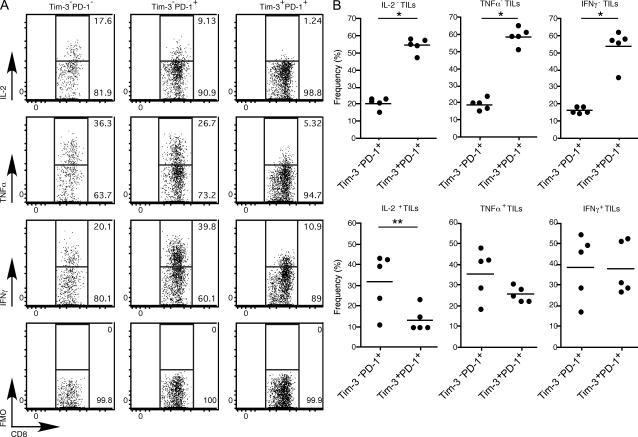
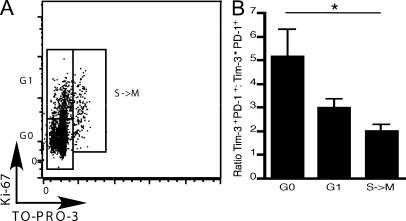
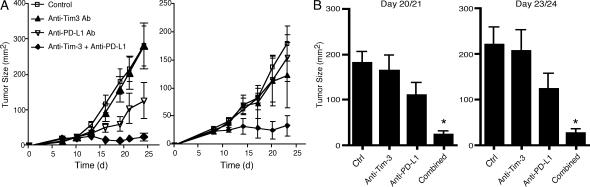
The immune response plays an important role in staving off cancer; however, mechanisms of immunosuppression hinder productive anti-tumor immunity. T cell dysfunction or exhaustion in tumor-bearing hosts is one such mechanism. PD-1 has been identified as a marker of exhausted T cells in chronic disease states, and blockade of PD-1-PD-1L interactions has been shown to partially restore T cell function. We have found that T cell immunoglobulin mucin (Tim) 3 is expressed on CD8(+) tumor-infiltrating lymphocytes (TILs) in mice bearing solid tumors. All Tim-3(+) TILs coexpress PD-1, and Tim-3(+)PD-1(+) TILs represent the predominant fraction of T cells infiltrating tumors. Tim-3(+)PD-1(+) TILs exhibit the most severe exhausted phenotype as defined by failure to proliferate and produce IL-2, TNF, and IFN-γ. We further find that combined targeting of the Tim-3 and PD-1 pathways is more effective in controlling tumor growth than targeting either pathway alone.
免疫反应在抵御癌症方面发挥着重要作用;然而,免疫抑制机制阻碍了有效的抗肿瘤免疫。肿瘤宿主中的 T 细胞功能障碍或耗竭就是这样一种机制。PD-1 已被确定为慢性疾病状态下耗竭 T 细胞的标志物,阻断 PD-1-PD-1L 相互作用已被证明可以部分恢复 T 细胞功能。我们发现,在患有实体瘤的小鼠中,T 细胞免疫球蛋白粘蛋白 (Tim) 3 表达在 CD8(+)肿瘤浸润淋巴细胞 (TIL) 上。所有 Tim-3(+)TIL 均共表达 PD-1,并且 Tim-3(+)PD-1(+)TIL 代表浸润肿瘤的 T 细胞的主要部分。Tim-3(+)PD-1(+)TIL 表现出最严重的耗竭表型,表现为增殖和产生 IL-2、TNF 和 IFN-γ 的能力失败。我们进一步发现,联合靶向 Tim-3 和 PD-1 途径比单独靶向任何途径更能有效控制肿瘤生长。

 Zotero 插件