
一个中央调控系统在很大程度上控制了拟南芥对磷酸盐饥饿的转录激活和抑制反应。
A central regulatory system largely controls transcriptional activation and repression responses to phosphate starvation in Arabidopsis.
机构信息
Department of Plant Molecular Genetics, Centro Nacional de Biotecnología-CSIC, Madrid, Spain.
出版信息
PLoS Genet. 2010 Sep 9;6(9):e1001102. doi: 10.1371/journal.pgen.1001102.
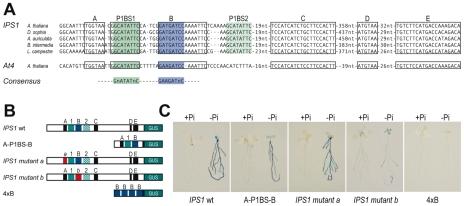
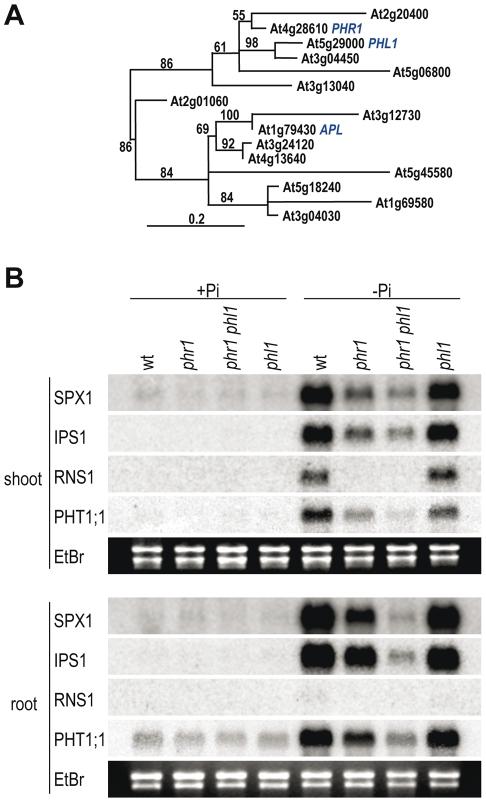
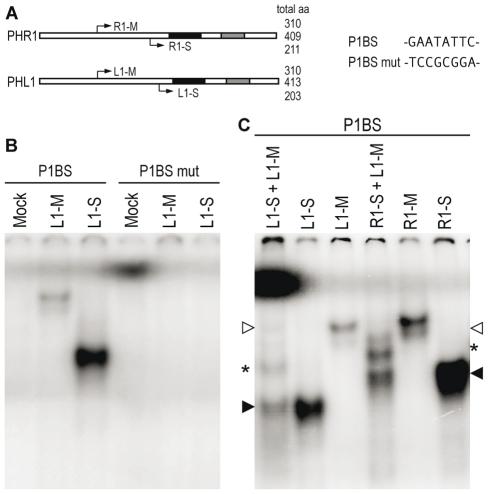
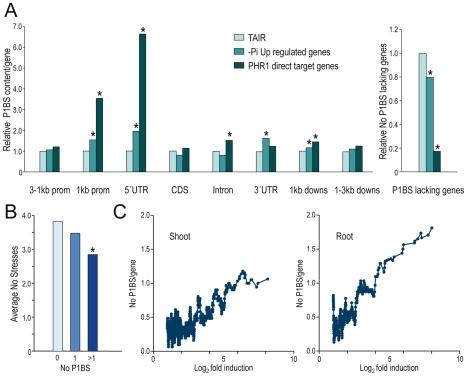
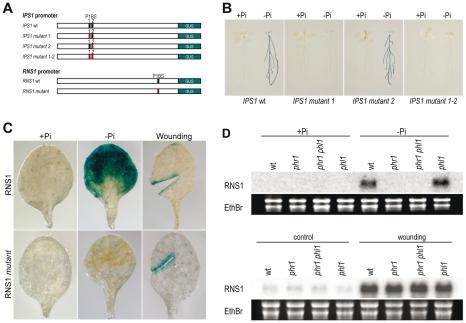
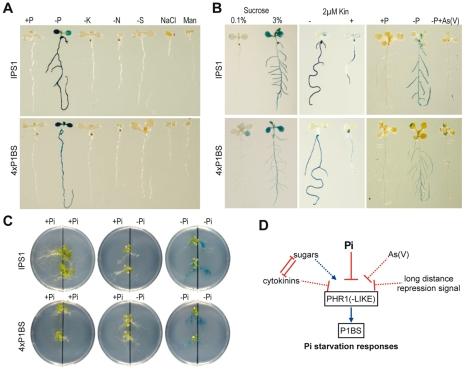
Plants respond to different stresses by inducing or repressing transcription of partially overlapping sets of genes. In Arabidopsis, the PHR1 transcription factor (TF) has an important role in the control of phosphate (Pi) starvation stress responses. Using transcriptomic analysis of Pi starvation in phr1, and phr1 phr1-like (phl1) mutants and in wild type plants, we show that PHR1 in conjunction with PHL1 controls most transcriptional activation and repression responses to phosphate starvation, regardless of the Pi starvation specificity of these responses. Induced genes are enriched in PHR1 binding sequences (P1BS) in their promoters, whereas repressed genes do not show such enrichment, suggesting that PHR1(-like) control of transcriptional repression responses is indirect. In agreement with this, transcriptomic analysis of a transgenic plant expressing PHR1 fused to the hormone ligand domain of the glucocorticoid receptor showed that PHR1 direct targets (i.e., displaying altered expression after GR:PHR1 activation by dexamethasone in the presence of cycloheximide) corresponded largely to Pi starvation-induced genes that are highly enriched in P1BS. A minimal promoter containing a multimerised P1BS recapitulates Pi starvation-specific responsiveness. Likewise, mutation of P1BS in the promoter of two Pi starvation-responsive genes impaired their responsiveness to Pi starvation, but not to other stress types. Phylogenetic footprinting confirmed the importance of P1BS and PHR1 in Pi starvation responsiveness and indicated that P1BS acts in concert with other cis motifs. All together, our data show that PHR1 and PHL1 are partially redundant TF acting as central integrators of Pi starvation responses, both specific and generic. In addition, they indicate that transcriptional repression responses are an integral part of adaptive responses to stress.
植物通过诱导或抑制部分重叠的基因表达来应对不同的胁迫。在拟南芥中,PHR1 转录因子(TF)在控制磷酸盐(Pi)饥饿胁迫反应中具有重要作用。通过 phr1、phr1 phr1 样(phl1)突变体和野生型植物的 Pi 饥饿转录组分析,我们表明 PHR1 与 PHL1 共同控制大多数对磷酸盐饥饿的转录激活和抑制反应,而不论这些反应对 Pi 饥饿的特异性如何。诱导基因在其启动子中富含 PHR1 结合序列(P1BS),而受抑制基因则没有这种富集,这表明 PHR1(样)对转录抑制反应的控制是间接的。这与转 PHR1 融合到糖皮质激素受体激素配体结构域的植物的转录组分析结果一致,该分析表明 PHR1 的直接靶标(即在存在环己酰亚胺时用地塞米松激活 GR:PHR1 后表达发生改变的基因)主要对应于在 P1BS 中高度富集的 Pi 饥饿诱导基因。含有多聚 P1BS 的最小启动子可重现 Pi 饥饿特异性反应性。同样,在两个对 Pi 饥饿有反应的基因启动子中突变 P1BS 会损害它们对 Pi 饥饿的反应性,但不会损害它们对其他胁迫类型的反应性。系统发育足迹法证实了 P1BS 和 PHR1 在 Pi 饥饿反应中的重要性,并表明 P1BS 与其他顺式基序协同作用。总之,我们的数据表明 PHR1 和 PHL1 是部分冗余的 TF,作为 Pi 饥饿反应的中央整合因子,既有特异性又有通用性。此外,它们表明转录抑制反应是适应应激的一个组成部分。

 Zotero 插件